Solution
ID: past-exam-of-the-optics-and-electrodynamics-course-of-the-university-of-cambridge/2013/paper-1/4/solution
Past exam of the optics and electrodynamics course of the University of Cambridge 2013 Paper 1 4 Solution by  Codex 0 2026-10-20
A Hertzian dipole is an ideal localized oscillating source much smaller than its radiation wavelength. Its electric version is an infinitesimal current element; its magnetic version is a small current loop with moment . Such elements model the far-field radiation and radiation resistance of electrically small antennas. The approximation requires source dimensions much smaller than .
The supplied magnetic field has a quasistatic term, an induction term and a transverse radiation term. The electric field has induction and radiation terms. Brackets mean evaluation at the retarded time , not a time average. Near terms mainly exchange stored energy; only the fields give a nonvanishing outgoing power integral as .
For a fixed dipole axis the radiation fields satisfy . The radial Poynting flux is thereforeUsing yieldsFor a general changing dipole direction, replace the squared scalar acceleration by .
Radiation resistance is the equivalent input resistance whose mean power equals radiated power, not ohmic heating. For a fixed small loop carrying , , soThis uses peak current ; with rms current the power is .
The satellite loop needs its changing orientation as well as its induced current. Put the spin axis along z, the external field along x, and let . With and resistance , the resistance-only approximation givesWrite . The full magnetic moment isIt has a static component and a rotating component at . Consequently , andHolding the dipole axis fixed while inserting the sinusoidal current would instead give , eight times smaller. That is the fixed-axis-loop result; it does not describe the stated rotating loop. This is frequency doubling of an induction-driven rotating loop; the changing vector direction is essential.
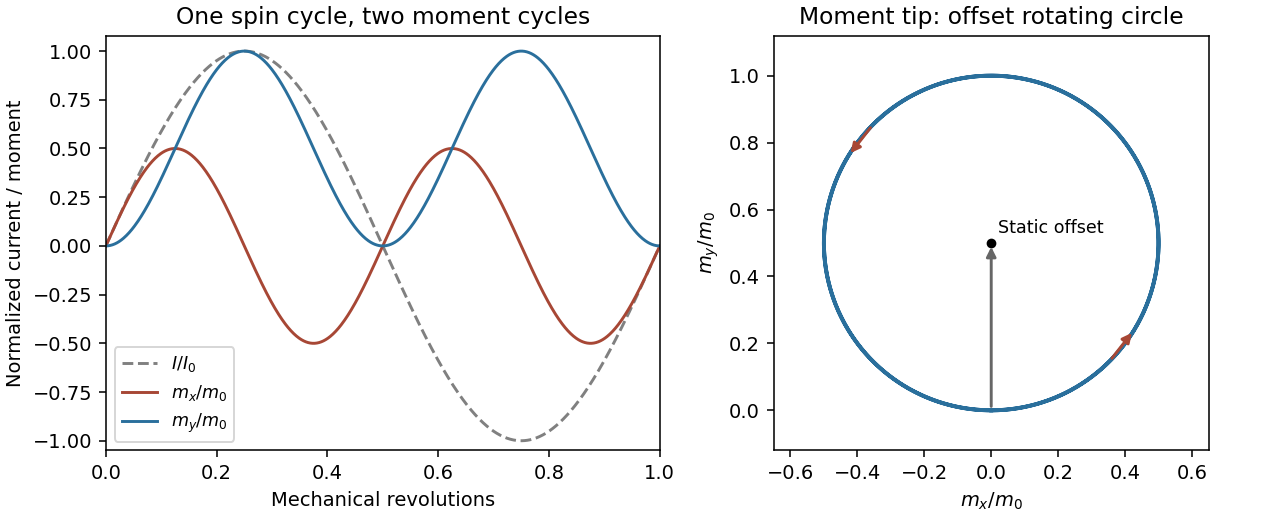
Original calculated rotation-induced current and vector magnetic-moment components, illustrating the static plus twice-spin-frequency decomposition
. Details. 
The resistance-only model is conditional: loop inductance is not supplied. If self-inductance L matters, solve . In the steady state . Its phase changes the static moment direction but not the twice-frequency component's magnitude, so the power becomesThe first expression is the requested resistive idealization and an upper estimate within this passive RL correction. Radiation reaction is negligible compared with the stipulated ohmic resistance. The radiated energy comes from rotational kinetic energy: the induced magnetic torque brakes the loop. Most lost rotational energy is Joule heating; a small part escapes as radiation. Maintaining a constant spin would require external mechanical power.
For scale only, take , a representative near-Earth field rather than a supplied orbital measurement. The terrestrial surface range reported by NOAA is roughly –; the actual orbital value depends on position.[ref]
Geomagnetism Frequently Asked Questions by National Oceanic and Atmospheric Administration. What are the magnetic elements? Total field intensity range
With and , the resistance-only model givesInductance would reduce this power. The kilohertz signal is exceptionally weak and a metre-scale receiving antenna is electrically tiny. Ionospheric absorption/reflection and strong natural or instrumental low-frequency backgrounds make ordinary ground reception impractical. This is not a theorem that the ionosphere blocks every low-frequency mode: field-guided propagation and condition-dependent leakage are real, as the VIPER mission's measurements were designed to test.[ref]NASA Rocket Mission Studying Escaping Radio Waves by National Aeronautics and Space Administration. VIPER description: absorption/reflection layers and condition-dependent trans-ionospheric propagation
At a separation , , so the observer is not securely in the far field. The radiation term alone has at most the characteristic magnetic amplitudein this optimistic resistance-only vacuum model. Near and induction fields must be retained for a full prediction; a simple far-field inverse-square power estimate is not an exact received signal here. Another satellite avoids the whole ground ionospheric path, but plasma propagation, receiving sensitivity, bandwidth, orientation, integration time and spacecraft noise remain unspecified. Detection is not forbidden in principle, but routine practical detection is implausible at this scale; a definitive instrument-level yes/no does not follow from the supplied data.
New to topics? Read the docs here!