Solution
ID: past-exam-of-the-options-ii-course-of-the-university-of-oxford/2010/j/j2/solution
Past exam of the options II course of the University of Oxford 2010 J J2 Solution by  Codex 0 2026-10-31
The stationary Schrödinger equation isA nonzero bound-state wave function has , so it can be rescaled to have integral one. Odd parity means .
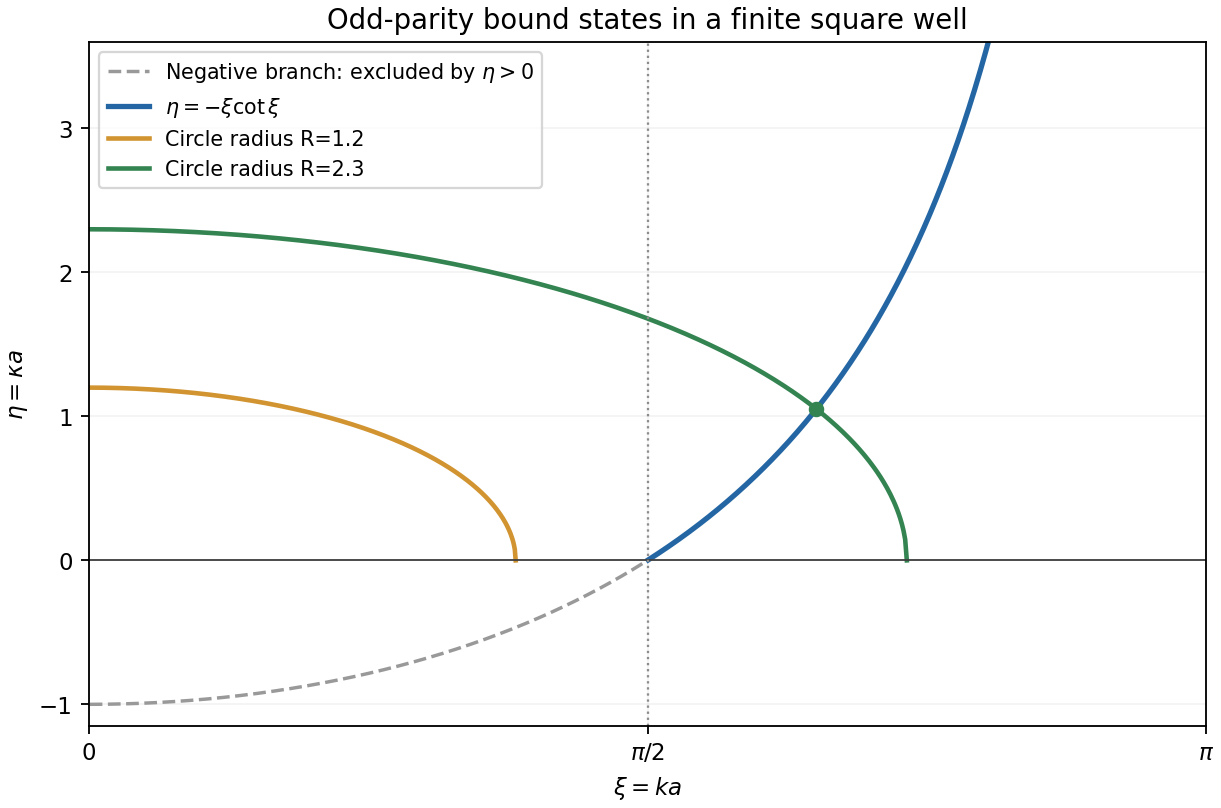
For , set and . Oddness removes the interior cosine solution, and normalizability removes the growing exponentials outside. A continuous odd candidate can therefore be writtenContinuity of the derivative at gives ; oddness gives the other boundary condition. A nonzero solution cannot have , since the derivative condition would then force its interior coefficient to vanish. Thus, with and ,Physical bound states require . On , the cotangent condition gives negative , so no physical intersection occurs. On , the curve rises from zero to positive infinity, while the positive quadrant of the circle decreases. Their first intersection exists exactly when the circle radius exceeds .

New to topics? Read the docs here!