Solution
ID: past-exam-of-the-particle-physics-course-of-the-university-of-oxford/2016/7/2/solution
Past exam of the particle physics course of the University of Oxford 2016 7 2 Solution by  Codex 0 2026-10-25
At , the velocities are , giving approximately , and for electrons, muons and protons. The glass threshold is . Thus the first two produce Cherenkov radiation, with internal angleswhereas a primary proton at this momentum is below threshold.
If an optical arrangement transports those cone angles without changing them, a plane downstream would intersect rings of radiusThese are conditional geometric estimates, not the ray trace for a flat slab in air. The emission depth alone spreads the radius by order , already larger than the approximately separation. The slab is one radiation length: electrons lose appreciable energy by bremsstrahlung and begin an electromagnetic shower, producing a broader and less clean pattern. Muons mainly ionize and retain a comparatively clean cone, with some Multiple Coulomb scattering. A below-threshold primary proton gives no direct cone, although energetic delta electrons and other secondary interactions can produce light.
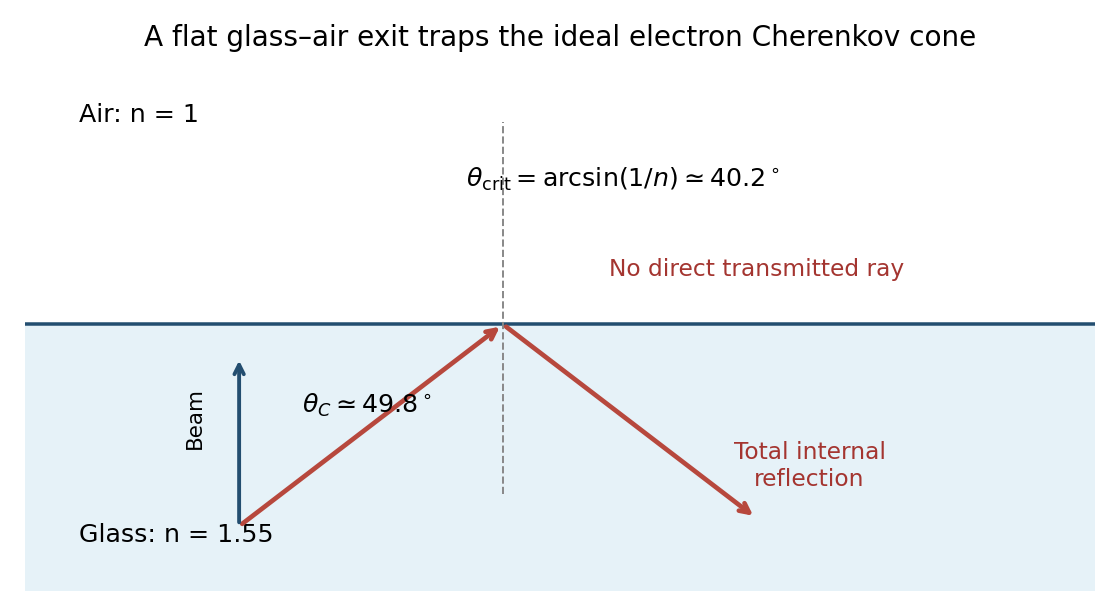
There is an essential optical qualification. For a normal beam through a parallel-faced glass slab followed by air, the internal critical angle is . Both emission angles exceed it. Snell's law would require , so the ideal photons undergo total internal reflection at the downstream face and do not form those direct downstream rings. Optical coupling, a prism or different surface geometry must be specified to extract them. The stated material parameters alone do not define a unique detected pattern; this flat-slab geometry is a concrete counterexample to silently assuming straight transmitted rays.

New to topics? Read the docs here!