Solution
ID: past-exam-of-the-particle-physics-course-of-the-university-of-oxford/2019/3/c/solution
Past exam of the particle physics course of the University of Oxford 2019 3 c Solution by  Codex 0 2026-10-25
The observed dominance of kaons supports a predominantly phi meson. In a connected strong decay, the original strange quark and antiquark survive into different kaons, while a gluon produces a light pair:This gives or and is allowed by the OZI rule. A pionic final state contains no strange valence constituents, so the initial pair must annihilate. The strong annihilation of a colour-singlet state requires at least three gluons: one gluon cannot carry the singlet colour, and two have the wrong charge-conjugation quantum number. This disconnected flavour topology is suppressed by the OZI rule, although it need not vanish.
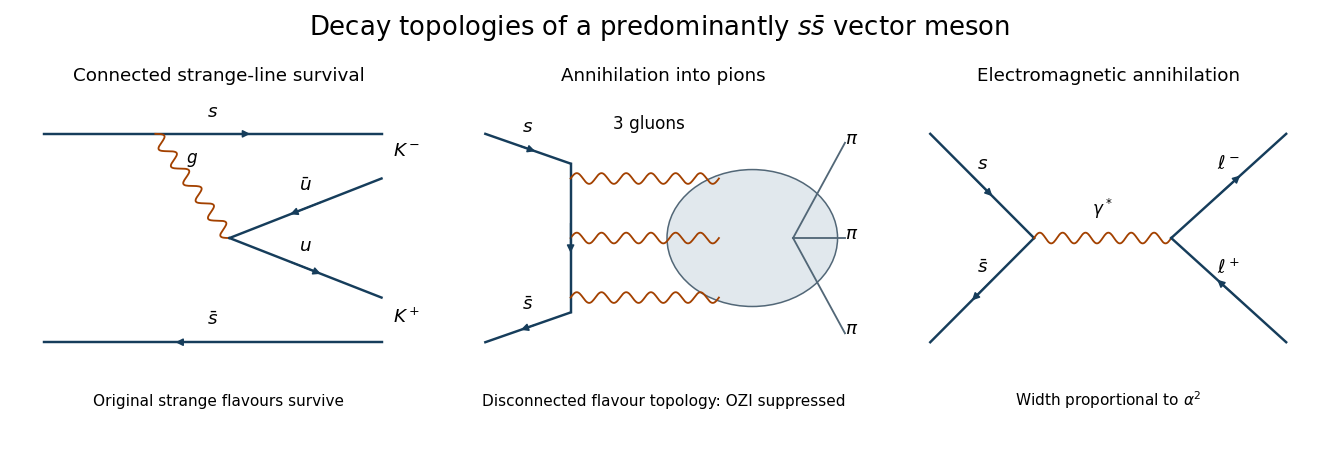
Original quark-level topologies for connected kaon production, three-gluon annihilation into pions, and electromagnetic annihilation into leptons. The hadronization blob is schematic.
Details. 
The leptonic mode proceeds through and is suppressed by electromagnetic couplings; its width is proportional to times the vector-meson overlap. Unlike a strong hadronic decay, it cannot create its final particles through quark rearrangement. Hence a branching fraction of order is qualitatively consistent with electromagnetic annihilation competing with strong modes.
Kaon dominance is especially suggestive because phase space is limited: using the supplied neutral-kaon and phi masses,The two spin-zero kaons have orbital angular momentum to match the vector parent, so their partial width has the additional near-threshold factor . Pionic modes have more phase space yet remain subdominant because of their annihilation topology. The observations therefore support, but do not establish exact, ideal vector-meson mixing: a small nonstrange admixture, electromagnetic amplitudes and nonperturbative strong dynamics can all contribute to the pionic rate.
New to topics? Read the docs here!