A hadron is a strongly interacting composite particle described by quantum chromodynamics. Familiar hadrons contain quarks and gluons in an overall color-neutral state. The proton and neutron are baryons; the pion is a meson.
The quark model labels ordinary hadrons by their valence content, but this does not list every dynamical constituent. Gluons and additional quark–antiquark contributions affect masses and interactions. Distinguishing a composite hadron from an elementary particle is useful when comparing low-energy models with scattering experiments that resolve internal structure.
A hadronic form factor parametrizes a current matrix element between hadron states, separating allowed Lorentz covariant tensor structures from scalar-valued functions of Lorentz invariant combinations of momentum transfer. These functions encode composite structure and strong interaction dynamics. Equal kinematic phase space does not imply equal form factors for different weak interaction transitions.
Ordinary baryons have three valence quarks, and ordinary mesons have a quark and an antiquark. Additive quantum numbers such as electric charge, baryon number and strangeness are sums of constituent values. This valence description organizes flavor symmetry multiplets while allowing sea constituents and gluons.
The quark model makes a large catalogue manageable: the same few quark flavors generate many different hadrons. It predicts relations between electric charge, strangeness and isospin, rather than assigning these independently to each new particle. It is especially useful for asking which combinations are possible and which additional measurements could distinguish them. A constituent list alone does not determine a mass, a decay rate or whether a proposed combination forms a bound state.
Four quark flavours in the defining representation of flavour SU(4) and their antiquarks give sixteen meson flavour states. The trace of is the trivial representation; its traceless part is the Adjoint representation. Under light-flavour SU(3), the full content is . Relative to the light-flavour nonet, the new states are . Inside the traceless fifteen-dimensional multiplet the additional singlet is instead . The pure state is a linear combination of this state and the full SU(4) singlet. The classification concerns flavour; it does not imply degenerate physical masses or fix spin.
For three light flavours and two spin states, an approximate spin-flavour symmetry acts on the six-dimensional single-quark spin-flavour space. A spatial ground-state three-quark colour singlet requires the symmetric representation of dimension . Under flavour symmetry and ordinary spin rotations, it decomposes as : the baryon decuplet has spin and the baryon octet spin . The product of spin and flavour factors can require a correlated sum, rather than a single unentangled product.
The constituent-quark model describes a low-energy hadron using effective massive quarks and phenomenological interactions. Its constituent quark masses include strong-interaction dressing and differ from short-distance running quark masses.
This effective baryon mass model adds a colour-magnetic spin-spin interaction to a sum of constituent quark masses. The common coefficient absorbs a spatial contact density, colour factors, and the strong coupling. has dimensions of energy cubed in natural units. A shared coefficient is an approximation because different flavour configurations can have different spatial wavefunctions.
Use dimensionless spin angular momentum operators with and the common-coefficient baryon hyperfine mass formula. The identical pair has total spin one, so its pair expectation is . For total baryon spin , the two mixed-flavour pair expectations sum to ; for total spin , they sum to . Their difference is , giving the title formula for either repeated-flavour choice. The equality assumes the same effective coefficient in the two flavour configurations; different spatial overlaps can change it.
For a three-light-flavor example, take up quarks, down quarks and strange quarks with the following additive quantum numbers. Here denotes electric charge in units of the positive elementary charge , is baryon number, is strangeness, is the third component of isospin, and is flavor hypercharge. An antiquark reverses all five displayed values. These are flavor coordinates, not spatial coordinates or electroweak hypercharge.
Adding these columns immediately explains familiar hadrons. A proton with valence quarks has and ; a neutron with has and . A positive kaon with has , and . Thus the same constituent rules describe both baryons and mesons.
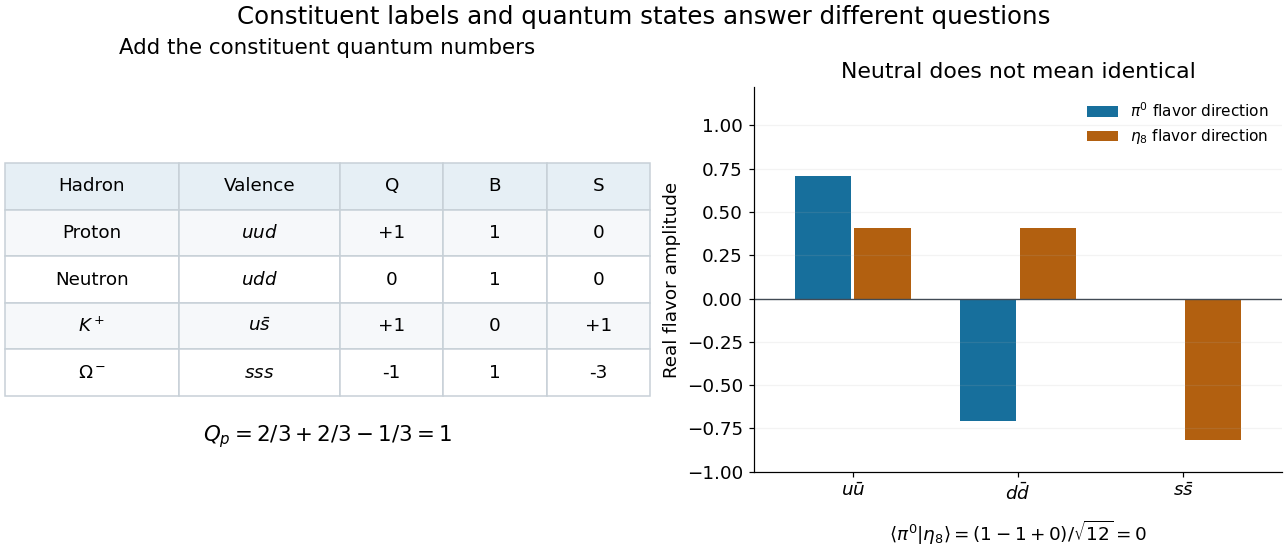
Adding constituent quantum numbers distinguishes charged and neutral hadrons
. Original arithmetic examples for the three-light-flavor quark model. The lower panel contrasts two orthogonal neutral flavor combinations: identical total electric charge does not make two states identical. These are ideal flavor basis states, not a mass fit or a reconstruction of an experimental event. Details.Two hadrons can have identical additive labels while differing in their internal state. The Lambda baryon and neutral Sigma baryon both have valence content , yet their total isospin differs. Likewise, the neutral pion flavor direction and the Eta octet state both have , but their inner product vanishes. Expanding that inner product gives . Constituent counting must therefore be supplemented by quantum superposition and the symmetry of the state.
A particularly economical example is the baryon decuplet. Restrict to fully symmetric three-quark flavor states. The nonnegative occupation numbers satisfy , giving possibilities by stars and bars. Their additive labels areThese formulas follow directly from the constituent table. With fixed , there are possible values of , so the weight diagram has rows of four, three, two and one states. Its outer triangle is therefore a consequence of the constituent construction, rather than an arbitrary drawing convention.
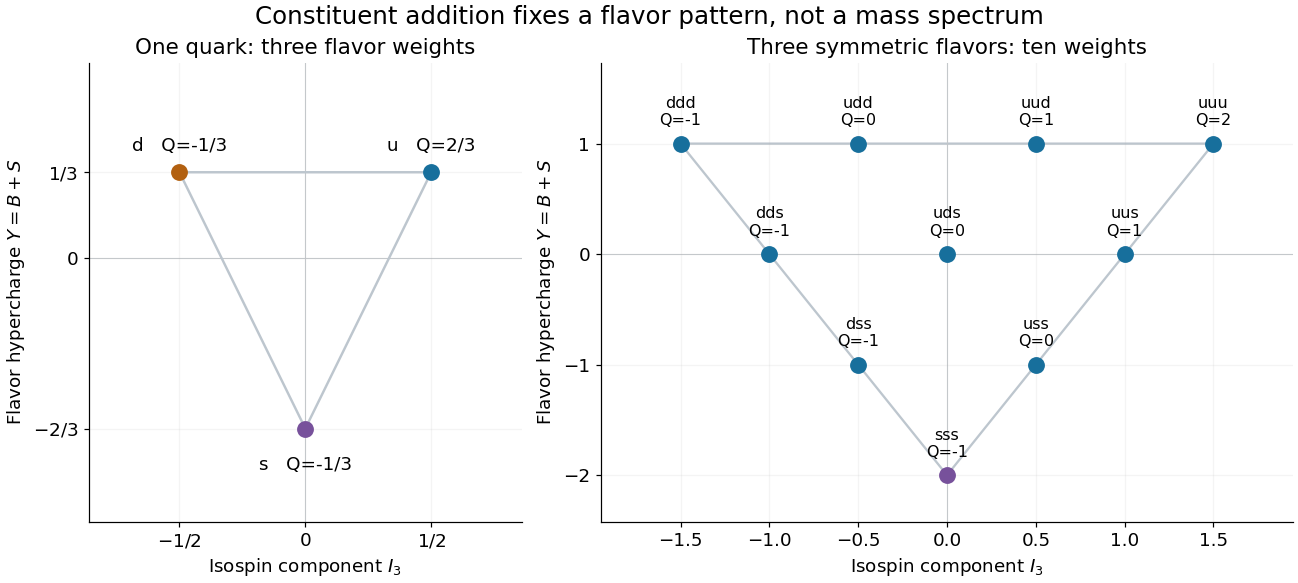
The bottom corner has , hence , and : the Omega baryon position. The top-right corner has and , corresponding to the doubly charged Delta baryon. Every point satisfies the Gell-Mann--Nishijima formula .
The flavor construction is only part of the state. The Pauli constraint on three-quark flavour multiplets also involves spin angular momentum, the spatial wavefunction and color charge. In particular, three identical fermions cannot be assigned a completely symmetric total state merely because the flavor diagram is symmetric. Nor does the same flavor diagram determine the hadron masses: an approximate flavor symmetry can organize a spectrum without making all its members degenerate.
In his 1964 paper, Murray Gell-Mann proposed fractional-charge quarks, constructing baryons and mesons from them. He also distinguished a mathematical constituent model from the hypothesis of finite-mass physical particles. The successful bookkeeping did not itself settle that distinction.[ref]
A Schematic Model of Baryons and Mesons by Murray Gell-Mann. pp.214–215: triplet construction and discussion of physical versus mathematical quarks
George Zweig's 1964 CERN model used three constituents called aces, with fractional electric charge and baryon number . Its abstract also proposed an experimental search.[ref]
An SU3 Model for Strong Interaction Symmetry and Its Breaking (Version 2) by George Zweig. Version2 title page and abstract, dated21February1964
The theoretical construction and the experiment that might discriminate between interpretations are separate parts of the argument. The Omega baryon discovery experiment illustrates the power of testing an incomplete particle pattern against new observations.A correlated pair of quarks. Its color, flavor, spin and orbital states are separate degrees of freedom and must collectively satisfy Fermi statistics. In flavor SU(3), the antisymmetric pair space is ; contraction with the invariant Levi-Civita symbol realizes the isomorphism. The antisymmetric flavor pair is an isospin singlet with flavor hypercharge . Combining two such flavor-antitriplet pairs with a strange antiquark permits the highest weight of the pentaquark antidecuplet; this flavor construction does not itself establish a bound state.
A meson is a hadron with integer spin and zero baryon number. In the ordinary valence quark model, it contains one quark and one antiquark. Their spins and relative orbital angular momentum combine to determine total angular momentum and parity.
Ground-state pions and kaons are examples of pseudoscalar mesons, with spin-parity . A meson need not be electrically neutral: the constituent quark charges can sum to a nonzero value. The valence label is a classification of its quantum numbers, not a claim that its exact interacting state consists of only two particles at all times.
In a simple constituent quark model, a spin-dependent contribution splits a spin-zero and spin-one meson having the same spatial configuration. For two spin-half constituents, addition of angular momentum gives , equal to for and for . ThusThe spin-averaged mass is . Positive places the vector state above the pseudoscalar. Determining from just needs an additional assumption about ; setting it equal to neglects all other spin-independent binding terms. A splitting below the pion mass closes a one-pion strong decay to the lower meson, often making the allowed electromagnetic transition with photon emission dominant.
A quarkonium is a bound state of a heavy quark and its own antiquark. Examples are charmonium and the bottom-antibottom states called Upsilon mesons. Spectroscopic labels distinguish radial excitation, total quark spin, relative orbital angular momentum and total angular momentum.
A hidden-bottom pseudoscalar meson, with leading quark model content . Its lowest configuration has and . Its net bottom flavor is zero, so annihilation into gluons is possible.
The ground-state pseudoscalar meson with quark model content is denoted . It is a hidden-charm quarkonium state, with zero net charm, rather than an open-charm D meson.
Single-photon electron-positron annihilation can directly form quarkonium with . A vector S-wave quarkonium can annihilate back through a virtual photon into a charged-lepton pair. At leading nonrelativistic order, its electronic partial decay width is proportional to , where the wavefunction at the origin describes the quark-antiquark annihilation overlap.
Below the threshold for a pair of heavy-light mesons, hadronic decays require annihilation, primarily into three gluons for a color-singlet state. One gluon cannot carry a color-singlet initial state, and two gluons have the wrong charge-conjugation parity. Above the heavy-light pair threshold, a strong interaction can instead separate the heavy quark and antiquark into different mesons after creating a light pair. This can greatly increase the total decay width without comparably changing the short-distance electronic partial width. A specific example is the contrast between the first three Upsilon mesons and the state. Higher radial states can additionally undergo hadronic or radiative transitions to lower quarkonium states.
A meson containing a bottom quark or its antiquark partner. The neutral pair and undergoes neutral meson mixing.
A neutral strange B meson has valence content in the conventional assignment; its antiparticle has . In its charged-current spectator amplitude for , and , while the original strange quark is carried into the final strange pair. This is one Standard-Model contribution, not a complete treatment of mixing, loop amplitudes or hadronization.
Charmonium is a family of bound states of a charm quark and its antiquark, with zero net charm. It differs from open-charm D mesons, which carry a charm quark together with a light antiquark.
The constituent spins and relative orbital angular momentum distinguish states such as the J/psi meson, eta c meson and chi c mesons. Their level separations and radiative transitions test the interaction between heavy quarks. Decay can proceed through annihilation of the charm–anticharm pair, so net charm conservation does not imply that a charmonium state is stable. A valence quark label organizes the spectrum while additional gluonic and quark-pair contributions remain part of the interacting state.
The spin-triplet P-wave charmonium multiplet , with and . Radiative cascades between S-wave vector mesons and these states generate bands in three-body Dalitz plots.
The J/psi meson is the ground spin-triplet S-wave vector state of charmonium, with leading valence content and quantum numbers . It has zero net charm and can decay into hadrons or charged-lepton pairs.[ref]
Review of Particle Physics by Particle Data Group (2022). J/psi(1S) listing, pp. 1–2: quantum numbers, width and decay modes
Its comparatively narrow decay width makes it a conspicuous resonance in reconstructed mass distributions. An electron–Positron mass peak in a fixed-target experiment and an enhanced event rate during an energy scan in an electron-positron collider were complementary observations in the Richter-Ting independent J/psi discovery experiments of 1974.[ref]
Experimental Observation of a Heavy Particle J by J. J. Aubert. Abstract: proton–beryllium experiment and electron–positron invariant-mass spectrum
[ref]Discovery of a Narrow Resonance in e+e- Annihilation by J.-E. Augustin. Abstract: enhanced collision cross section during the center-of-mass energy scan
A peak's measured width also includes detector resolution or beam-energy spread, so it must not automatically be identified with the intrinsic lifetime width.An isospin-zero quark paired with or gives a meson isospin doublet of charges . Spin addition at zero orbital angular momentum gives both pseudoscalar mesons and vector mesons. Pairing the new antiquark with gives the charge-conjugate doublets. For strange or charm flavour these are the kaon or D-meson families and their vector partners.
For an ordinary quark-antiquark meson, opposite intrinsic parities and orbital parity give . For a self-conjugate flavor state, charge conjugation exchanges the two constituents. Reversal of their relative momentum gives , spin exchange gives , and reordering the two fermionic creation operators gives one extra minus sign. Their product is . Electrical neutrality alone does not imply that a state is an eigenstate of charge conjugation; charged mesons have no individual C eigenvalue.
The omega meson is an isospin-zero vector meson with charge conjugation value minus one and consequently G parity minus one. Three-pion decay is compatible with the isospin-symmetric strong interaction, whereas two-pion decay violates its G-parity rule.
The rho meson is an isospin-one vector meson. Its neutral member has charge conjugation value minus one, so all three charge states have G parity plus one. The two-pion decay is allowed by G parity, whereas a purely strong isospin-conserving three-pion decay is excluded.
A meson with total angular momentum one and negative parity. In the ordinary quark model, a quark-antiquark pair with orbital angular momentum zero and total spin one has these quantum numbers; its neutral self-conjugate states have charge conjugation . The light-flavour tensor product gives an octet and a singlet, forming a vector nonet, just as spin-zero negative-parity pairs form a pseudoscalar meson nonet. Nonzero orbital excitations can also produce vector states.
Mixing of the flavour singlet and isoscalar octet vector states so that the mass eigenstates separate into nonstrange and strange flavour. In the basis , , the determinant-one rotation to has angle . Basis phases change the quoted angle but not the flavour content.
A neutral vector meson of spin-parity , predominantly in the ideal quark-flavour description. A pseudoscalar decaying to this meson and a pion requires relative orbital angular momentum one if total angular momentum is zero.
A meson with zero spin angular momentum and negative parity. The pion and kaon are familiar examples. Between two pseudoscalar mesons, parity conservation in the strong interaction forces the axial current matrix element to vanish, while the vector current has pseudoscalar-to-pseudoscalar form factors. The weak decay as a whole need not conserve parity.
The vacuum-to-meson axial-current normalization defined by . It controls exclusive weak annihilation rates. Ratios of tau lepton decays into kaons and pions determine ; extracting the Cabibbo-Kobayashi-Maskawa matrix ratio alone requires independent hadronic input.
In the quark model, the light-flavour triplet and its antiquark conjugate give an octet and a singlet. A colour-singlet pair with orbital angular momentum zero and total spin zero has parity minus one, giving a pseudoscalar nonet. Its six outer weights are charged pions and four kaons. At the centre the octet contains the neutral pion and octet eta direction; the additional singlet direction gives a third state at the same weight.
These neutral isospin-zero pseudoscalar mesons have . Their light-quark components mix the Eta octet state and eta singlet state. The singlet axial anomaly contributes to the unusually large eta-prime mass, while flavour breaking also affects both masses and the mixing. The simple orthogonal one-angle flavour model is useful for explaining the nonet; detailed decay-constant descriptions can require more than one parameter.
The heavier physical isoscalar member of the light pseudoscalar meson nonet. It mixes the octet and singlet flavor directions, and is distinct from the lighter eta meson; both occupy the central flavor weight.
Mixing of the Eta octet state and eta singlet state to produce physical neutral pseudoscalar mass eigenstates. It limits mass identities derived by treating the physical eta meson as a pure octet state.
The lighter physical neutral pseudoscalar meson in the eta and eta prime mesons system. The pure Eta octet state is a useful approximation to its flavor content, not its exact physical mass eigenstate.
This flavour combination is the invariant scalar in the octet and singlet in a fundamental SU3 tensor product. Its isospin and flavour hypercharge vanish. Although it shares the central weight with the Eta octet state, it lies in a different irreducible representation. Physical eta mixing and the singlet axial anomaly distinguish the mass eigenstates from the pure flavour directions.
Between spin-zero pseudoscalars, Lorentz covariance decomposes a vector current matrix element into , with . Strong interaction parity symmetry in quantum field theory makes the corresponding axial current matrix element vanish.
Transitions between a neutral meson carrying flavour and its antiparticle. Decays are described on this two-state subspace by an effective Hamiltonian operator with Hermitian matrices .
If a wrong-sign amplitude is , the same final state's right-sign amplitude is . Their ratio is not exactly obtained by replacing the right-sign rate with a pure exponential. For series and , division gives .
For , exchanging both initial flavour and final-state labels defines . It equals exactly when . This holds for a common CP eigenstate final ray. CP symmetry of paired amplitudes alone does not imply it for distinct final states: , , gives both ratios .
For mass eigenstates , unequal forward and reverse flavour transition probabilities occur when . They are proportional to and . This diagnostic is invariant under rephasing the two flavour eigenstates.
If semileptonic decay tags the decaying flavour, wrong-sign decays require neutral meson mixing. With no direct CP violation and no wrong-sign direct decay amplitudes, their rate asymmetry is . The common time dependence cancels; contaminating direct amplitudes invalidate that isolation.
Neutral B meson mixing converts the flavor eigenstates and into one another through the weak interaction. The propagating mass eigenstates are and , with .
In units , neglect their width difference and take . Evolution of an initial at proper time gives the undecayed flavour probabilitieswhere and is the common decay width. Their sum is the survival probability, not one.
For a common final state, mixing and direct decay interfere through . In the Standard Model, combines a J/psi meson with a short-lived neutral kaon. Neglecting subleading weak amplitudes and small kaon CP violation,Here the are CKM matrix elements; the minus sign reflects the approximate negative CP parity of this specified final state. A different charmonium-kaon final state need not have that same sign.[ref]
Review of Particle Physics by Particle Data Group (2022). CP Violation in the Quark Sector, equation 13.82 and preceding paragraph: the J/psi K_S channel
A decaying particle-antiparticle pair is described by a two-dimensional effective Hamiltonian for neutral-meson mixing with dispersive matrix and decay matrix , both Hermitian matrices. The effective Hamiltonian for neutral-meson mixing itself is generally not a Hermitian matrix. CPT symmetry equates its diagonal entries, by separately equating diagonal masses and decay widths. For the eigenvalues are and generic eigenvectors are , with correlated square-root branches. Complex eigenvalues give masses and decay widths through .
CPT symmetry equates the diagonal entries of the decay-effective Hamiltonian operator. It does not make this effective matrix Hermitian operator; its imaginary diagonal part describes a total decay width.
Neutral D-meson mixing is the time evolution between the flavor states and . The states with definite propagation masses and decay widths are generally superpositions of these flavor states, so an initially tagged flavor need not remain unchanged before decay.
A measurement tags the production flavor and compares time-dependent rates into selected final states. Some final states can be reached both directly and after mixing, producing interference; a wrong-flavor candidate is therefore not automatically a pure mixing event. The effective two-state Hamiltonian includes both dispersive and absorptive parts. Separating mixing, direct suppressed decays and detector charge asymmetries is part of the inference.[ref]
Review of Particle Physics by Particle Data Group (2022). Review 70, D0–D0 Mixing, §§70.1–70.2 and Eqs. 70.1–70.6
A kaon is a strange meson. The ground-state flavor assignments are and , with antikaons and . These ground states have spin-parity . The anti-strange assignments have strangeness , with the opposite sign for their antiparticles.[ref]
Review of Particle Physics by Particle Data Group (2022). Strange Mesons summary table, p. 1: valence content and quantum numbers
Charged and neutral kaons differ in more than electric charge. Through neutral kaon mixing, the neutral flavor states combine into propagation states with markedly different decay behavior. Their time-dependent decays provide sensitive tests of CP violation. Specifying whether a label denotes a flavor state or a propagation state is therefore essential when describing a neutral-kaon experiment.
The neutral strange meson with strangeness and valence content . It is distinct from the neutral kaon flavour state , which has strangeness . These are flavour eigenstates, not the weak-interaction propagation eigenstates of neutral kaon mixing.
The neutral flavour states and can mix through second-order weak interactions. Box diagrams with W bosons and internal up-type quarks induce a strangeness-changing-by-two four-quark operator. The GIM mechanism removes its flavour-independent part.
The short-lived neutral kaon is one of the two propagating eigenstates of the effective neutral kaon mixing problem. It is a coherent combination , with coefficients depending on the phase convention and normalized so .
In the limit of exact CP symmetry, it is approximately the CP-even combination and readily decays to two pions; the corresponding long-lived state has different allowed decay channels. Small CP violation makes the exact identification with a CP eigenstate imperfect. The observation of two-pion decays in the nominally long-lived beam was therefore evidence for CP violation, not a redefinition of the short-lived state.[ref]
Evidence for the 2π Decay of the K₂⁰ Meson by James H. Christenson and others. 1964 long-lived-beam two-pion decay experiment
In the exchange-positive CP convention for neutral kaon mixing, a coherent source with decay amplitudes and for and has projected amplitudes and . For equal phase space, their decay-rate asymmetry is , . Expanding the squared moduli proves the identity. Knowledge of alone cannot fix the asymmetry: gives zero, whereas gives constructive interference in the symmetric channel.
The CP eigenstates of neutral kaons depend on a flavor-state phase convention. Using , set and . They are respectively CP even and odd. Reversing the flavor-exchange sign reverses which written sum is even; it does not change the CP eigenvalues. With CP violation, the physical short- and long-lived states need not equal these CP eigenstates; kaon CP mixing parameter and neutral-kaon CP impurity and two-pion decay describe the mixtures.
In the flavor convention and , the parameter writes normalized mass states as and . In the Hermitian mass-only approximation with correlated roots, and the states are orthogonal. For the full non-Hermitian decay matrix the real part need not vanish. The parameter depends on the flavor-state phase convention; observable CP violation involves convention-invariant combinations with decay amplitudes.
In the phase convention , the symmetric flavor combination is CP even and the antisymmetric one CP odd. For an equal-diagonal effective matrix with entries b,c off diagonal, choose correlated roots r,s with , and eigenvalues . Its eigenvectors are . Writing gives the displayed CP-basis mixtures, up to an overall phase. Their deviation is small only if ; noninvariance alone does not guarantee that. This convention must not be mixed with one in which flavor exchange carries a minus sign.
With CPT symmetry, a Hermitian kaon mass matrix is . Its eigenvalues are . For correlated roots , and , the normalized lower and upper eigenvectors are and . They are orthogonal. This is a mass-only result; including decay requires the generally non-Hermitian effective matrix .
In a Hermitian neutral-kaon mass matrix, independently choosing square-root signs of and can interchange the eigenvalue labels. Choose , and , so , continuously from the desired CP-conserving limit. Then is the lower-mass eigenvector. At a degenerate off-diagonal zero the mass eigenbasis is not fixed by diagonalization alone.
A Standard Model charged-current box diagram converts into . Internal quarks run over , and the flavor sum contains with . The loop function depends on internal masses; CKM matrix unitarity gives , producing the GIM mechanism cancellation of flavor-independent terms. The amplitude is of order and second order in the weak interaction.
For relativistically normalized kaon states and , define . The dimensionless kaon bag parameter measures strong interaction corrections to the vacuum-insertion normalization. The coefficient and matrix element must be defined in the same renormalization scheme and at the same scale. Dividing by gives the corresponding two-state mixing-Hamiltonian normalization.
The ground-state D meson family contains open-charm mesons with a charm quark and a light antiquark: and , together with their antiparticles. Their spin-parity is . A Ds meson instead pairs charm with a strange antiquark.[ref]
Review of Particle Physics by Particle Data Group (2022). Charmed Mesons summary table, p. 1: D valence content and quantum numbers
These ground states decay weakly, making their lifetimes and final-state distributions probes of charm-changing interactions. Excited D-family states need not share that decay pattern: when kinematically allowed, an excited state can decay strongly to a lower charmed state and other hadrons. The neutral ground state also participates in neutral D-meson mixing.
A charmed strange meson. Its ground-state charged particle has valence content and spin-parity . Its antiparticle has the conjugate valence content. Nonleptonic decays are governed by weak charged currents and hadronic transition matrix elements.
A baryon is a hadron with half-integer spin and baryon number one. Ordinary valence baryons contain three quarks, whereas an antibaryon has opposite baryon number and conjugate valence content. The proton and neutron are the most familiar examples.
Three valence quarks do not fix every property: their flavor, spin coupling and orbital angular momentum distinguish different states. For example, a proton and a Delta-plus baryon both have valence content but different spin and excitation energy. Gluonic and additional quark–antiquark contributions also belong to the interacting state, so adding three free-quark masses is not a complete baryon-mass calculation.
In the additive ground-state quark model, a baryon magnetic moment is the expectation of in its spin-and-flavor wavefunction, with constituent quark masses . For a spin-up proton and neutron this gives and . Approximately equal up and down constituent masses imply and . This is evidence for the valence quark model, not proof that sea quark-antiquark pairs are absent.
A baryon containing one or more strange quarks and no heavier quark. The light hyperon multiplets include lambda, sigma, xi and omega baryons. Strong and electromagnetic interactions conserve strangeness, whereas a weak interaction can change it; a photon in the final state does not by itself make a hyperon decay electromagnetic.
A strong interaction decay must conserve quark flavour and have final rest energy below the initial mass. An excited light baryon can often decay to a lighter baryon plus a pion. A ground-state strange baryon may lack any such open flavour-conserving channel even when its spin permits one. In particular, the Omega baryon cannot decay strongly to a Xi baryon plus a pion because that changes strangeness; its flavour-conserving Xi-kaon channel is closed by the mass threshold. A spin-three-half assignment alone does not imply a strong decay.
An antibaryon is the antiparticle of a baryon. In the valence quark model it consists of three antiquarks in a colour singlet. Charge conjugation reverses its additive charges and third component of isospin, preserving total isospin and spin.
A baryon containing a charm quark. For one charm and two up/down quarks in the spatial ground state, light-diquark spin-isospin correlation gives the isosinglet Lambda c baryon and the isotriplet Sigma c baryon families.
The symmetric light pairs with one charm quark give isospin one and charges . Their light spin is one; coupling the charm spin gives the Sigma c baryon triplet and excited-spin triplet conventionally marked by a star.
The lowest Lambda c baryon has valence content , electric charge , isospin zero and spin angular momentum . Its light pair has antisymmetric flavour and spin zero. This is the charm analogue of the Lambda baryon.
The light-quark member of the spin-three-halves baryon decuplet has strangeness , baryon number , flavor hypercharge , and isospin zero. The Gell-Mann--Nishijima formula gives electric charge minus one. Its position at the bottom of the decuplet's triangular weight diagram follows by replacing all three up or down quarks with strange quarks.
The 1964 report exposed Brookhaven's 80-inch hydrogen bubble chamber to a mass-separated negative-kaon beam. A photographed decay chain, track momenta and bubble density supported the particle identification. Two converted photons helped reconstruct a neutral pion. Alternative assignments were tested kinematically. The authors reported an Omega baryon candidate with , and mass , reserving a detailed systematic-error discussion for further events.[ref]
Observation of a Hyperon with Strangeness Minus Three by V. E. Barnes. Original Barnes et al. letter, Phys.Rev.Lett.12(1964), pp.204–206: Fig.2, TableI and final identification
This is an inference from several linked observations. A charged particle can leave a visible bubble-chamber track, while a neutral segment must be reconstructed from its production and decay products. Agreement between possible decay channels, electric charge, momentum conservation and the reconstructed mass is stronger evidence than a suggestive track shape alone. The event tests a predicted hadron pattern; it does not photograph the three strange quarks individually.
For example, an independently constructed two-body kinematic check usesIn a parent rest frame with equal and opposite daughter momenta, the momentum sum vanishes, giving . In units , stipulated daughter masses , and momentum magnitude give , and . A common Lorentz boost changes the daughter energies and momenta while preserving this reconstructed invariant mass. These chosen units and numbers are an illustration, not a reanalysis of the 1964 event.
A baryon with constituent content four quarks and one antiquark, whose net baryon number is one. Such content admits more flavour representations than three quarks alone. A representation in the tensor product is not evidence by itself of a bound state.
Exotic flavour weights can decay into a baryon and a meson while preserving every strong quantum number: or , , and . These are quark rearrangements. If above threshold with unsuppressed couplings, such states are short-lived strong resonances. Flavour symmetry alone fixes neither masses nor widths.
Two antisymmetric flavour quark pairs can each transform in , combine into , and with an antiquark give . The antidecuplet rows are . Exactly three weights are absent from all three-quark states: and .
In a three-quark colour singlet, a symmetric spatial state requires symmetric spin-flavour symmetry. Completely symmetric decuplet flavour couples to symmetric spin ; mixed octet flavour couples to mixed spin in the symmetric permutation combination. Antisymmetric singlet flavour cannot have a symmetric S-wave orbital state, since forbids a completely antisymmetric state of three spin- quarks. Mixed orbital and spin states can instead realize the required antisymmetry.
Two light quarks in a symmetric spatial state and the antisymmetric colour pair inside a three-quark colour singlet require symmetric spin-flavour symmetry. Their isospin singlet and spin singlet are both antisymmetric, while their respective triplets are symmetric. Thus the allowed pairs have or ; opposite exchange parities are excluded. Coupling an isospin-zero spin-one-half quark gives an baryon or baryons.
For an isospin singlet quark of charge , the antisymmetric light-flavour pair gives an state with charge . The symmetric light-flavour pairs give triplets of spins and , with charges . These follow from light-diquark spin-isospin correlation and addition of constituent electric charges, with zero orbital angular momentum.
Three light quarks have a six-dimensional single-quark spin-flavour space . A symmetric spatial ground state and the antisymmetric three-quark colour singlet require the symmetric cube of that space. Its dimension is , and restriction to flavour and spin gives a baryon decuplet of spin and a baryon octet of spin . The two mixed-permutation multiplicity spaces pair once in the symmetric sector, explaining why the two flavour-octet copies in the unconstrained tensor cube do not represent two distinct ground-state octets.
The invariant colour state of three fundamental quarks is the normalized completely antisymmetric tensor . With this colour factor, the Pauli exclusion principle requires the remaining spatial-spin-flavour wavefunction to be symmetric. Colour and approximate flavour symmetry are distinct SU(3) actions.
If three quarks are hypothetically spin-zero bosons, their total state is symmetric under particle exchange. In an symmetric spatial state, the unchanged antisymmetric three-quark colour singlet therefore requires an antisymmetric quark flavour state. With three flavours its space is , of dimension one. The sole flavour state contains one quark of each flavour and has total angular momentum zero.
For an identical-flavour pair in the symmetric spatial ground state of a baryon, the flavour factor is symmetric and the three-quark colour singlet is antisymmetric under their exchange. The Pauli exclusion principle therefore requires a symmetric pair spin factor. Two spin-one-half quarks then form a triplet state, , rather than a spin singlet. The conclusion applies to the identical pair in both spin-one-half and spin-three-half ground-state baryons.
The baryon octet contains the isospin doublet . Each has strangeness , with valence quark content , .
The baryon octet contains an isospin triplet . Each has strangeness ; their valence quark contents are , , .
The neutral Sigma baryon and Lambda baryon both have valence content , but different spin-isospin couplings. An electromagnetic transition changes those internal couplings without changing any quark flavour. In the simple ground-state quark model, the nonzero magnetic transition is associated with the up- and down-quark electromagnetic currents; the strange-quark spin operator alone cannot change the pair from spin one to spin zero. Four-momentum conservation gives photon energy in natural units.
The in the baryon octet is an isospin singlet with strangeness and zero electric charge. Its ordinary valence quark content is .
The proton and neutron form the nucleon isospin doublet, with spin angular momentum and baryon number one. A unit Skyrmion with the fermionic Finkelstein-Rubinstein constraints gives these quantum numbers in its lowest rotational multiplet.
The proton is a positively charged spin- baryon with ordinary valence quark content . It carries electric charge and baryon number one. A hydrogen atomic nucleus is a single proton, while other ordinary atomic nuclei contain protons together with neutrons.
A proton is composite even when an atomic calculation treats it as a pointlike source. Electron scattering at increasing momentum transfer probes its spatial and magnetic response, whereas low-energy atomic behavior often needs only its charge, mass and magnetic moment. Its mass is about electron masses; that ratio does not make it a bound collection of electrons.
The root mean square radius of the proton charge distribution. Finite nuclear size changes hydrogen atom energy levels and enters precision predictions for the Lamb shift.[ref]
The neutron is the electrically neutral spin-one-half baryon found with protons in most atomic nuclei.
A neutron is a nucleon: it contributes to an atomic nucleus without adding electric charge. Its spin one-half makes it a fermion, and it belongs to the baryons. Electrical neutrality does not mean an absence of interactions: a neutron can transfer momentum and kinetic energy to an atomic nucleus, producing a charged nuclear recoil that a particle detector can register. This indirect route is central to neutron detection by proton recoil.
The beautiful feature of the Chadwick neutron discovery experiment is that an unseen projectile acquired a measurable mass through the motion of things it struck. Penetration alone left competing explanations open; combining nuclear recoils from different target masses supplied a much stronger test.
In the neutron rest frame with a massless antineutrino, the smallest electron total energy is . At the upper endpoint the neutrino becomes soft and the electron and proton recoil with opposite equal momenta. The proton is not at rest there.
A neutron released on the short timescale associated with the fission event, rather than after a precursor radioactive transformation. Prompt describes emission timing, rather than the neutron speed after subsequent scattering.
A neutron emitted following a radioactive transformation of a precursor, rather than promptly in the original nuclear fission. The waiting time reflects the precursor lifetime. It is distinct from the later detection of a prompt neutron after scattering or moderation.
The fraction of fission-related neutron production assigned to delayed neutrons under the chosen averaging convention. Effective kinetics parameters can include spatial and spectral weighting; a small fraction can still have a large influence on population timescales.
A radioactive fission product whose decay chain can populate a neutron-emitting daughter state. A simplified kinetics model can replace many such species by one effective population and lifetime, losing the distinct decay-time spectrum.
Neutron scattering measures how a specimen changes the directions and kinetic energies of incident neutrons. Neutron diffraction uses the elastic scattering pattern to investigate crystal structure and magnetic order; inelastic neutron scattering uses energy transfer to investigate excitations such as phonons and magnons. The two measurements ask complementary questions: what arrangement repeats in space, and what disturbances can propagate through it?
The 1994 Nobel Prize in Physics recognized Clifford Glenwood Shull's diffraction work and Bertram Neville Brockhouse's spectroscopy.[ref]
Nuclear scattering couples to atomic nuclei; magnetic scattering couples the neutron's magnetic moment to electronic magnetic moments. The latter underlies both magnetic neutron diffraction and magnon spectroscopy. An atomic number is not a nuclear neutron scattering weight: the relevant coefficient in the elementary coherent model is the nuclear neutron scattering length.
Small-angle neutron scattering probes structure using a neutron beam deflected through small scattering angles. For elastic scattering at wavelength , if is the full angle between incident and scattered beams, the transferred wave vector has magnitudeThe corresponding structural length scale is roughly , so a small angle accesses larger structures than an atomic-scale diffraction angle at the same wavelength.[ref]
Small Angle Neutron Scattering by National Institute of Standards and Technology. Overview, relation between scattering angle, wavelength and probed size
A collimated neutron beam with selected wavelength passes through the sample; a distant position-sensitive detector records the angular distribution. Comparing different sample-to-detector distances accesses different ranges. The measured intensity depends on neutron scattering length density contrast, shape and spatial correlations, rather than giving a direct photograph. Subtracting background and specifying the measured range are essential to interpreting a fitted size or correlation length.[ref]
A Kiessig fringe is an oscillation in reflected intensity caused by wave interference between contributions from the two sides of a thin film. For specular neutron scattering at grazing angle and wavelength , the normal wave vector transfer is . Well above the critical edge, a film of thickness contributes a relative wave phase approximately , giving fringe spacingThus closely spaced fringes indicate a thicker film. As a calculated example, spacing corresponds to about . Interface surface roughness, contrast, additional layers and instrumental resolution affect the fringe pattern; thickness is inferred with an appropriate reflectivity model, especially near the critical edge.[ref]
Understanding PNR Data Features by National Institute of Standards and Technology. Thickness fringes, critical edge and their relation to layer thickness and scattering-length-density contrast
The sum of nuclear coherent scattering lengths per unit volume, . Matching it between media suppresses their ideal interface contrast.
Articles were limited to the first 100 out of 129 total.



