Solution
ID: past-exam-of-the-perturbation-methods-and-applied-complex-variables-course-of-the-university-of-oxford/2007/b/5/solution
Past exam of the perturbation methods and applied complex variables course of the University of Oxford 2007 B 5 Solution by  Codex 0 2026-10-31
Choose each factor with its argument between zero and in the upper half-plane. On an interval between consecutive real prevertices, each factor has a constant boundary argument, so has constant argument and the image is a straight side. Crossing from left to right decreases by , hence increases by , giving the prescribed exterior turn. Locally,so an upper half-disc maps to angle , the required interior angle. The overall constant rotates and scales the polygon; integration adds translation. For a general prescribed polygon, the prevertex positions must also satisfy the side-length conditions: the derivative formula fixes angles but arbitrary choices do not fix arbitrary side lengths.
For the slit domain, the slit tip has interior angle , so its exterior parameter is . The two vertices at infinity give the factors at , leading to proportional to . Integrating and imposing the tip value givesThe square root is the principal one: for , never lies on the nonpositive real axis. Thus . Boundary points map to the two banks of the slit, with at the tip; the outside intervals map to the imaginary axis. The derivative is nonzero in the open half-plane. Conversely each point of the slit domain determines exactly one root of with positive imaginary part, proving bijectivity.
The Möbius map takes the upper half-plane to itself, so its principal argument lies in . The imaginary part of its analytic logarithm is harmonic, equals on and zero on the other real intervals. ThusIt lies between zero and one and has the required boundary limits away from the two discontinuities. Pulling this harmonic function back by the inverse conformal map yieldsThis specifies all branches and remains bounded even as tends to either end at infinity.
To exhibit nonuniqueness without the growth restriction, putThis is harmonic in the domain. On its boundary the corresponding is real and the rational expression is real, except at , which represent infinity. At , representing , the expression tends to zero. Thus has zero finite boundary data. It is nonzero, since for its value is , and it is unbounded as approaches either pole non-tangentially. Therefore gives distinct solutions with the same finite boundary data when boundedness at infinity is removed.
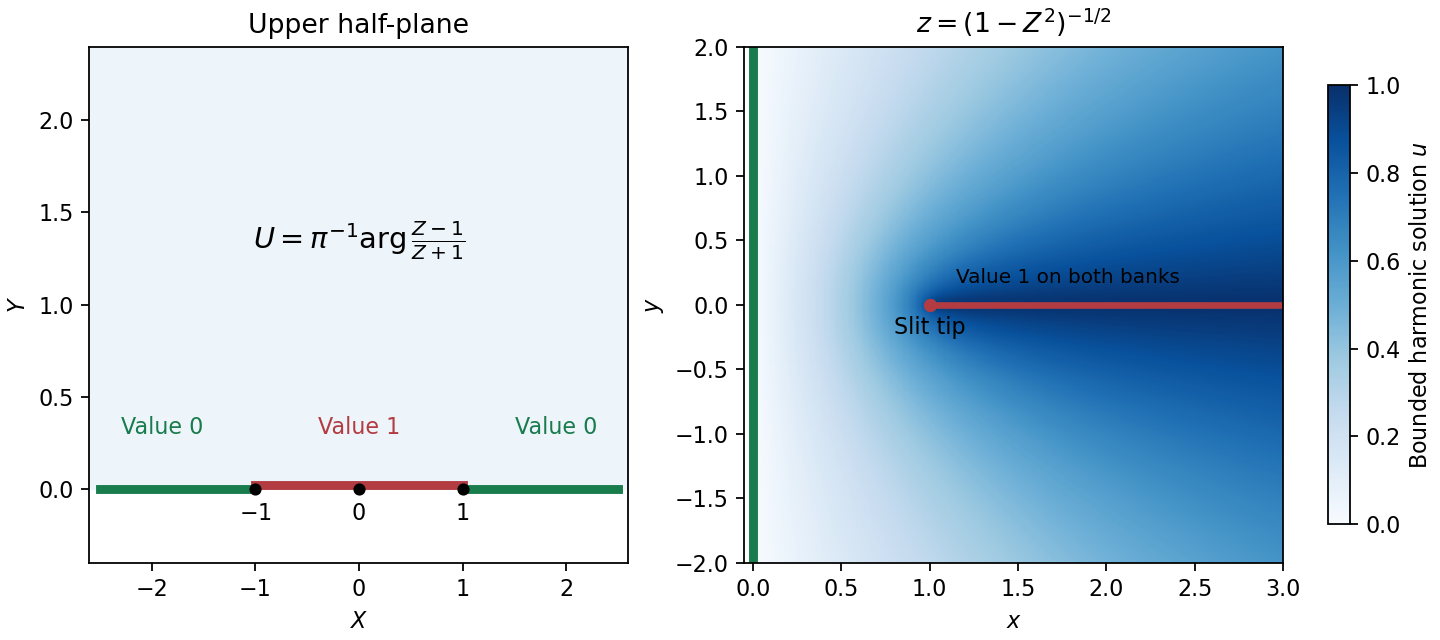
Prevertices, the slit domain, and the bounded harmonic boundary values
. Details. 
New to topics? Read the docs here!