For a positive real base , the logarithm is the inverse function of the exponential function :It asks which exponent produces a given positive number. Thus and . The base restrictions matter: would produce only one value, while a negative base does not define as a real-valued function for every real exponent.
The useful transformation isFor example, corresponds to in base two. Products become sums and ratios become differences. The logarithm does not generally convert a sum into a sum of logarithms. Base conversion uses the natural logarithm: . It also gives , positive when and negative when .
Historically, John Napier's 1614 Mirifici logarithmorum canonis descriptio presented logarithmic tables and their use, documented in the Smithsonian Libraries' digitized original. Tables made multiplication-heavy calculations more manageable by replacing products with addition and a lookup. The 1619 Constructio title page below belongs to a later publication from the same work on logarithms. These historical publications preceded the modern inverse function and integral presentation used here.

For integers , rationality of is equivalent to equality of some positive integer powers . Exponentiation proves one direction and taking logarithms proves the other. Thus multiplicatively independent integers give an irrational number as their logarithm ratio. For distinct prime bases and arguments, unique factorization supplies that independence.
The logarithm is strictly concave on positive real numbers, as its second derivative is negative. Thus the Jensen inequality gives for a probability measure and an integrable positive , whenever the left side is defined. It also controls the negative logarithmic part of convex combinations of strictly positive functions.
The Cauchy principal value integral is the logarithmic integral. The offset version differs by a constant and is often used with the prime-counting function. It has .
The natural logarithm is the logarithm with base Euler's number, and the inverse function of the real exponential function. A particularly geometric definition isFor , it is the area under the hyperbola from to . For , the reversed integration limits give a negative value. The fundamental theorem of calculus gives , so the natural logarithm is increasing, while gives concavity.
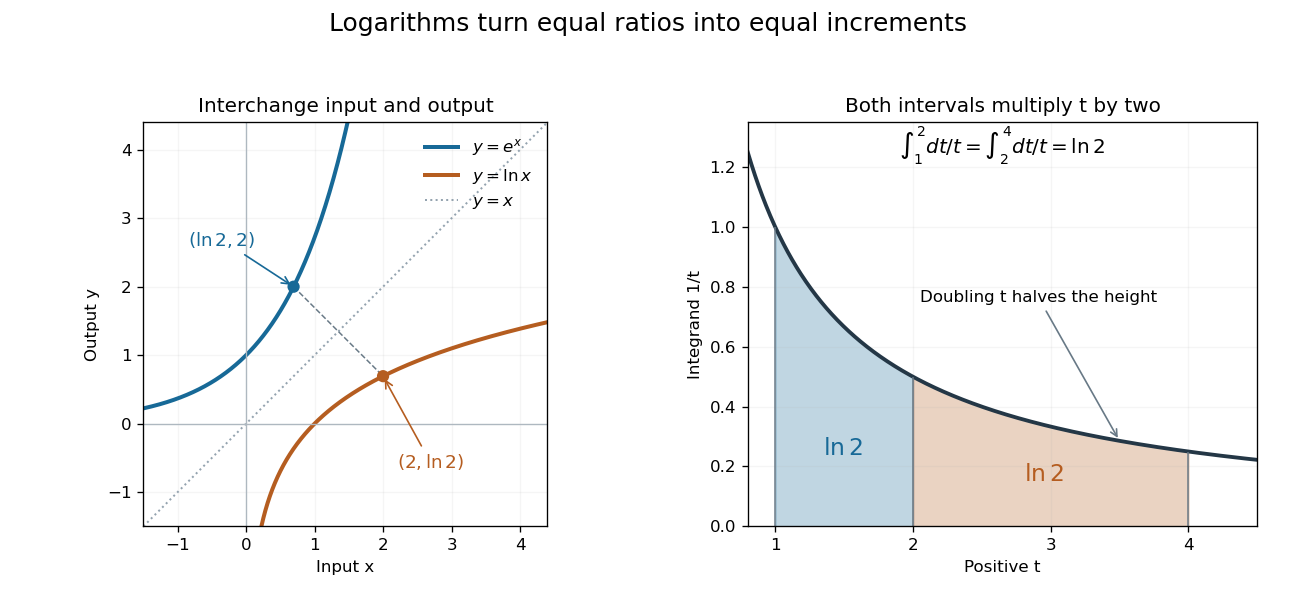
Exponential function and natural logarithm graphs reflect across ; equal multiplicative intervals have equal logarithmic areas
. Details. The change of variables shows for . Thus the intervals from to and from to each contribute area , explaining . Equal ratios give equal increments on a logarithmic scale, even though the ordinary differences grow. This makes the natural logarithm useful for comparing multiplicative changes and solving for time in exponential growth or exponential decay. The integral construction and inverse function properties are discussed in OpenStax, the natural logarithm as an integral.
A scale whose coordinate is a logarithm of a positive quantity. Equal ratios occupy equal coordinate intervals; for example, are equally spaced under the natural logarithm because every successive difference is .
For positive-definite Hermitian operators,The same statement on supports follows by regularizing with a positive multiple of the identity and taking a limit.



