Solution
ID: past-exam-of-the-phase-transitions-and-collective-phenomena-course-of-the-university-of-cambridge/2012/paper-1/2/b/solution
Past exam of the phase transitions and collective phenomena course of the University of Cambridge 2012 Paper 1 2 b Solution by  Codex 0 2026-10-20
The magnetization correlator is an average of a phase difference, not merely its lowest Taylor expansion. Gaussian phase averaging giveswhereThe coincident value is ultraviolet-regularized at a microscopic scale . At large :
- For , the infrared integral for converges. Choosing , , so within the low-temperature spin wave thermodynamic phase.
- For , , hence .
- For , the leading growth is , hence . In particular , , gives .
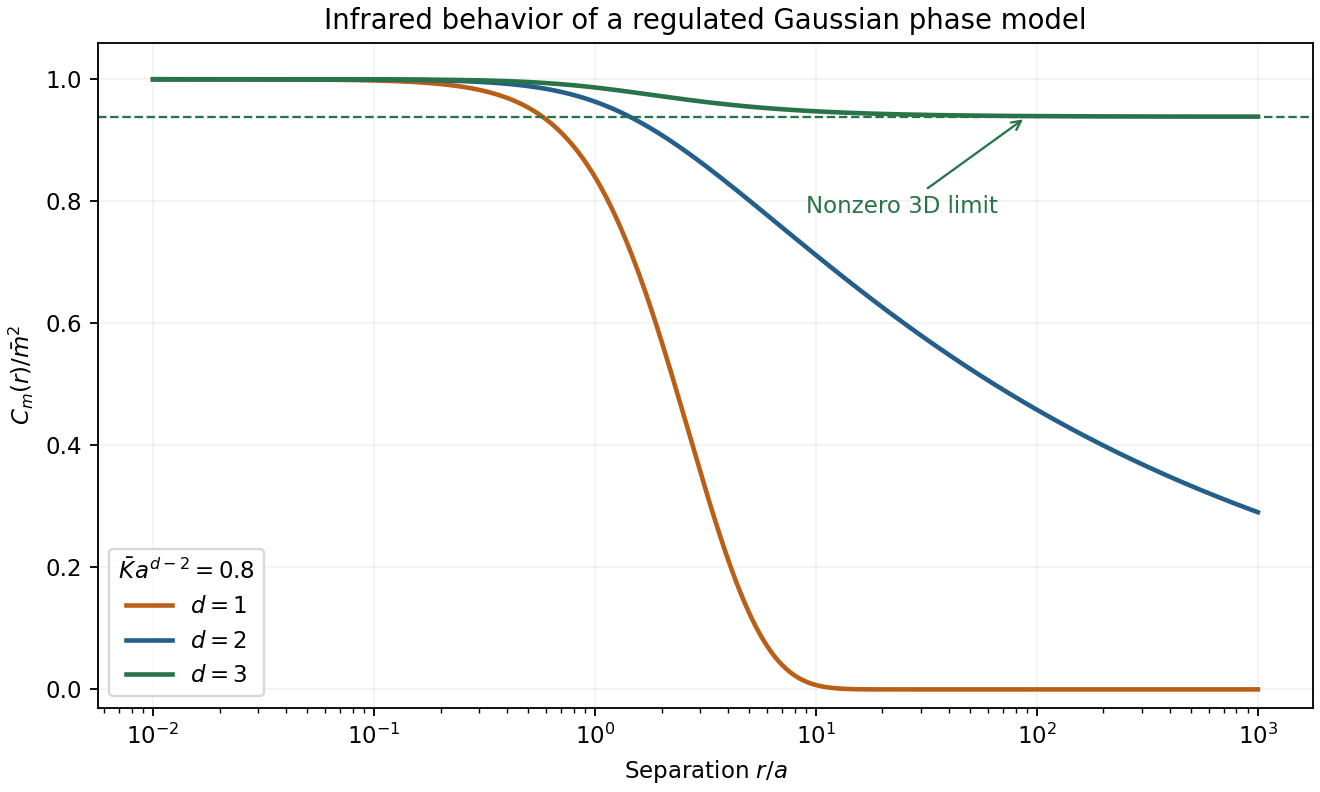

Thus two is the lower critical dimension for conventional positive-temperature continuous-symmetry order under the short-range assumptions. Two dimensions can still have quasi-long-range order and a thermodynamic transition; zero limiting magnetization does not forbid them. The spin wave result describes an admissible low-temperature ordered thermodynamic phase, not order at arbitrarily high temperature. The Mermin-Wagner theorem supplies the more general no-order statement below or at two dimensions.[ref]
Statistical Field Theory by David Tong. §4.2.3: infrared phase fluctuations and continuous-symmetry order
New to topics? Read the docs here!