The lower critical dimension is the spatial dimension at or below which fluctuations prevent the ordered phase associated with a proposed finite-temperature transition. A short-range model with discrete symmetry normally has , whereas continuous symmetry has .
The Berezinskii–Kosterlitz–Thouless transition in the two-dimensional XY model separates a low-temperature phase with algebraically decaying correlations from a high-temperature phase with unbound vortices and exponentially decaying correlations. It does not produce conventional long-range order.
How can something resist a twist when its orientation never settles down? The distinction is between long-range order, a nonzero limiting correlation function, and phase stiffness, a free energy cost for a slow spatial twist. In a uniform two-dimensional XY model at positive temperature, smooth spin waves can erase the first while leaving the second finite. Vortex-antivortex binding then decides whether that resistance survives on arbitrarily large scales.
Vadim Lvovich Berezinskii developed an earlier description of two-dimensional order. John Michael Kosterlitz and D. J. Thouless independently developed the defect mechanism; Kosterlitz's 2016 lecture explicitly acknowledges their initial ignorance of Berezinskii's work. The central step was to include rare vortices alongside smooth spin waves.[ref]
Topological Defects and Phase Transitions by John Michael Kosterlitz. 2016 Nobel lecture, pp. 89–94, sections 2–3; independent Berezinskii work, winding sectors and vortex renormalization
The Mermin-Wagner theorem concerns continuous symmetry and sufficiently short-range interactions in the thermodynamic limit. It does not say that every two-dimensional system is disordered in every sense, nor that every continuous symmetry gives a Berezinskii–Kosterlitz–Thouless transition. Here the order parameter has a circular phase, permitting integer winding numbers. Finite-scale vortex renormalization explains why a finite sample can look coherent even when its infinite counterpart lacks long-range order.
Consider an original counting example: a square two-dimensional XY model of side , a microscopic core radius , and a fixed phase stiffness . This deliberately neglects screening by other vortices. Away from a unit phase vortex, and . Integrating the Goldstone-mode effective free energy over an annulus givesBoundary shape changes finite terms. There are order core positions, so the positional entropy is , where is the Boltzmann constant. With , subtracting gives the displayed free energy.
For and , the dimensionless free energy cost is about at and at . The same logarithm appears in the cost and the positional reward: increasing the system size strengthens whichever has the larger coefficient. The corresponding one-defect Boltzmann factors, about and , are relative statistical weights, not normalized probabilities. The latter signals failure of a dilute single-defect estimate.
A single net phase vortex requires compatible boundaries: on a periodic sample use neutral pairs, as required by vortex charge neutrality. This argument identifies a possible threshold, but predicting the universal stiffness jump requires the renormalized phase stiffness, after smaller pairs have responded. It does not justify setting the transition temperature equal to a bare lattice coupling divided by a universal constant.
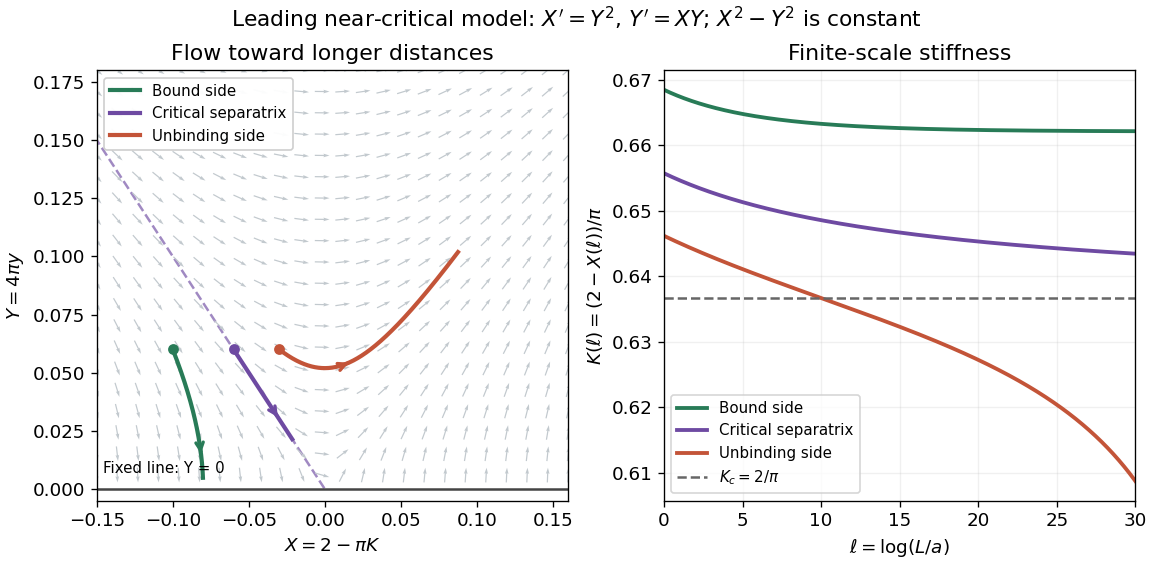
In the dilute-vortex description of the two-dimensional XY model, is dimensionless stiffness and is phase vortex fugacity. A phase vortex has logarithmic energy , while its placement entropy is . Small phase vortex pairs screen the logarithmic interaction, lowering the stiffness. Near , the rescaled variables , obey , to leading order. The invariant leads to an essential correlation-length singularity , not a finite power-law exponent.
Here increases toward larger observation distances, and the vortex fugacity is a dimensionless weight per unit core, conventionally initialized as with the microscopic measure fixed. Numerical coefficients depend on this normalization. In the displayed convention, differentiating using the original flow givesOnly replacing the prefactor by one near gives the scaled leading model. Its first integral follows directly:Thus this first integral belongs to the stated scaled model, not exactly to the original equations. For , the critical separatrix is . The bound side has and flows to , ; the unbinding side ultimately runs to large vortex fugacity, where the dilute approximation ceases to be quantitative.
To derive the unusual correlation length scaling without fitting an exponent, write the invariant on a nearby unbinding trajectory as . Then and the time to cross fixed small limits to is . If a physical one-parameter path crosses the separatrix transversely, its is proportional to the positive reduced temperature. Since distance grows as , this gives , with a nonuniversal . This is the dimensionless-temperature form of the singularity above.
An experiment of size stops the renormalization-group flow at a finite . In the leading scaled model take the original initial conditions and . The invariant is respectively . The first approaches , hence ; the second follows the critical separatrix; the third eventually leaves the small-vortex fugacity regime. These are chosen model trajectories, with no fitted experimental parameters.
On the critical separatrix, implies , henceEven a critical finite sample therefore has a phase stiffness above its asymptotic jump value, with a slow logarithmic correction in . Slightly above the transition, a sample with can resemble the algebraic phase before the flow reaches unbound vortices. A trap additionally varies the local density and phase stiffness; neither its whole-cloud coherence nor a finite observation window automatically measures the homogeneous thermodynamic limit.

The renormalized phase stiffness has this discontinuity at the Berezinskii–Kosterlitz–Thouless transition. The algebraic correlation function has exponent at the transition from the ordered side.
The stiffness here is an energy in two dimensions, not an areal mass density. For a neutral superfluid of particles of mass , let be the superfluid number density per unit area. Substituting the superfluid velocity into the kinetic energy gives . Consequently the jump can also be writtenwhere is the thermal wavelength. It is the large-distance superfluid number density, rather than the total density or a locally inferred condensate density, that enters this relation.
Within the vortex-pair renormalization flow, changes from irrelevant to relevant at , with the large-distance dimensionless phase stiffness. Combining this with the spin wave result gives . Above the transition the homogeneous equilibrium phase stiffness vanishes at infinite observation scale. A discontinuous response coefficient is compatible with a diverging correlation length; it does not imply a latent heat.[ref]
Topological Defects and Phase Transitions by John Michael Kosterlitz. Section 3, pp. 92–94: fugacity flow and renormalized superfluid-density jump
In the phase with quasi-long-range order, vortex defects of opposite winding remain bound in pairs. Their unbinding produces the disordered phase with a finite correlation length.
For two unit vortices of opposite charge separated by , the vortex Coulomb gas gives before screening. At distances much greater than , their phase gradients cancel at leading order: the pair field decays as , whereas a lone phase vortex has a gradient. A neutral pair therefore has finite energy as at fixed . Bound does not mean absent: small pairs remain thermally excited and reduce the phase stiffness through their response to a twist.
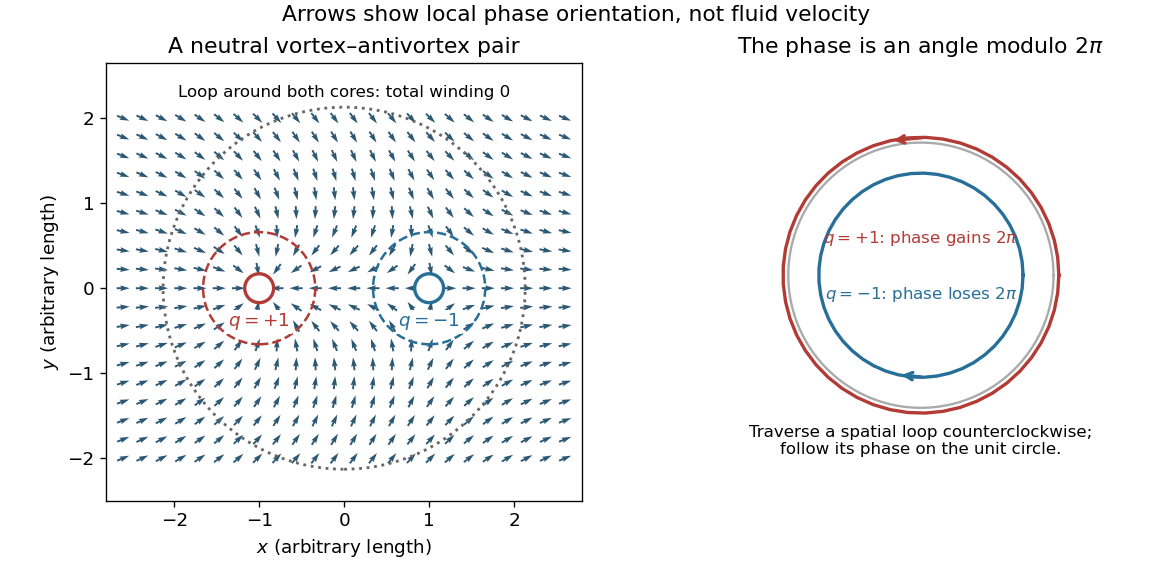

Quasi-long-range order means that correlations decay algebraically rather than approaching a nonzero constant. It occurs in the low-temperature phase of the two-dimensional XY model, where spin waves destroy true long-range order but bound vortex pairs preserve power-law correlations.
For a dimensionless Gaussian action , the phase-difference variance at is up to bounded cutoff terms. Gaussian phase averaging then givesEvery positive makes , so there is no conventional long-range order, even when the phase stiffness is finite. This is how an accumulation of gentle, cheap twists destroys global alignment without making every local twist free.
In 2006, Zoran Hadzibabic, Peter Krüger, Marc Cheneau, Baptiste Battelier and Jean Dalibard split a cooled rubidium-87 cloud into two independent planar gases using an optical lattice. After release, the expanding sheets overlapped; absorption imaging recorded their matter-wave interference. Smooth fringe waviness revealed thermal phase fluctuations, while sharp dislocations indicated isolated vortices. The initial evaporative-cooling endpoint controlled the preparation; central fringe contrast served as a degeneracy proxy because direct thermometry in the lattice was difficult.[ref]
Berezinskii-Kosterlitz-Thouless Crossover in a Trapped Atomic Gas by Zoran Hadzibabic and others. Pages 1–2, preparation and readout; Fig. 1; temperature control and Fig. 2
Loss of extended coherence coincided with increased vortex signatures. The optical trap and finite cloud produced a crossover; tightly bound pairs were unresolved, and short-wavelength modes could contaminate high-temperature counts. These were observations of the vortex-unbinding mechanism, not a direct measurement of phase stiffness or a sharp homogeneous universal stiffness jump. The authors left the sample's superfluidity open.[ref]
Berezinskii-Kosterlitz-Thouless Crossover in a Trapped Atomic Gas by Zoran Hadzibabic and others. Pages 3–4, Figs. 3–4; geometry, invisible pairs, detection limits and final paragraph on unmeasured superfluidity
Articles by others on the same topic
There are currently no matching articles.