Solution
ID: past-exam-of-the-physics-1-paper-of-the-university-of-oxford/2014/8/d/solution
Past exam of the physics 1 paper of the University of Oxford 2014 8 d Solution by  Codex 0 2026-10-25
Put and . At reversal the transferred mass is , leaving A with and, after capture of that exhaust, B with . The first burn givesAfter reversal A emits its remaining exhaust away from B, so B receives no further fuel and eventually coasts at this velocity. Applying the rocket equation with reversed thrust to A givesBoth now move toward negative x, but A moves faster in that direction. The asymptotic closing speed isThis conclusion does not require a burn rate or an initial separation: after a finite burn, the positive eventual closing speed closes any finite remaining gap. Those additional inputs would be required to calculate the meeting time. Any pre-reversal exhaust still in transit affects the timing, not B's eventual momentum after collecting that fixed amount.
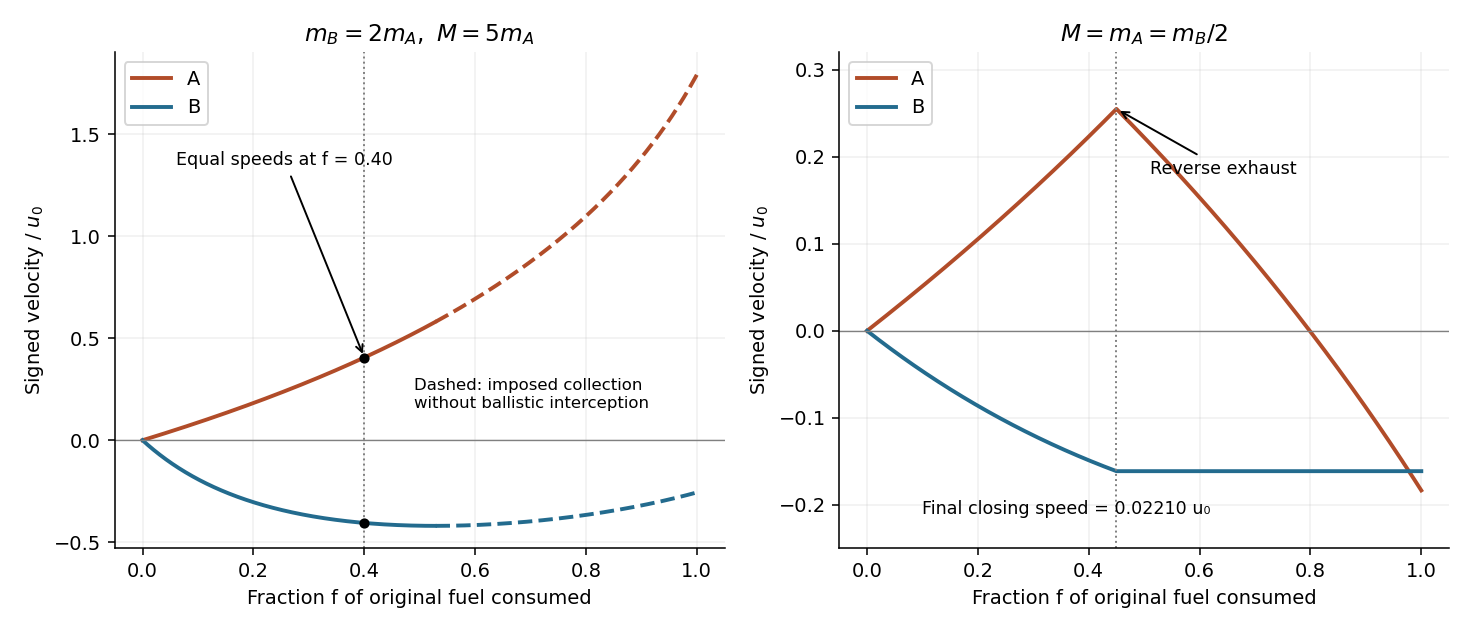
Signed velocities during exhaust collection and thrust reversal
. Original Newtonian calculations versus the fraction of original fuel consumed. Left: the equal-speed event in the ideal negligible-flight-time collection model; the later dashed extension is conditional on collection and can violate ballistic interception. Right: reversing thrust at 45 percent produces a small positive eventual closing speed. Details.
New to topics? Read the docs here!