Solution
ID: past-exam-of-the-physics-a-course-of-the-university-of-cambridge/2012/paper-2/section-b/b6/solution
Past exam of the physics A course of the University of Cambridge 2012 Paper 2 Section B B6 Solution by  Codex 0 2026-10-20
For a narrow packet, phase velocity is and group velocity is . Set . The uncovered surface hasEquality occurs at , also the minimum of . Numerically,The long-wave gravity limit has ; the short-wave capillary limit has .
A compact packet subsequently spreads because different wavenumbers have different group speeds. In the gravity regime , so smaller and longer waves move ahead. Individual crests move twice as fast as the envelope, appearing at its rear and disappearing at its front. In the capillary regime , shorter waves move ahead; the envelope overtakes its slower individual crests, which drift backward relative to it. Thus both the wavelength ordering within the spread packet and the crest motion relative to its envelope reverse.
For the sheet define . The elastic-cover frequency ratio for water waves isAt small , : sheet inertia lowers the frequency, while bending first enters at higher order. At sufficiently large , bending dominates the restoring force and sheet inertia dominates the extra mass, giving . The curve initially dips below one, reaches a minimum, then rises and crosses one. This asymptote describes the supplied ideal dispersion law; arbitrarily large eventually violates a thin-sheet continuum model.
For a pinned-square surface displacement mode, with . The fundamental has . The uncovered frequency is and , soThis uses a square two-dimensional surface mode, not the one-dimensional estimate. A clamped plate or additional hydraulic boundary conditions would require a different mode calculation.
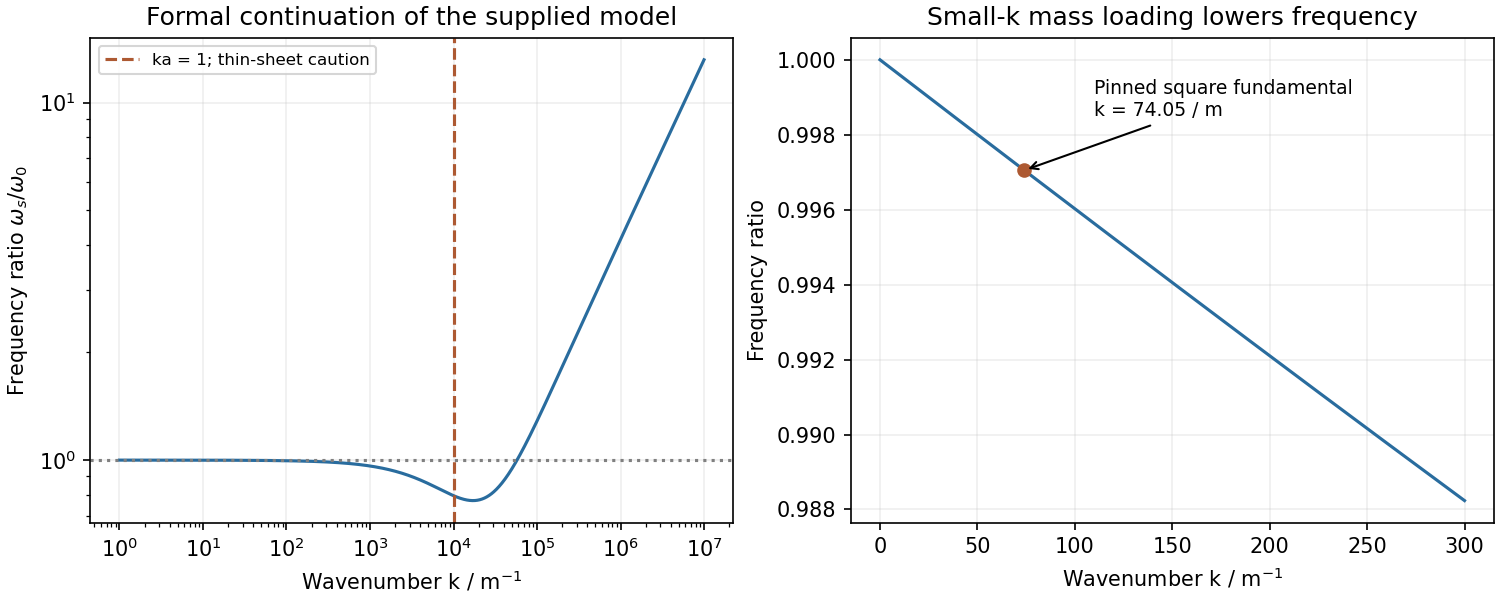
Original sheet-to-uncovered frequency ratio, with the pinned-square fundamental and the ideal large-wavenumber asymptote
. Details. 
New to topics? Read the docs here!