Solution
ID: past-exam-of-the-physics-a-course-of-the-university-of-cambridge/2015/paper-2/section-b/b8/solution
Past exam of the physics A course of the University of Cambridge 2015 Paper 2 Section B B8 Solution by  Codex 0 2026-10-20
Take the aperture in and the observation point , with . Under scalar diffraction theory, the Huygens-Fresnel principle sums complex amplitudes from area elements, rather than summing their intensities. Apart from a common normalization,Here is the complex aperture transmission, is the axial distance, and is the angle of the secondary ray to the aperture normal. The obliquity factor describes the direction dependence of the secondary contribution; one Kirchhoff convention is for normal illumination. Other scalar boundary approximations have slightly different angular weights, all tending to unity near the axis.
Put . The paraxial approximation gives in the phase and in the amplitude. Removing common yieldsAssumptions are uniform normally incident plane-wave illumination, coherent monochromatic propagation, aperture dimensions large enough for the scalar description, , and phase accuracy over the relevant aperture. The last condition justifies dropping the quartic distance term; geometric smallness alone does not guarantee phase accuracy.
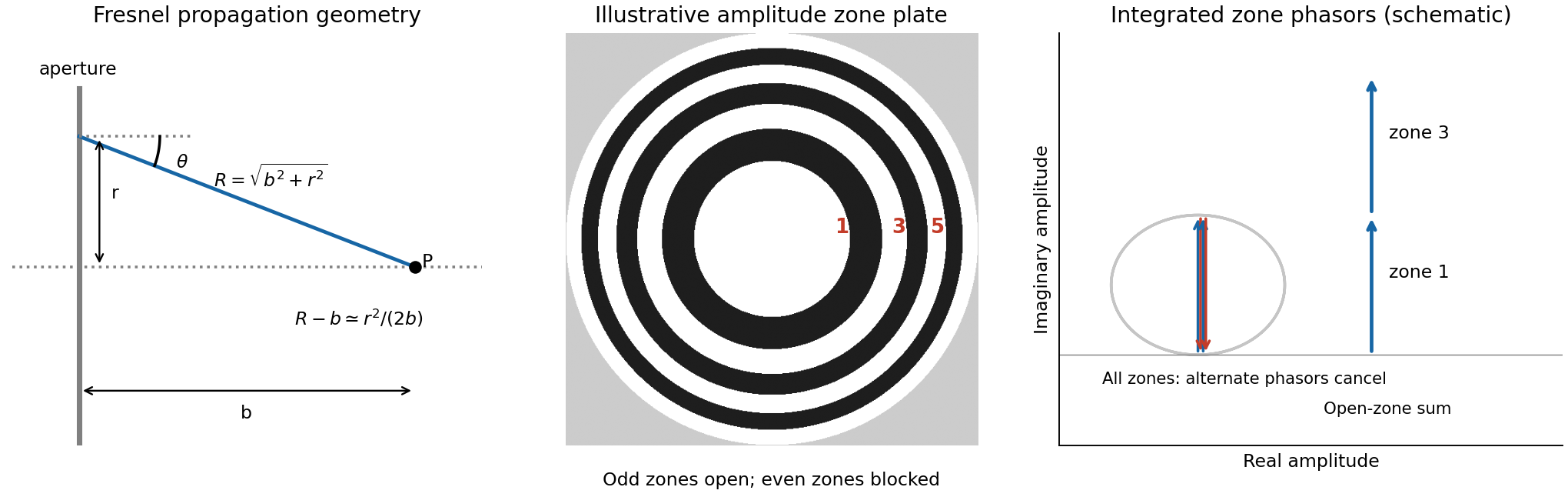

For a circular aperture, for and zero elsewhere. Rotational symmetry and give , , andThe constant can be absorbed into the proportionality factor, producing the required one-dimensional integral.
At a focus a distance away, half-period-zone boundaries obeyWith slowly varying obliquity and illumination, each zone has almost the same area and its integrated phasor has the opposite sign to its neighbour. A zone plate blocks alternate zones, so the remaining phasors add instead of nearly cancelling. Choosing an open central zone, the first three open regions have outer boundaries :These are outer radii, not zone widths; the second open region is the annulus between and .
For the specified outer radius, : there are approximately 49 half-period zones, of which 25 odd zones are open. Normalize to the field of the unobstructed plane wave. The normalized Fresnel aperture integral isFor any odd open annulus this gives , so the whole plate gives andThe axial intensity gain of an amplitude zone plate grows as the square of the number of open zones. Treating the number of zones continuously gives , the same accuracy as an estimate. This large local intensity gain is consistent with conservation of energy because light is concentrated into a small focal spot. It is not a power efficiency; the ideal first-order power efficiency of a binary amplitude zone plate is only .[ref]
Zone Plates by Janos Kirz and David Attwood. X-Ray Data Booklet, §4.4, first-order efficiency paragraph
“Without the zone plate” has here meant removing the finite plate and its outer stop, giving the unobstructed incident wave. If instead a clear circular aperture of radius is retained, its axial field is , so the ratio to that finite-aperture reference is . The two reference experiments differ; neither ratio should be confused with total transmitted power.
New to topics? Read the docs here!