A wave is a propagating or standing disturbance that can carry energy and momentum. Its oscillations are described by quantities such as wavelength, frequency, and wave speed.
A pulse is a localized disturbance that passes a fixed location during a bounded or effectively bounded time interval. A travelling wave pulse may be written with localized . Its width and peak amplitude describe its extent and size; a wave packet additionally emphasizes a carrier and an envelope.
Transfer of wave energy between distinct local branches when spatial variation couples their polarizations or their dispersion relations approach one another. Loss from one observed branch need not mean dissipation: conservation of energy includes every outgoing branch.
For time dependence , the three-dimensional radial solutions and describe outgoing and incoming spherical waves away from the origin. Their inverse-radius amplitudes make their flux through spheres independent of radius. They form the asymptotic radial ingredients of partial-wave scattering.
A waveguide confines a wave transversely while allowing propagation along a longitudinal direction. Material properties and boundary conditions select transverse normal modes, whose longitudinal dispersion relations may have cutoffs even when the bulk material is nondispersive. Examples include an optical fiber, a hollow electromagnetic waveguide, and a membrane waveguide. Guiding reduces geometric spreading along the chosen route but does not eliminate absorption, scattering or leakage.
A transverse wave has its oscillating vector perpendicular to the direction of propagation. In a plane electromagnetic wave in vacuum, the electric field and magnetic field are transverse; their orientation is described by polarization of waves.
At distance below the support of a flexible uniform cable of length , the equilibrium tension is , with linear mass density . The local transverse speed is . Integrating its reciprocal from zero to gives the displayed travel time. The speed vanishes at the free end, but the travel-time singularity is integrable. With variable tension, the small-amplitude wave equation is ; its characteristic speed is still .
A longitudinal wave has an oscillating displacement parallel to the direction of propagation. An acoustic wave in a fluid supplies a familiar example.
A monochromatic wave has a single angular frequency. Its sinusoidal components can have different wave amplitudes and wave phases while sharing that angular frequency, as in the polarization of waves examples.
Wave intensity measures the time-averaged power transferred through unit area perpendicular to propagation. Its SI units are .
Here light intensity means the time-averaged energy flux per perpendicular area for light. It is the propagation-direction component of the averaged Poynting vector. For plane electromagnetic waves in the same medium it is proportional to squared electric field wave amplitude, giving the projection-squared factor in Malus's law.
Polarization of waves describes the direction and time-dependent geometry of a transverse wave's vector during its oscillation at a fixed position. In three spatial dimensions, a transverse wave can have two independent directions of oscillation, both perpendicular to its direction of propagation. For polarization of an electromagnetic wave, the relevant vector is the transverse electric field; for a mechanical transverse wave, it can be the transverse displacement. A purely longitudinal wave has no choice between these transverse directions, and the orientation of a static electric field is not polarization of waves.
Choose transverse axes in a Cartesian coordinate system. A monochromatic wave with a fixed phase difference has the real electric fieldHere are wave amplitudes, is the angular frequency, and is the phase difference of the oscillation relative to the oscillation. The vector's tip traces its path during the wave period . Both plotted coordinates are real electric field components; neither axis represents the imaginary part of a complex amplitude.
For nonzero wave amplitudes, or modulo gives linear polarization: the vector moves back and forth along a fixed line. Equal nonzero wave amplitudes and modulo give circular polarization: the tip traces a circle of constant radius. Unequal nonzero wave amplitudes with give a noncircular ellipse whose axes coincide with . More generally, nonzero wave amplitudes and give elliptical polarization, with circular polarization as a special case. If exactly one wave amplitude vanishes, the nonzero wave has linear polarization for every ; if both vanish, there is no nonzero wave to assign a polarization of waves. [ref]
https://www.feynmanlectures.caltech.edu/I_33.html#Ch33-S1. Feynman Lectures, I §33–1: the electric vector of light
.For example, take , so the wave period is . The choices , and , with electric field wave amplitudes in , produce respectively the line segment , the circle and the ellipse , when coordinates are measured in . At , their tips are respectively , and . The last two share a point without having the same path.
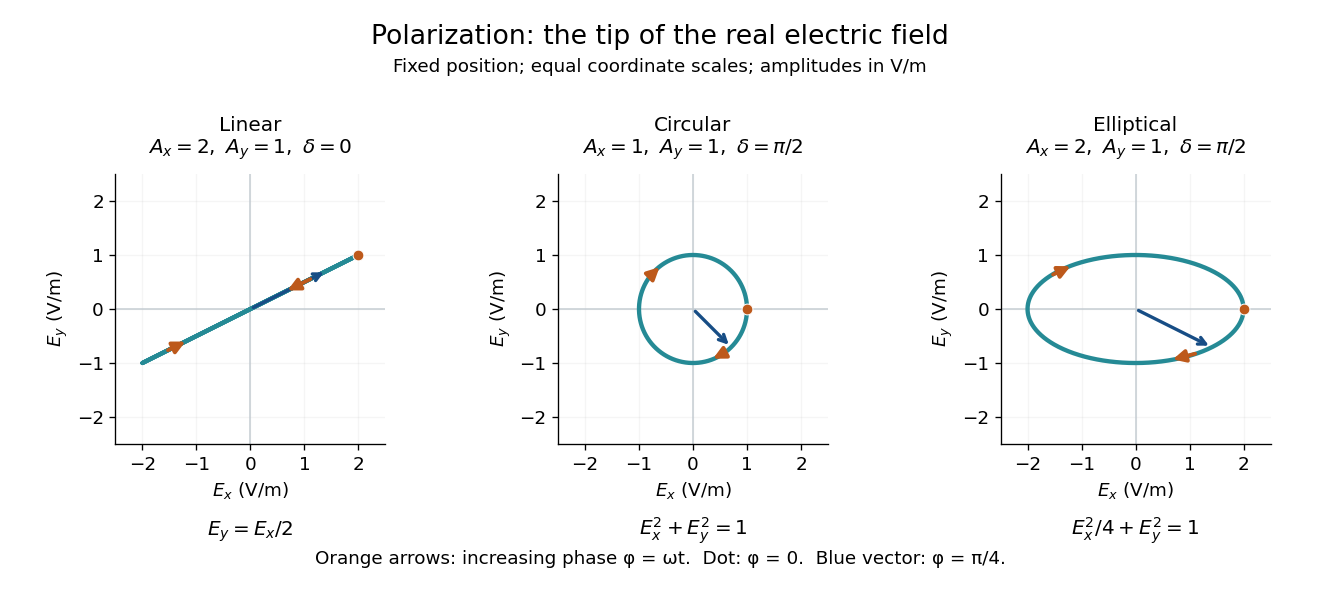
Real transverse electric field trajectories for linear polarization, circular polarization and elliptical polarization
. All panels use the same coordinate scale. Orange arrows follow increasing wave phase ; the dot marks . The blue vector is the electric field at . These are paths at one fixed position, rather than spatial drawings of a propagating wave. Details.Resolving the electric field into two transverse components makes polarization of waves useful: the same frequency and wave amplitudes can describe different paths when their phase difference changes. An ideal linear polarizer selects the component along its pass axis, letting its orientation probe the direction of linear polarization through Malus's law. A fixed pair of wave amplitudes and a fixed phase difference describe one stable path; unpolarized light requires a statistical description rather than one fixed ellipse.
Pure polarization means that the transverse components of a light field have a fixed complex amplitude ratio. A single Jones vector describes the state; its coherency matrix has rank one. Removing overall intensity and a common phase leaves two real parameters, which determine its polarization ellipse.
The degree of polarization quantifies how strongly a transverse optical field departs from an unpolarized mixture. Here are the eigenvalues of its coherency matrix. For two mutually uncorrelated orthogonal linear components of intensities , . It is undefined when the total light intensity is zero. A signed difference is a separate convention that also identifies a preferred polarization direction.
The optical coherency matrix records the second moments of transverse complex amplitudes. Normalize its trace to light intensity. Under a deterministic Jones matrix , . Unpolarized light has , so its output intensity is ; it cannot be represented by one fixed Jones vector.
Jones calculus represents fully polarized light by a Jones vector and linear optical transformations by complex matrices.
A Jones matrix is a complex two-by-two linear transformation of a Jones vector through a deterministic nondepolarizing optical element. Successive elements multiply in reverse reading order. An ideal linear polarizer along a real transverse unit vector has matrix . A common nonzero scalar phase does not change the output polarization of waves.
For fixed circular eigenvectors , let . A uniform optical medium with amplitude propagation coefficients has the displayed Jones matrix. Put and . ThenThe sum of the two modal exponentials supplies a hyperbolic cosine, not its reciprocal. The determinant is , and . Real modal coefficients give circular dichroism; purely imaginary coefficients give lossless circular birefringence. Complex modal labels do not have an intrinsic numerical ordering.
A Jones vector records the two transverse complex amplitudes of a completely polarized monochromatic wave. Multiplication by a common nonzero complex number preserves its polarization of waves, while changing overall amplitude and phase. With the convention , gives , an ellipse with the longer axis along . Handedness labels require both a viewing direction and a naming convention.
For a differentiable Jones vector with , the ratio fixes polarization independently of common amplitude and phase. The title quotient derivative tests first-order polarization sensitivity. If for a complex scalar , then . For a lossless normalized output, differentiation of makes , so this change is a common phase. A vanishing component requires the complementary ratio or a basis-independent polarization coordinate instead.
For an elliptically polarized wave, the tip of its transverse vector traces an ellipse at a fixed point during each wave period. For polarization of an electromagnetic wave, this is the electric field vector. With the real components in polarization of waves, assume and . Eliminating time givesA short derivation uses and the cosine addition formula to obtain ; squaring and using the sine and cosine identity gives the displayed equation. Outside phase quadrature, the mixed term gives a tilted ellipse; are component wave amplitudes and need not be its semi-major and semi-minor axes.
In phase quadrature, , the mixed term vanishes. For , the ellipse is , its semi-major and semi-minor axes have lengths and , and its electric field magnitude varies between and . At with , the electric field is and has magnitude . Equal wave amplitudes instead give circular polarization, a special case of elliptical polarization with constant magnitude. As approaches or , the ellipse collapses to a line segment and gives linear polarization; this limit is degenerate rather than a nondegenerate ellipse.
Changing from to reverses traversal of the same ellipse. In the displayed plot, moves from toward negative as time increases. A label such as right- or left-handed circular polarization additionally requires a stated viewing direction and naming convention: viewing along propagation and viewing against propagation reverse the apparent rotation. [ref]
https://www.feynmanlectures.caltech.edu/I_33.html#Ch33-S1. Feynman Lectures, I §33–1: polarization conventions
.The ellipse records both the relative wave amplitudes and the phase difference of two transverse oscillations. This separates a change of polarization of waves from a change of overall wave amplitude: multiplying both components by the same positive factor enlarges the ellipse while preserving its shape and orientation.
A rotating ideal linear polarizer can probe this geometry. For the ellipse in phase quadrature, orthogonal projection onto a pass axis at angle gives , in . Averaging its square over a wave period gives , while the incoming squared electric field magnitude averages to . Thus the transmitted fraction of light intensity is : it is at , at and at . There is no single incident line of linear polarization to insert into Malus's law; projecting the electric field and averaging its square is the appropriate generalization. This measurement cannot distinguish from , because reversing the traversal leaves all these squared averages unchanged.
Two coherent waves with common propagation direction and frequency can combine into a polarization ellipse. Take circular components , and add along . The resulting semiaxes are and . Choosing positive gives a nondegenerate ellipse with unequal axes. Uncorrelated relative phases do not describe the same fixed pure polarization.
The polarization ellipse is the curve traced by the transverse electric field of a monochromatic wave at a fixed point. Its orientation and signed ratio of minor to major semiaxis specify a pure polarization. A zero minor semiaxis gives linear polarization, and equal semiaxes give circular polarization.
For incident light with linear polarization, an ideal linear polarizer transmitswhere is light intensity and is the angle between the incident electric field's line of oscillation and the polarizer's pass axis. The input and output are compared in the same medium. The classical explanation is an orthogonal projection: for a unit vector along the pass axis,The dot product reduces the transmitted wave amplitude by . For a plane electromagnetic wave in the same medium, light intensity is proportional to squared electric field wave amplitude, giving Malus's law. For example, transmits one quarter of the incident light intensity, although the transmitted wave amplitude is one half. [ref].
Start with light already in linear polarization along the horizontal axis and let its light intensity be . Two ideal absorbing linear polarizers with pass axes and give . Insert a polarizer between them: the first leaves unchanged, the middle transmits with linear polarization along , and the last transmits with linear polarization along . Each angle in Malus's law is relative to the preceding output, so the final step uses :
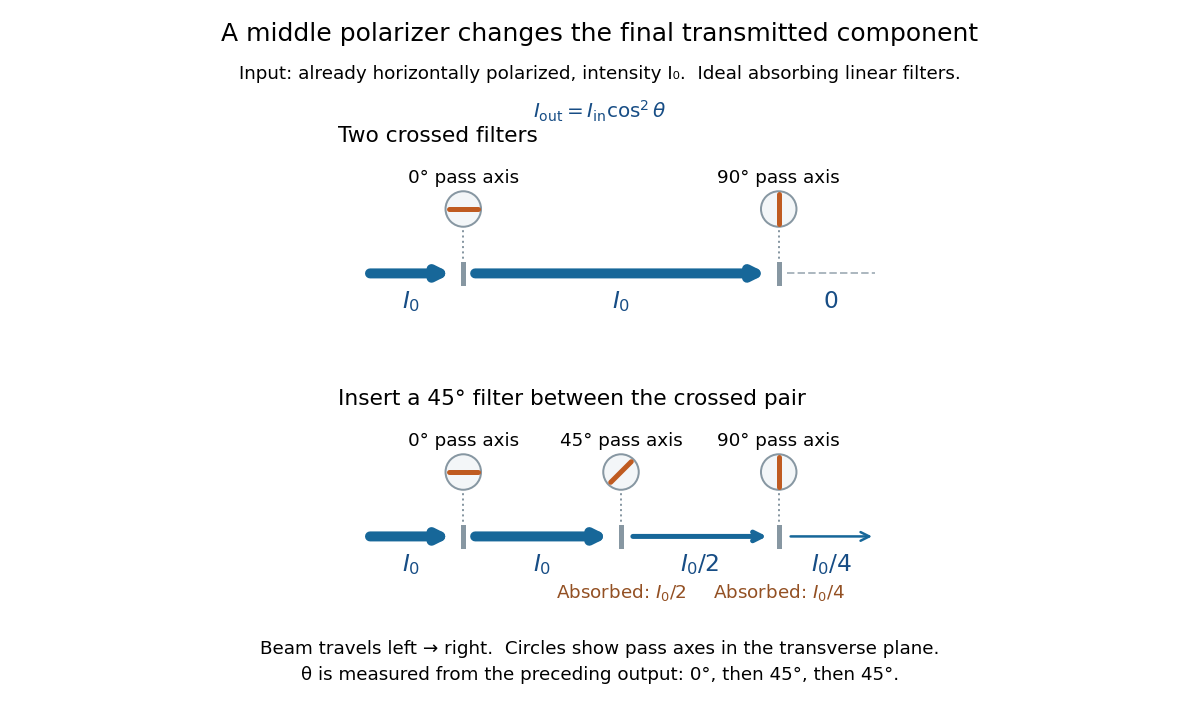
Two crossed polarizers transmit zero; inserting a middle polarizer transmits for initially horizontal linear polarization
. Pass axes are measured from horizontal. Each blue segment represents transmitted light intensity, and each inset shows the pass axis in the transverse plane. The two successive changes each halve light intensity by Malus's law. Details.For these ideal absorbing polarizers, the rejected electric field component transfers energy to the filter. In the three-filter arrangement the middle absorbs the fraction , and the last absorbs , leaving transmitted. Conservation of energy holds at each step. Inserting the middle polarizer changes the linear polarization arriving at the last one; it does not create light. The effect illustrates why successive orthogonal projections cannot generally be replaced by a single comparison of the first and last axes.
The initially horizontal assumption matters. For unpolarized light of light intensity , the first ideal linear polarizer transmits : averaging over uniformly distributed incident orientations gives . The same sequence then transmits . This extra first-stage factor does not apply to the already horizontally polarized input in the figure.
For ideal polarizers with successive transverse transmission directions , the Jones matrix is the rank-one orthogonal projection . The identity reduces the transmitted probability amplitude analogue, here the optical complex amplitude, to a product of projections. For unpolarized light, the first element transmits half the incident light intensity, giving the displayed product. For a specified incident linear polarization, replace the first half-factor with its actual projection.
Unpolarized light has no preferred transverse polarization direction in its time-averaged statistics. An ideal linear polarizer transmits half its incident light intensity: equal transverse components give the averaged projection factor . This statistical description differs from the fixed deterministic phase relation of a monochromatic wave in a pure polarization of waves state.
An oscillation is a repeated variation about an equilibrium or central value. A normal mode describes a single frequency of oscillation.
Coupled oscillators exchange energy through interactions. Linear equations can be transformed into normal mode coordinates; the spatial pattern of an applied force determines which normal modes are driven.
For masses connected in sequence to a moving support by springs , displacement coordinates give . The squared normal-mode frequencies are . For support motion with , the negligible-damping steady response is . The first mass has a response zero between the two resonances. Finite damping generally makes that zero imperfect.
Two identical vertical springs connect a driven pivot to two equal masses in sequence. After subtracting the static gravitational equilibrium, the laboratory displacement equation is . For and , a particular solution is . Thus the upper mass has zero driven response even though this frequency is not an eigenfrequency. The general solution also contains both free normal modes.
A free mass driven by can be coupled by a single spring of stiffness to an auxiliary free mass . With no wall attachment or damping, the periodic displacement amplitude of is . Tuning gives antiresonance: while the auxiliary mass has signed amplitude , supplying an exactly cancelling spring force. A nearby pole occurs at . For relative tuning error sufficiently small, the primary amplitude relative to its free response grows as . A light absorber is therefore narrowband and may require large auxiliary travel. This cancellation dissipates no energy, and undamped free modes persist unless excluded by initial conditions.
In a finite-dimensional undamped linear oscillator, a bounded periodic particular solution can exist away from natural resonances. Adding any homogeneous normal mode gives another solution, and that free motion does not decay. Thus the late-time motion is not determined by the drive alone. At a resonant frequency with nonzero drive projection onto the corresponding mode, the particular solution grows secularly, so no bounded periodic steady response exists.
Place two equal masses on a massless mechanical string with spans and uniform tension . Fix one end and drive the other with displacement . Linear transverse force balance gives and . The mass-normalized stiffness matrix has symmetric and antisymmetric normal modes with squared angular frequencies and . The mode coordinates and separate the forced equations.
For a cosine drive of amplitude , the periodic response of an end-driven two-bead string has signed amplitudes and , where . At , while . Equal and opposite transverse forces from the driven end and moving first bead cancel at the second bead. This antiresonance differs from a natural resonance: it is a zero of one measured response between the two natural frequencies. Free normal modes remain unless initial conditions exclude them.
For equal masses , positive end spring constants and coupling spring constant , the stiffness matrix is . Its eigenvalues divided by are the squared normal mode angular frequencies , where . Holding the opposite mass fixed gives . Since , subtraction proves the title ordering. Holding a mass fixed retains the coupling stiffness; removing the coupling spring produces a different system.
Consider identical harmonic oscillators with unit mass, natural angular frequency , and positive coupling :An initial impulse on the first gives and . The normal mode coordinates and have angular frequencies and . Solving their initial value problems provesLet . To leading order in , sum-to-product identities give the displacement amplitude envelopes and . Thus the first nearly complete energy transfer occurs at , and localization returns at . More precisely, at , the first oscillator has exactly zero velocity and residual displacement , of order .
Here transferred energy means kinetic energy plus the uncoupled quadratic potential energy; the coupling potential energy is relatively small. The fast phase need not make the receiving oscillator pass through zero displacement at the transfer time. Expanding as small is invalid on the transfer scale . This lemma complements absolute and signed beat envelopes by keeping that slow phase.
For equal lengths, end masses , middle mass , and equal springs between adjacent bobs, reflection symmetry gives mode vectors , and . Their squared frequencies are displayed above. These vectors are orthogonal in the inner product weighted by . Equal end masses, rather than equality of all three masses, suffice for this symmetry reduction.
For , the slowly varying signed factor is . The absolute amplitude envelope repeats in , half the period of that signed factor.
Two equal small-angle pendulums coupled by a spring have displacement patterns and , with squared angular frequencies and . An initial displacement of only the first pendulum excites both patterns equally.
Anharmonicity is departure from the motion of a harmonic oscillator, often caused by nonquadratic terms in a potential energy. It can make the oscillation frequency depend on amplitude and generate higher harmonics. A quartic oscillator has one such anharmonic potential energy.
A wave period is the time for a monochromatic wave to complete one oscillation. For angular frequency , it is . In cascade order-of-magnitude estimates the factor is normally suppressed, giving a linear interaction time of order .
The angular spectrum is the transverse Fourier transform of a monochromatic field on a reference plane. In a uniform medium, each transverse wavevector component propagates with a longitudinal wavenumber satisfying the Helmholtz equation. Components beyond the propagating wavenumber range are evanescent waves. The outgoing angular spectrum chooses the longitudinal branch that propagates or decays away from the plane.
For a scalar complex wave amplitude , the squared-amplitude scalar wave intensity convention is . It is nonnegative and unchanged by multiplying by a unit-modulus wave phase factor. This convention is useful in paraxial propagation and phase screen models. Conversion to physical energy flux also depends on the field variable and medium; an arbitrary superposition need not have its full flux determined by this scalar alone. For a random field, is the mean wave intensity, whereas is the squared coherent field; these generally differ.
A complex number can encode both the wave amplitude and phase of a harmonic disturbance: . Its modulus is the real oscillation amplitude and its complex argument fixes the wave phase.
Reference wave phases label complex amplitudes without changing measured powers. If , choose diagonal matrices whose entries have modulus one, and set , . Then and each component has unchanged squared modulus. For a beam splitter scattering matrix, transforming without transforming input complex amplitudes changes the stated physical input.
A phasor is a complex amplitude representing a sinusoid at one specified angular frequency: . Its modulus gives the peak amplitude and its complex argument gives the wave phase in this convention. Both may instead use root mean square magnitudes if that normalization is stated.
A phase shift is a change in an oscillation's wave phase, specified modulo . It can arise from propagation, reflection or an imposed response. With the time convention , a delay multiplies the complex amplitude by . A sign reversal is a phase shift.
A phase factor is a unit-modulus complex number . Multiplying a complex amplitude by it changes its wave phase by while preserving its squared modulus. A common phase factor does not change light intensity, while different phase factors of contributions can change their interference.
The difference of two wave phases at the same place and time, considered modulo . It determines whether two same-frequency oscillations reinforce, cancel, or are in phase quadrature.
For an oscillation written relative to , a positive represents delayed maxima. The corresponding unwrapped delay is , while a single periodic observation determines the phase difference only modulo .
Two sinusoidal signals are in phase quadrature when their phase difference is a quarter cycle, for example and . Their time averages have zero correlation over a cycle. In a plane wave, this separates fields such as displacement and its time derivative, velocity.
Wave absorption transfers energy from a propagating wave to other degrees of freedom of a medium. For a plane wave that is a monochromatic wave, with amplitude proportional to and , its wave intensity decreases as . The intensity absorption coefficient is therefore when this loss is due to absorption. A decreasing transmitted wave intensity can also result from wave reflection or wave scattering, which redistribute energy rather than necessarily converting it into heat.
Wave reflection returns part of an incident wave into the medium from which it arrived, as a consequence of an interface or spatial variation of material properties. An amplitude reflection coefficient compares the reflected and incident waves; its squared modulus gives their wave intensity ratio when both use the same medium and normalization. Reflected energy has not necessarily undergone wave absorption.
In a reciprocal medium, appropriately normalized source and receiver responses can be exchanged: the scalar Green function satisfies . Reciprocity alone does not imply absence of wave absorption.
For an operator with positive stationary coefficients and reciprocal boundary conditions, its delta-normalized Green function satisfiesMultiplying its frequency-domain equation by and using the bilinear Green second identity proves the relation. Both Green functions must use the same outgoing or causal prescription. Exchanging source and receiver preserves time lag, and involves no complex conjugation.
The scattered wave is the part of the total solution produced by the scatterer relative to the prescribed incident wave. It obeys an outgoing radiation condition. For a rough reflecting surface, this convention includes both specular flat-surface reflection and the roughness-dependent correction. Its coherent field is its ensemble mean, which need not equal the full mean intensity.
The incident wave is the prescribed background solution that illuminates a scatterer. It solves the unperturbed Helmholtz equation in scalar time-harmonic models. The scattered contribution is defined by subtracting this field from the total field; reflected waves from a planar boundary are included unless a separate reference reflection is explicitly removed.
If a unit incident plane wave has scattered field , the differential wave scattering cross-section isIt is the far-field limit of times the scattered-to-incident energy flux ratio. The common physical amplitude normalization cancels when the incident and scattered waves are in the same background medium. The formula assumes that the Green-function factor, if present, is already included in the far-field pattern.
In the Born approximation for scalar wave scattering, with and zero-mean stationary unit-variance , define . The leading expectation of the differential cross-section for scalar wave scattering isFor a regular volume much larger than the covariance range, the overlap is approximately , giving . Statistical isotropy, beyond statistical homogeneity, permits the scalar argument . If the spectrum is defined for the index fluctuation rather than , it already contains .
Anderson localization is the confinement of electron wave functions, or other wave modes, by interference between repeated wave scattering paths in static disorder. A localized eigenstate occupies a limited region even in a much larger sample. Disorder can therefore suppress diffusion without absorbing the wave. In 1958, Philip Warren Anderson studied random site energies and intersite coupling, finding a regime without transport. His paper develops a theoretical model; it does not report an Anderson laboratory measurement.[ref]
Absence of Diffusion in Certain Random Lattices by Philip Warren Anderson. Anderson, 1958, pp.1492–1494, Sections I–II
The distinction from ordinary multiple scattering is the retention of wave phases: alternative paths contribute probability amplitudes before their squared modulus is taken. Adding path probabilities alone loses the cross terms responsible for interference. This makes Anderson localization useful as a warning about transport models: repeated deflections need not produce unlimited diffusion. It also connects electron transport with wave propagation in a random medium, although the detailed equations and experimental diagnostics differ between electrons, light and acoustic waves.
Philip Warren Anderson's 1977 lecture distinguishes localized magnetic moments from disorder-localized states. It credits Nevill Francis Mott with recognizing the significance of the mobility edge. A Mott insulator instead requires electron interactions and can exist without disorder.[ref]
Local Moments and Localized States by Philip Warren Anderson. Local Moments and Localized States, pp.376–377,395–396; inspected institutional mirror www.nevis.columbia.edu/~haas/documents/physics_nobel_lectures/physics71-80-2.pdf
John Hasbrouck Van Vleck developed quantum mechanics explanations of magnetic susceptibility, including its temperature dependence; this is a distinct contribution from Anderson localization.[ref]
Quantum Mechanics: The Key to Understanding Magnetism by John Hasbrouck Van Vleck. Quantum Mechanics: The Key to Understanding Magnetism, pp.355–356; inspected institutional mirror www.nevis.columbia.edu/~haas/documents/physics_nobel_lectures/physics71-80-2.pdf
Interference of time-reversed multiple-scattering paths can enhance return probability and reduce conductance in a coherent disordered conductor with the appropriate symmetries. Magnetic fields, spin-orbit coupling and dephasing alter or suppress the correction; some symmetry classes exhibit antilocalization. This small-correction regime must be distinguished from strong Anderson localization.
An energy interval with no extended bulk energy eigenstates available for transport. It can contain localized eigenstates and have a nonzero density of states; a mobility gap need not be a spectral gap.
A localized eigenstate is an energy eigenstate whose spatial weight remains concentrated near some position as the system grows. An exponentially localized eigenstate has a decaying envelope characterized by a localization length. A small participation ratio measures concentration in a chosen site basis; it does not by itself establish an exponential tail or a transport law.
An energy eigenstate changes only by an overall wave phase under time evolution, whether localized or extended. Its stationary probability distribution alone therefore does not distinguish transport mechanisms. The important distinction concerns spatial extent and how superpositions of energy eigenstates carry or retain a disturbance. A wave packet assembled from localized eigenstates with nearby centres can remain confined, whereas extended modes can support propagation.
The localization length measures the decay scale of a localized eigenstate's wave amplitude envelope. Here is the site spacing and its centre. With this amplitude convention, probability decays on half that scale:Individual random tails fluctuate; this notation describes their typical envelope, not exact equality at every site. A localization length much greater than a finite sample's length makes a state look extended inside that sample. The participation ratio below is an effective site count, not an independent fitted value of .
For an eigenvector normalized by , the participation ratio in its site basis isIt estimates how many sites carry appreciable probability. Equal weight on sites and zero elsewhere gives , irrespective of their wave phases. A single occupied site gives ; uniform probability on all sites gives . These are exact constructed examples, not claims about particular Hamiltonian operators.
To prove the bounds, write . Since , , giving . The Cauchy-Schwarz inequality gives , giving . Thus the measure has useful limits without assuming an exponential shape. Comparing as increases helps distinguish a state filling the sample from one occupying a fixed region, provided energy selection and disorder statistics are controlled.
A mobility edge separates localized from extended energy eigenstates on the energy axis. Three-dimensional disordered models can have both. In the infinite one-dimensional tight-binding model with independent continuous random site energies, all states are localized for any nonzero disorder, with probability one. This statement excludes specially correlated disorder.[ref]
Local Moments and Localized States by Philip Warren Anderson. Local Moments and Localized States, pp.395–396, mobility edge and one-dimensional localization; institutional mirror as above
A mobility edge is not a band gap: states can exist on both sides of , but differ in spatial extent. For electrons, the location of the Fermi energy relative to a mobility edge matters for low-temperature electrical conductivity. A three-dimensional sample need not have an extended interval at every disorder strength. In particular, the finite one-dimensional calculations below neither locate a three-dimensional mobility edge nor establish a nonzero universal critical disorder.
Consider a noninteracting electron in a finite tight-binding model with open ends:The vectors form an orthonormal basis of site states. The hopping energy is ; it is not the time coordinate. Draw each independently from the continuous uniform distribution on and then hold it fixed. The disorder strength is dimensionless. Open ends mean no hopping bond connects sites and ; equivalently set . There are no electron interactions, phonons or wave absorption in this model.
The eigenvalue equation in the interior isAs a simple local calculation, if a state's peak is at , a neighbouring site with receives a small leading contribution . Several successive large mismatches multiply small factors. This explains why large disorder can restrict spreading, but is not a proof of Anderson localization: near-resonant denominators and alternative interference paths prevent treating this expansion as uniformly valid.
For the first original calculation, take , , and the fixed random seed . Diagonalizing the resulting real symmetric matrix with
numpy.linalg.eigh and selecting the eigenvalue closest to zero gives , a probability peak at site , and . The selected eigenvector has total probability one. This is one chosen realization, not a disorder average or a measured specimen.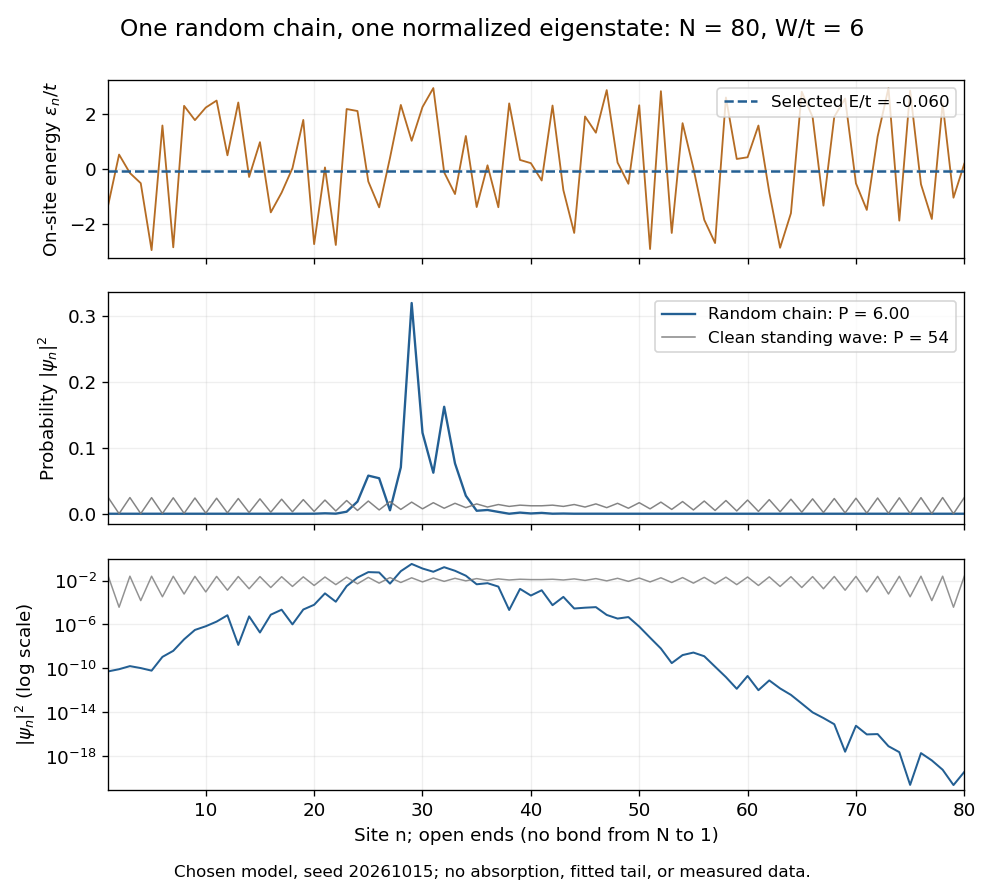
The clean comparison needs care. With , the open chain has standing wavesFor even , the identity and finite trigonometric sums give , hence . Thus the clean -site comparison has , although it extends across the chain. Extended does not mean uniform probability. For odd , the special central mode has zeros on alternating sites and instead ; the even-size assumption avoids that exception.
The second original calculation compares and over . For each size, draw independent site patterns using seed , with the size included in the random-seed construction. Scale each fixed pattern across disorder strengths. At every point, average over the four energy eigenstates closest to . The solid line is the median across these sample averages; shading spans their th–th percentiles. The selected states can change as varies: lines connect one sample's selections rather than tracking a single mode.
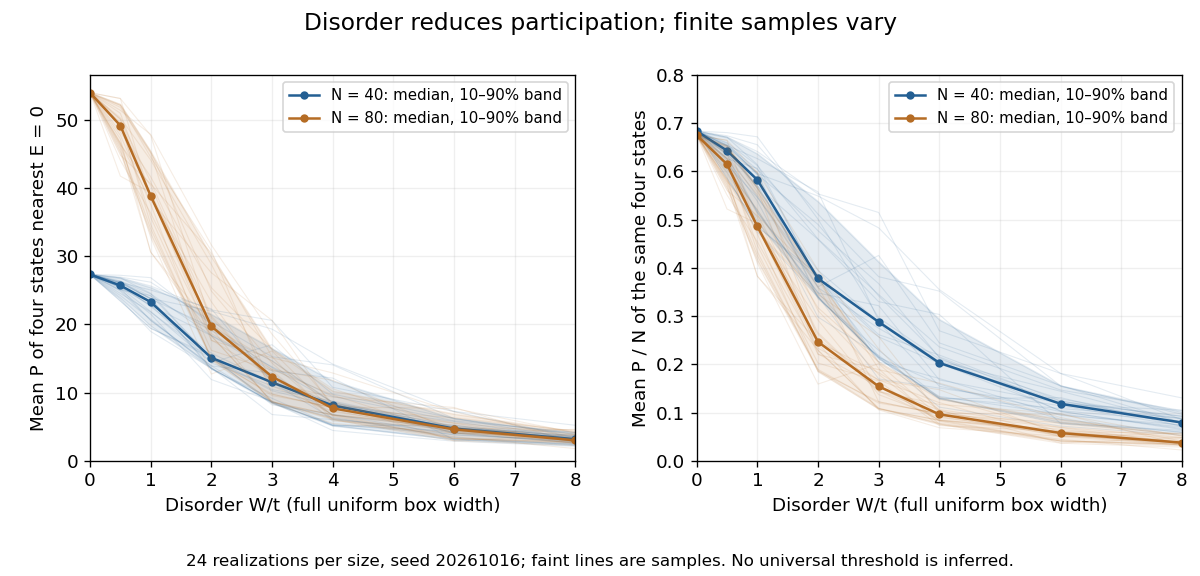
Participation ratio varies across disorder realizations and finite chain sizes
. Original One-dimensional Anderson chain calculations. Faint lines show individual sample averages, solid lines their medians and bands their th–th percentiles. The left panel plots ; the right divides by site count . These finite samples illustrate concentration and variability, without a fitted critical disorder. Details.At the two clean values are and . At , the computed median sample averages are approximately and . In the latter regime, doubling hardly changes the typical occupied site count, so falls. At weak disorder the larger chain permits more spatial extent. Neither a single curve nor the overlap of finite-size bands proves the infinite-system statement under mobility edge; a long localization length can hide confinement in either size.
Nevill Francis Mott's 1977 lecture discusses silicon deposited in a glow discharge. Injected electrons provided a drift-mobility readout; electrical conductivity and temperature dependence tested localized-state transport and excitation toward a mobility edge. Varying temperature distinguishes transport regimes. The lecture gives no contact geometry or timing circuit here, so none is inferred. Its Figure 2 is schematic, not measured data.[ref]
Electrons in Glass by Nevill Francis Mott. Electrons in Glass, pp.404–406, Fig.2 and discussion of glow-discharge-deposited silicon; inspected institutional mirror www.nevis.columbia.edu/~haas/documents/physics_nobel_lectures/physics71-80-2.pdf
This evidence motivates a transport question beyond the closed-chain eigenvalue problem: how does a prepared charge disturbance move under the conditions of a real sample? The numerical figures above supply neither drift-mobility measurements nor a model of the deposition process. Finite-size concentration alone cannot reproduce an experimental electrical conductivity curve.
Finite temperature permits phonon-assisted hopping between localized eigenstates or thermal excitation toward a mobility edge; localized states therefore need not imply zero measured electrical conductivity at every nonzero temperature.[ref]
Electrons in Glass by Nevill Francis Mott. Electrons in Glass, pp.405,407, localized-state hopping and thermal excitation
Real dephasing destroys the relative wave phases needed for long-path interference. Observing coherent confinement requires the distance over which those wave phases survive to be long enough to explore the localized region, and the sample to be large enough to resolve it. Temperature alone is not an automatic switch: the actual inelastic processes set the relevant scales. Static elastic wave scattering preserves coherence within each realization. Loss of the ensemble-averaged coherent field through random wave phases is therefore not, by itself, physical dephasing of an individual sample.
For a complex random wave amplitude, this two-point expectation retains the coherent field and uses a complex conjugate on the second amplitude. It is not a normalized wave-field correlation coefficient. Subtracting gives the centered covariance function. At coincident points the uncentered wave-field correlation equals the mean wave intensity. Under second-order stationarity it depends only on the separation and has a spectral measure of a stationary random field. A deterministic field is included by taking a degenerate ensemble.
For a random complex wave amplitude , its mean squared amplitude is . Expanding , with , givesThe mixed terms vanish. Thus the squared coherent field is only one part of the mean intensity; the other is the diffuse contribution. A fixed acoustic or optical normalization converts this squared-amplitude quantity to physical energy flux. This ensemble mean differs from the angularly averaged radiative-transfer mean intensity.
In wave propagation in a random medium, the coherent field is the expectation of the complex wave amplitude, . The remaining field has zero expectation. This is the coherent and diffuse wave fields decomposition. Statistical homogeneity of the medium does not make spatially constant when the incident field is localized: translation symmetry applies to the response together with its incident data. The coherent component can attenuate while the total ensemble-averaged wave intensity remains substantial.
For the linear weak-index parabolic wave equation, a Markov approximation with integrated covariance givesThe drift follows by converting the multiplicative Stratonovich integral to an Itô integral for a Brownian field with transverse covariance . For a Gaussian beam with one transverse coordinate entering the random region at , . The coherent field retains transverse beam structure. The white-noise closure needs short longitudinal correlations and the corresponding separation of propagation scales; Gaussian one-point statistics alone are insufficient.
For a parabolic wave equation with , a zero-mean stationary real field of unit variance, and , finite-correlation perturbation theory givesHere is the coherent field, is the autocorrelation function of a random field and is the one-coordinate Fresnel propagator. Expand the random solution once using the Duhamel principle, multiply by and average to obtain the memory term. The local phase term comes from the term in . The expansion is for fixed propagation distances with suitable covariance regularity and moment bounds. A Markov approximation is an additional scale assumption that can turn this integral equation into a local attenuation equation.
If the physical refractive index is , then . In the parabolic wave equation, the last term produces in the mean equation. For unit-variance, finite-correlation fluctuations, in a weak-fluctuation expansion, giving a coherent phase drift to second order. This term is absent if the model deliberately linearizes to . It is not obtained by squaring ideal Gaussian white noise, whose pointwise square is not the finite-variance random variable .
An outgoing three-dimensional Green function behaves as . Evaluating a point-coupled discrete-level equation at cutoff distance produces a real shift proportional to and an imaginary outgoing-wave term proportional to . The bare level must depend on the cutoff to keep the measured detuning finite.
For between angular cutoffs, the leading total cross section is . Multiply its mean count by the one-scatter second moment to obtain the displayed total angular variance. A single-plane projected variance is half as large. Comparing the scattering angle to a magnetic bend explains the approximately momentum-independent scattering contribution to relative track uncertainty.
Frequency is the number of repetitions of a periodic phenomenon per unit time. For a wave of period , its frequency is , measured in hertz. The angular frequency is .
The frequency ratio of two nonzero frequencies is a dimensionless ratio. Ordinary and angular frequencies give the same result because both are converted by the same factor . Rational ratios imply a common period for their sinusoidal motions, while the special ratio two means that one mode completes two cycles during one cycle of the other.
A radio frequency is a frequency in the range used for radio waves. It describes the rapid oscillation of a radio wave, which can differ from the rate at which information is transmitted in radio communication.
The unit of frequency equal to one cycle per second.
The Doppler effect is a change between emitted and received frequency caused by motion of the source or receiver. An approaching siren can send more wave crests per second to a microphone than the source emits per second; a receding siren sends fewer. The source need not change its own oscillation. The Doppler shift is , where is emitted frequency and is received frequency, both measured in hertz.
For acoustic waves, motion must be specified relative to the material carrying the wave. The speed of sound is measured in that material's rest reference frame. Moving the source changes the spacing of successive wavefronts; moving the receiver changes how quickly it crosses those wavefronts. These two mechanisms give different exact factors in the classical Doppler effect for sound, even for the same closing relative velocity.
This makes a microphone a motion probe: a stable tone supplies a repeating clock, and changes in arrival spacing reveal the source's motion toward or away from the receiver. An acoustic Doppler measurement can test the prediction directly. A passing source also illustrates why geometry matters: its speed can stay constant while the received frequency changes continuously, as in Doppler frequency along a trajectory.
The following sound model assumes linear acoustics in uniform stationary material with isotropy, constant speed of sound and negligible wave dispersion. Source and receiver speeds are below the speed of sound, and there is a single direct propagation path. Air motion requires transforming source and receiver velocities into the air's rest reference frame; a nonuniform flow requires a more general propagation model. At the sonic threshold the simple periodic-arrival picture fails; moving-point acoustic wavefronts and the Mach cone describe the relevant geometry, while finite shock waves require further physics. Light in vacuum instead requires the relativistic Doppler effect: the acoustic formula cannot be converted into its exact optical counterpart just by replacing the speed of sound with the speed of light.
An observer moving through isotropic blackbody radiation sees a direction-dependent temperature. With the sky angle measured toward the velocity apex in the observer frame, , where and . First-order expansion gives the displayed dipole. The forward sky is hotter. The cosmic microwave background dipole is an application.
A frequency change associated with rotation and exchange of angular momentum. If an optical element rotates at angular velocity about a chosen axis and gains angular momentum from a photon, its mechanical energy gain is in the prescribed slow-rotation model. Energy conservation then gives photon frequency change . The rotating half-wave plate frequency shift is a spin-polarization example.
A rotating ideal half-wave plate flips circular polarization. The spin change has magnitude per photon, so its mechanical energy exchange produces a frequency shift of magnitude . For Jones convention and , the combination . Acting on gives ; with time dependence and , the output frequency is . The opposite input eigenpolarization reverses the shift.
Articles were limited to the first 100 out of 114 total.