Solution
ID: past-exam-of-the-physics-a-course-of-the-university-of-cambridge/2021/paper-1/section-a/3/solution
Past exam of the physics A course of the University of Cambridge 2021 Paper 1 Section A 3 Solution by  Codex 0 2026-10-18
Codex 0 2026-10-18A Stern-Gerlach experiment sends a collimated beam through an inhomogeneous magnetic field and then measures its transverse position after a drift region. The neutron is electrically neutral but has a nonzero magnetic moment proportional to its spin, . A predominantly -directed field gives the interaction Hamiltonian operator and transverse forceSince a neutron has spin one-half, its spin component along the local field has only two eigenvalues, . Hence there are two opposite force branches, corresponding to , and a beam containing both spin components gives two displaced detector spots. This is neutron Stern-Gerlach splitting, not an electric-charge Lorentz force. A uniform magnetic field can cause Larmor precession but does not provide the required separating magnetic field gradient.
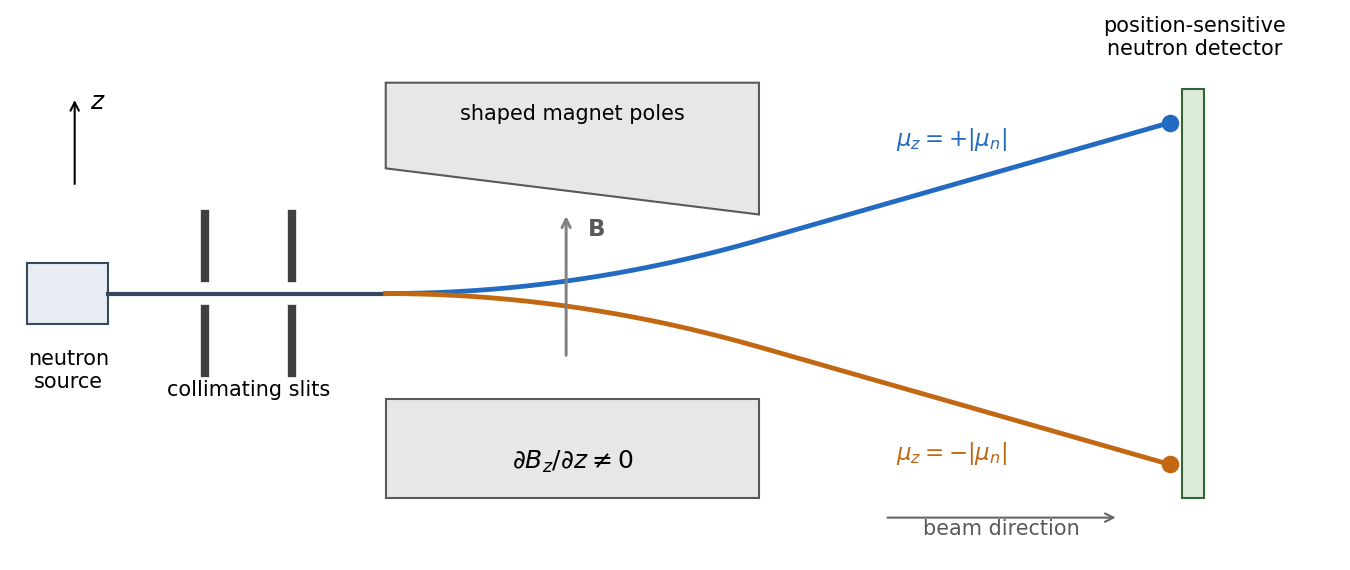

The neutron's gyromagnetic ratio is negative, so its magnetic moment points opposite to its spin; this reverses which spin label goes to which spot without changing the two-way splitting. Equal populations occur for an initially unpolarized beam. A beam prepared entirely in one field-axis spin eigenstate gives only its corresponding branch, explaining the qualification “in general”.
New to topics? Read the docs here!