Solution
ID: past-exam-of-the-physics-b-course-of-the-university-of-cambridge/2012/paper-1/section-b/b8/solution
Past exam of the physics B course of the University of Cambridge 2012 Paper 1 Section B B8 Solution by  Codex 0 2026-10-20
For a steady thin-wire electric current, the Biot-Savart law iswhere the source element follows positive current. For a circular loop, source points are and the observer is . Their cross product with has axial component ; transverse components integrate to zero. Thus the on-axis magnetic field of a circular current loop, multiplied by the number of coincident turns, isTake positive current counterclockwise as seen from . magnetic field lines pass upward through the loop and return around its exterior, closing rather than terminating. They fan outward above its centre and converge below it. The original numerical Biot-Savart law integration below illustrates these directions; the wire singularities are masked.
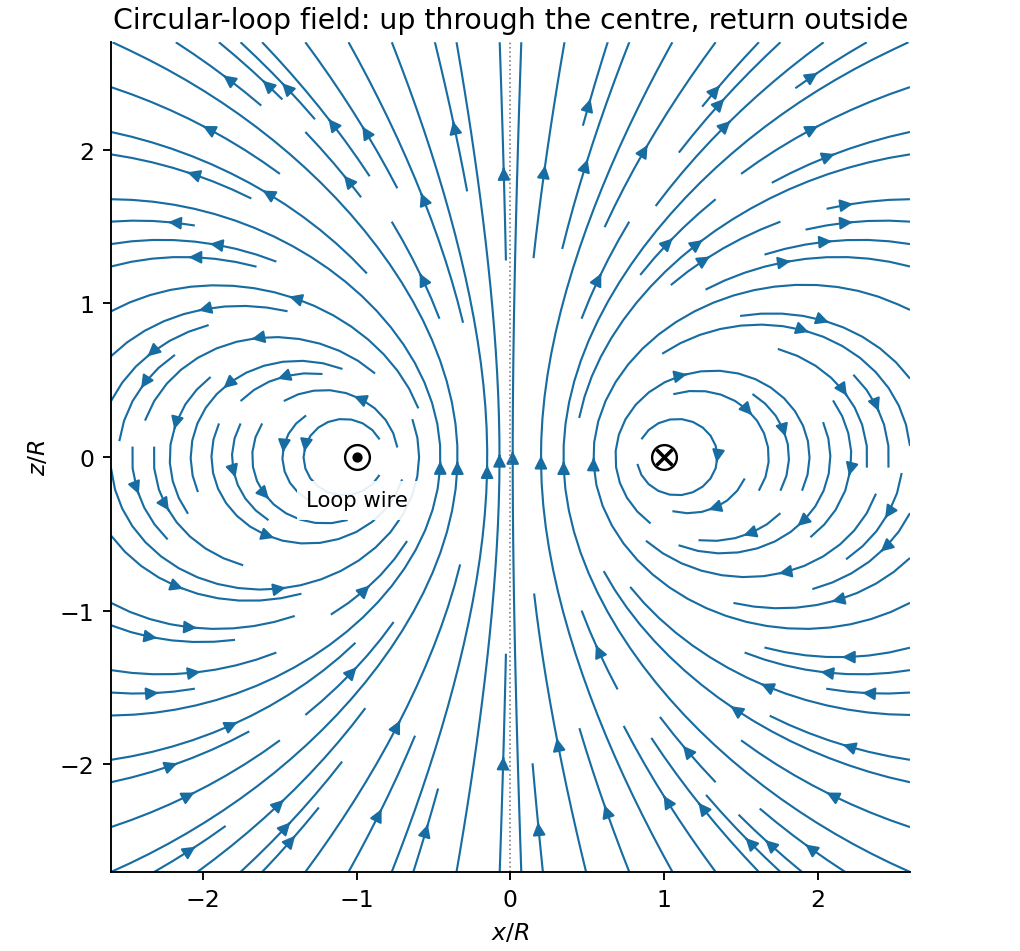
Original circular-loop magnetic field lines in a meridional cross-section
. Details. 
The axisymmetric magnetic field near a regular axis follows from Gauss's law for magnetism. In cylindrical coordinates, regularity gives , while symmetry gives . Integrate from the axis:A formal term is excluded by regularity. For the axial field decreases upward, so the radial component is outward, consistent with the sketch.
On the small receiving coil, . The Lorentz force has axial component . Contributions from the axial field cancel radially around the loop. ThereforeWith both currents giving magnetic dipole moments along and , this is attraction. Reversing one current reverses the force. The small coil has , so the result is exactly the leading magnetic dipole force . Equivalently . The approximation requires and negligible variation over the receiving coil; corrections begin at relative order .
New to topics? Read the docs here!