Solution
ID: past-exam-of-the-physics-of-atmospheres-and-oceans-course-of-the-university-of-oxford/2017/4/c/solution
Past exam of the physics of atmospheres and oceans course of the University of Oxford 2017 4 c Solution by  Codex 0 2026-10-25
A hydrostatic pressure interval contains moles of background gas per area. Its absorbing column is , so for a nadir rayThe assumed Planck-temperature power and dry adiabat give . To first order in optical depth, , and the radiance solution becomesFor a uniform mixing ratio this also evaluates to . Its total optical depth is , so the deficit is .
A pressure-resolved perturbation defines the infrared absorber sensitivity kernel by , withIt is zero at the top, negative in the interior, and zero again at the surface. The magnitude is largest where , namelySign and coordinate qualification. Literally the maximum of the signed kernel is zero at the endpoints; is its minimum and the maximum of its absolute value. The derivative with respect to a single vertically uniform is the integrated constant and has no pressure location. For equal-width logarithmic pressure perturbations the kernel is instead and its magnitude peaks at . The stated pressure-interval convention is therefore essential.
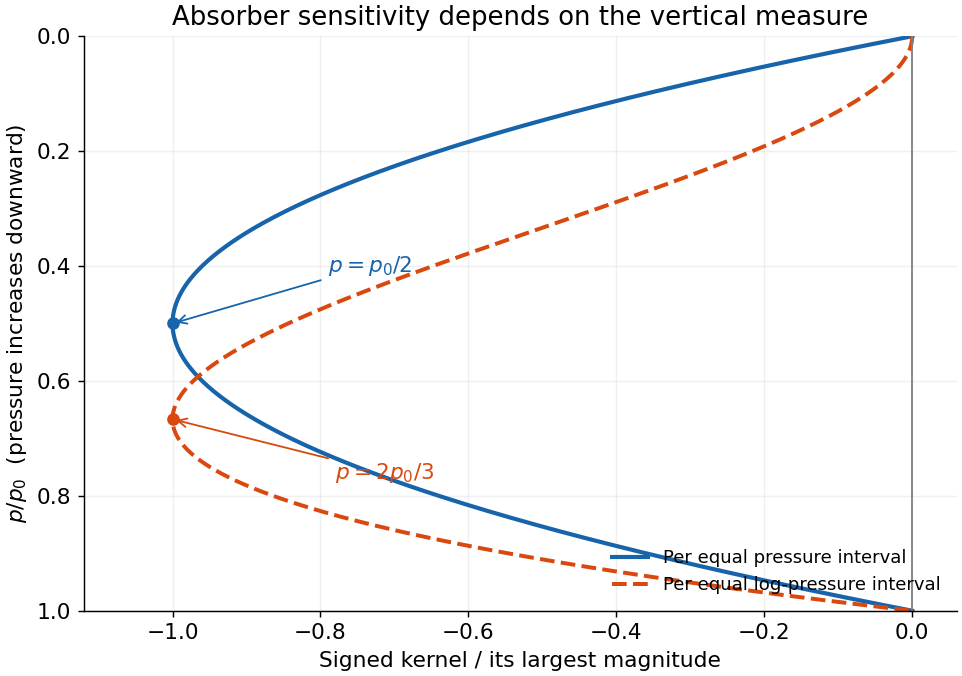

The low top-of-atmosphere sensitivity reflects the small pressure-broadened absorption coefficient and small molecular column per there; the low surface sensitivity reflects small thermal contrast. The printed phrase that temperature decreases with pressure reverses the actual stipulated relation: with positive exponent, temperature decreases as pressure decreases upward. The derivation uses the explicit adiabatic formula.
New to topics? Read the docs here!