Solution
ID: past-exam-of-the-physics-of-the-earth-as-a-planet-course-of-the-university-of-cambridge/2014/paper-1/3/b/solution
Past exam of the physics of the Earth as a Planet course of the University of Cambridge 2014 Paper 1 3 b Solution by  Codex 0 2026-10-20
Oceanic thermal subsidence. Newly formed oceanic lithosphere is hot and buoyant. Cooling increases its column density, causing subsidence by isostasy as it moves away from a ridge. The half-space cooling model has profile isWith volumetric thermal expansion coefficient , the excess column mass relative to hot mantle isCompensation with seawater density givesThus young-to-intermediate-age seafloor generally deepens approximately as the square root of age. At old ages, finite thermal-plate thickness and basal heat supply flatten this trend; indefinite half-space deepening is inappropriate. Sediments, variable crust, volcanic swells and dynamic topography also perturb bathymetry. Ocean-floor depth and heat flow jointly constrain cooling models.[ref]
An analysis of the variation of ocean floor bathymetry and heat flow with age by Barry Parsons and John G. Sclater. 1977, half-space cooling, bathymetric age trend and finite-plate alternative
Effective elastic thickness. This is the thickness of a homogeneous elastic plate with the observed effective flexural rigidity, not necessarily the crustal or thermal lithospheric thickness:Infer it by modelling deflection around known loads, such as seamounts or trenches, or fitting gravity-topography admittance and gravity-topography coherence across wavelengths. A simple Fourier balance is for a signed transverse load. The transition from buoyancy-dominated to bending-dominated behaviour constrains ; then assumed Young's modulus and Poisson's ratio give .
Good inference includes load geometry and density, buried interfaces, sediment and internal loading, boundary conditions and data resolution. These can trade off with rigidity. Plastic yielding, faulting, mechanical layering and creep make an effective, timescale- and stress-dependent quantity. Older, colder lithosphere is often stronger, but age at loading and subsequent relaxation matter; a single universal age-to- conversion is unjustified.
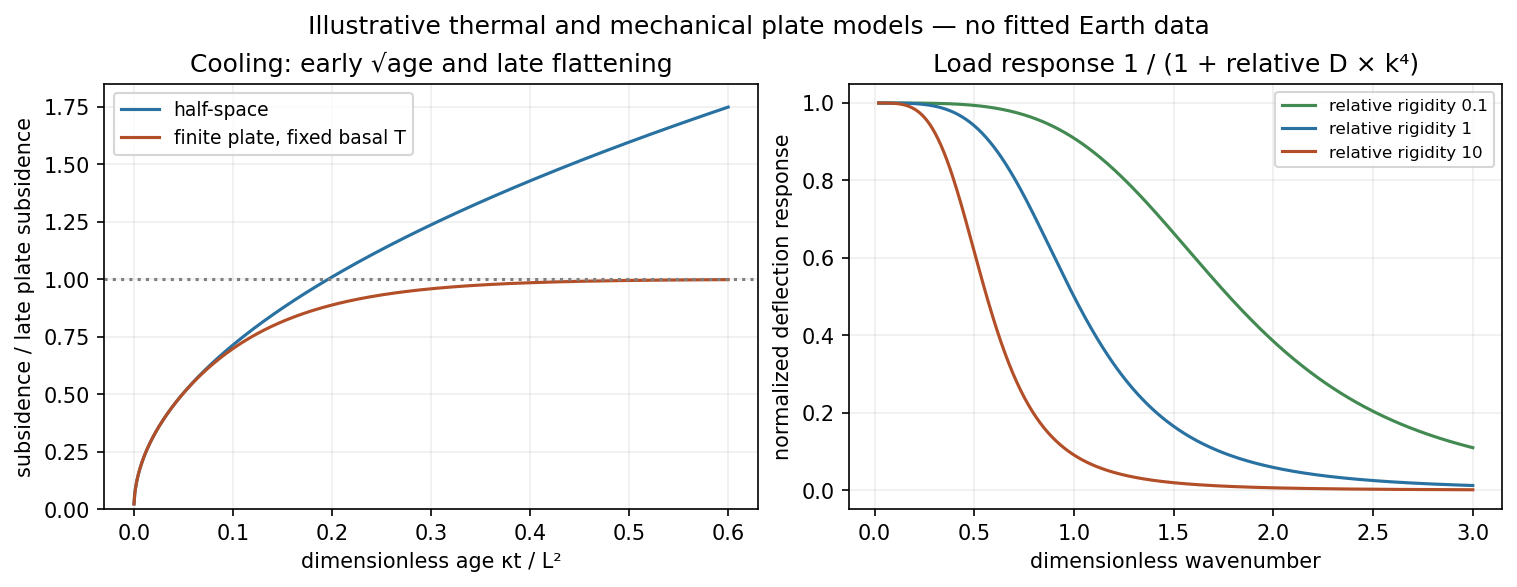
Square-root cooling versus finite-plate saturation, and stiffness sensitivity of the flexural response
. Details. 
New to topics? Read the docs here!