Heat is energy transferred across a thermodynamic system's boundary because of a temperature difference. It is measured in joules, like work and internal energy. A hot cup transfers heat to cooler surroundings; its temperature describes its state, while the transferred heat describes a process. The cup stores internal energy, rather than a substance called heat. [ref]
https://openstax.org/books/university-physics-volume-2/pages/1-4-heat-transfer-specific-heat-and-calorimetry. Ling, Moebs and Sanny, OpenStax, University Physics Volume 2, section 1.4: heat and internal energy
For a closed system with unchanged bulk kinetic energy and potential energy, choose for heat entering and for work done by the system. The first law of thermodynamics givesHere is the stored internal energy. For example, a sealed piston cylinder receiving of heat and delivering of work gains of internal energy. A closed system retains its matter while exchanging energy; it need not be an isolated system. [ref]
https://openstax.org/books/university-physics-volume-2/pages/3-3-first-law-of-thermodynamics. Ling, Moebs and Sanny, OpenStax, First law of thermodynamics and sign conventions
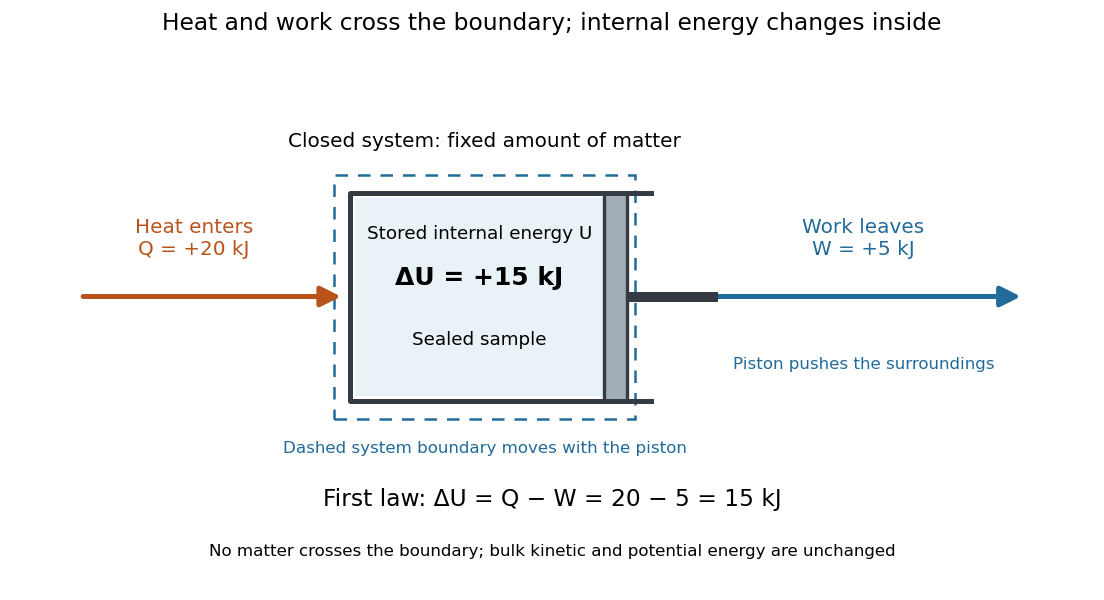
Unlike internal energy, heat is not a state function: different paths between the same equilibrium states can transfer different , with compensating differences in work. The symbol records this dependence on the path; there is no stored quantity whose difference is always . The two paths in first law of thermodynamics illustrate this directly. Supplied heat can raise temperature as sensible heat, change a phase fraction through latent heat, or help supply expansion work. Measuring temperature alone therefore does not determine transferred heat.
For a reversible thermodynamic process, , where is absolute temperature and is entropy. This identification requires reversibility: an irreversible adiabatic process has and can nevertheless increase entropy. Likewise , with enthalpy , requires the particular fixed-pressure conditions in enthalpy. These distinctions make heat useful as a precise boundary-transfer quantity in heat engines, refrigerators and heating calculations.
Historically, James Prescott Joule's paddle experiments showed that stirring water with input work could raise its temperature, helping establish conservation of energy. The lesson is still useful: a temperature rise can result from work even without incoming heat. [ref]
https://openstax.org/books/university-physics-volume-2/pages/1-4-heat-transfer-specific-heat-and-calorimetry. Ling, Moebs and Sanny, OpenStax, section 1.4: Joule's paddle experiment
Heat transfer asks how quickly heat crosses a boundary and how the temperature varies along its path. Its principal mechanisms are thermal conduction, convection and thermal radiation. A warm wall can conduct heat through its interior while exchanging heat with moving air and emitting thermal radiation at its surfaces. Identifying these paths lets us estimate heating requirements and cooling times.
Distinguish the accumulated heat from its rate , a power measured in . The heat flux is the rate per unit area, measured in : a uniform normal heat flux across area gives . The steady bar in thermal conduction carries through , hence ; maintained for , it transfers . This distinction makes a surface's intensity and a whole object's heating load easy to compare.
For a homogeneous material, thermal inertia is , where is thermal conductivity, is density and is specific heat capacity. It measures the resistance of the surface temperature to periodic heating and controls the phase lag relevant to the Yarkovsky effect.
A body loses internal energy by emitting thermal radiation faster than it absorbs radiation or receives other heating. In a gravitating gas this can remove pressure support and allow further contraction.
Hot electrons can transfer energy to Cosmic microwave background photons through Compton scattering. For a fixed electron fraction and electron temperature well above the radiation temperature, the optically thin gas cooling time scales approximately as . Its volume loss scales with electron density, not with , because the radiation density is independent of local gas density. The process tends toward the radiation temperature; it heats rather than cools electrons colder than that radiation.
Dust grains emit thermal radiation after absorbing energy from radiation or collisions. Collisions can transfer thermal energy from dense gas to grains, whose radiation then cools the gas. This channel requires dust and does not operate in strictly pristine hydrogen-helium material without prior enrichment.
Thermal electrons can transfer energy to lower-energy radiation photons through Compton scattering. In the nonrelativistic Thomson regime, the net cooling power per electron is for a blackbody photon bath. A sufficiently hot electron population therefore loses energy; a colder population is heated instead. The Cosmic microwave background radiation energy density grows as , making this channel more important for high-redshift diffuse ionized gas.
An astrophysical cooling function packages radiative losses of a plasma into a temperature-dependent coefficient. In the hydrogen-density-squared convention, the volume energy loss is , so the coefficient has units . Its dependence on ionization state, chemical abundances and radiation field must be specified; a low-density collisional-equilibrium curve is not universal.
Radiation from rotational and vibrational transitions of molecules removes gas thermal energy. In primordial gas below the atomic threshold, molecular hydrogen is a principal coolant; hydrogen deuteride can matter in suitable chemical conditions. Molecular formation, photodissociation, optical depth and density-dependent level populations control the rate. This allows some small systems below the atomic virial temperature threshold to form stars.
Photoionization changes the ion population, often removing bound-state coolants at temperatures where collisional equilibrium would retain them. It can therefore suppress primordial line-cooling peaks. It also supplies photoionization heating. The net loss is cooling minus heating and depends on radiation spectrum, intensity, shielding and gas density. A universal density-independent function of temperature alone is not generally sufficient for irradiated gas.
For a nonrelativistic ideal gas with thermal particles per volume, divide its thermal energy by the optically thin volume radiation loss. In the cooling convention this becomes , where . Density scaling and ionization-dependent particle count must be kept consistent.
Equating the optically thin cooling time to the uniform-sphere free-fall time gives a critical gas density proportional to . With hydrogen mass fraction , particle ratio and gravitating gas fraction , it is . At fixed temperature, gas above this density cools faster than free fall. A smaller gravitating gas fraction moves the boundary upward because gravity is faster at a fixed gas density.
The primordial atomic cooling curve describes hydrogen-helium gas without heavy elements. Near the hydrogen excitation threshold it rises sharply, then shows hydrogen and helium excitation/ionization features. Bound-state losses weaken when both elements become highly ionized. At sufficiently high temperatures thermal bremsstrahlung gives a slowly rising tail. Composition, density convention and ionization assumptions fix the numerical normalization.
Atomic line cooling removes gas kinetic energy by collisional excitation followed by photon escape. It is strongest where atoms or ions have bound Electrons and thermally accessible transitions. If photons are trapped, or if the relevant atoms are fully ionized, the simple optically thin line-cooling rate no longer gives the same loss.
Heavy elements provide many ionic transitions at temperatures where hydrogen and helium have lost their most effective line emitters. Metal-line cooling can therefore increase the plasma cooling function substantially and broaden its temperature features. Low-energy fine-structure transitions also permit cooling below the hydrogen atomic threshold when the relevant ions and Electrons are present.
Heat flux density is a vector describing the rate of heat transfer per unit area, measured in . Through a planar face of area with uniform normal component , the signed rate is in ; positive means heat travels in the chosen positive normal direction. Fourier's law determines the conductive contribution. In a bar with a constant cross-sectional area, steady thermal conduction without internal sources or side losses makes both and constant along the bar. Constant need not mean constant when the cross-sectional area varies.
Thermal conduction transfers heat through microscopic interactions without bulk transport of matter. To predict the heating load through a bar, combine Fourier's law with conservation of energy and the imposed end temperatures. In the isotropic model with positive thermal conductivity , the conductive heat flux points from high to low temperature, opposite to the temperature gradient. A spoon warming along its handle and heat escaping through a wall are familiar examples.
Consider a bar of length , constant cross-sectional area and constant thermal conductivity . Maintain its ends at and , with increasing toward the colder end. Assume a steady state, one-dimensional thermal conduction, no internal sources and no heat transfer through the sides. The temperature falls by over , givingThe difference between the two readings in degree Celsius units is the same -kelvin difference. The positive heat flux carries heat toward increasing .
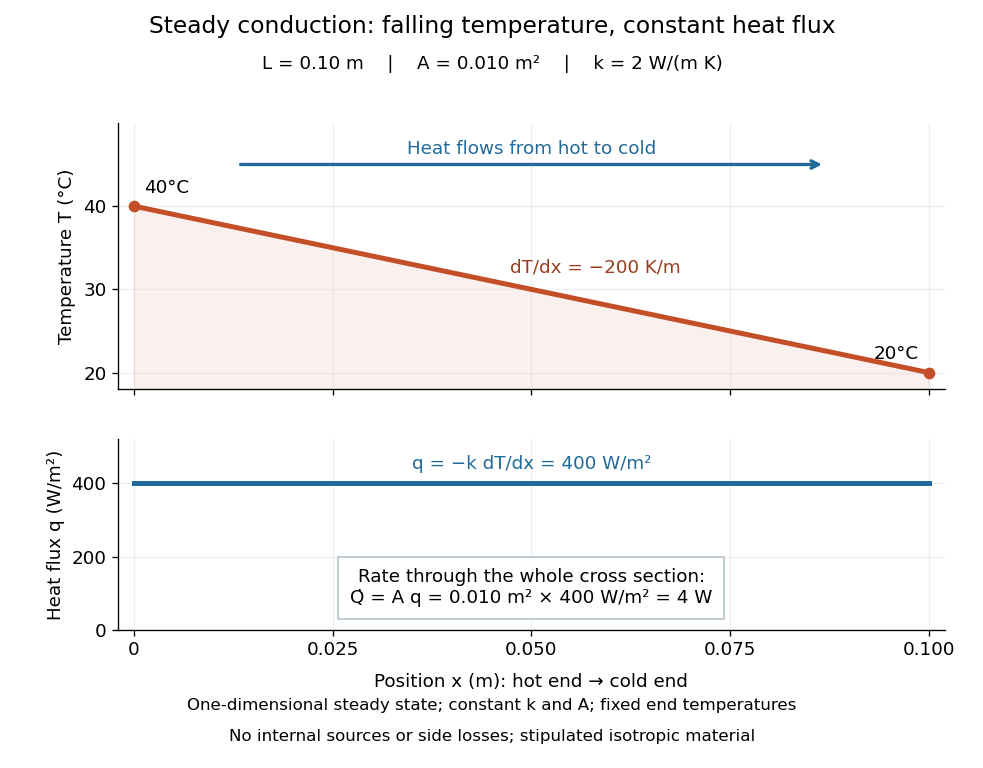
The general solution under these assumptions isA proof outline is enough to explain the straight line: conservation of energy in any small slice, with no accumulation, sources or side losses, gives . Constant cross-sectional area gives ; constant thermal conductivity and Fourier's law then give . Two integrations and the end boundary conditions determine the displayed affine function. This is why a visually simple temperature profile can encode a continuous flow of energy. [ref]
https://web.mit.edu/16.unified/www/FALL/thermodynamics/notes/node117.html. E. M. Greitzer, Z. S. Spakovszky and I. A. Waitz, MIT Thermodynamics and Propulsion, section 16.3: steady one-dimensional conduction
Doubling the length halves the rate, while doubling the cross-sectional area doubles it, at fixed end temperatures and thermal conductivity. This explains why a long narrow support can limit unwanted heat transfer, while a short broad path can help remove heat. Joining materials leads to thermal resistance in series. During initial warming, internal energy can accumulate and the temperature profile need not be a straight line; the time dependence is described by the heat equation and thermal diffusivity.
Now join two layers, each of length , with constant cross-sectional area and stipulated constant thermal conductivities and . Keep the outer ends at and . Assume a steady state, one-dimensional thermal conduction, no internal sources or side losses, and perfect contact: the temperature is continuous at the interface, with no extra contact drop. For each layer, use the area-specific thermal resistance and . The series calculation gives
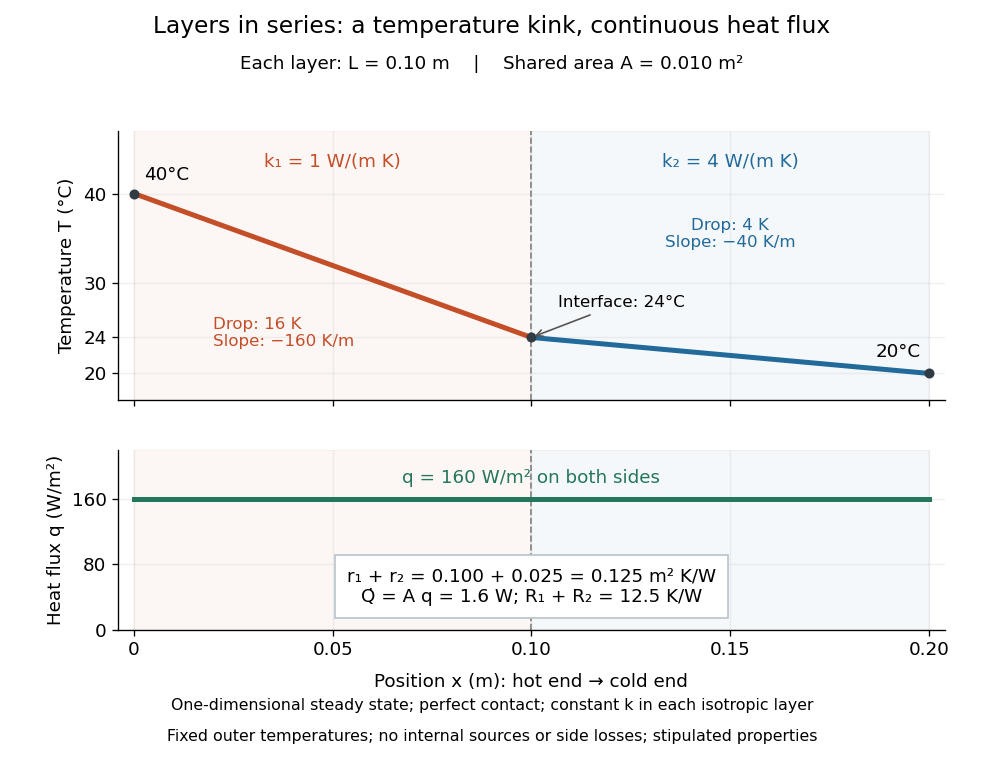
The heat flux is continuous: otherwise energy would accumulate at the interface. Yet Fourier's law gives different temperature gradients, and . Lower thermal conductivity requires a steeper temperature gradient to carry the same heat flux; equal lengths therefore give drops in the ratio . A kink in the temperature profile records the change of material while perfect contact keeps the temperature itself continuous.
The temperature gradient is the gradient of the temperature field. It points in the direction of fastest temperature increase.
Thermal conductivity is the positive material coefficient in Fourier's law. It may depend on temperature, composition, and direction.
Thermal diffusivity is , the ratio of thermal conductivity to volumetric heat capacity. It sets the diffusion length over time .
The Prandtl number is the ratio of kinematic viscosity to thermal diffusivity. It compares the rates at which momentum and temperature variations diffuse. In thermal-diffusion units the Boussinesq equations have momentum inertia multiplied by ; large, rather than small, Prandtl number supplies the usual instantaneous Stokes flow limit.
The thermal diffusion time across a distance is , where is the thermal diffusivity. It is the time required for a temperature disturbance to spread over that distance by thermal conduction.
The Stefan–Boltzmann law gives the thermal-radiation flux emitted by a surface as , where is its emissivity and is the Stefan–Boltzmann constant.
The Stefan-Boltzmann constant is the proportionality constant in the blackbody flux . The blackbody radiation pressure is .
Emissivity is the ratio of the thermal radiation emitted by a surface to that emitted by an ideal black body at the same temperature.
A body is in radiative equilibrium when absorbed radiative power equals emitted radiative power. A surface absorbing flux and emitting as a grey body has equilibrium temperature .
Heat capacity measures the heat supplied per small temperature increase along a specified process:The subscript records the constraint, such as fixed volume or fixed pressure. The units are . The symbol emphasizes that heat is a transfer along a path, rather than a state function with a differential . Consequently, an unspecified heat capacity does not determine the required heat.
For a closed system of fixed composition undergoing a quasistatic process, assume that only pressure-volume work occurs, with no friction and no change in bulk kinetic energy or potential energy. The first law of thermodynamics and , where is internal energy and is enthalpy, then giveThese partial derivatives define heat capacity at constant volume and heat capacity at constant pressure, with the amount and composition also held fixed. Integrating along the selected constraint gives within a single thermodynamic phase; requires constant . [ref]
For a computed example, take a monatomic gas in the classical ideal gas regime, with amount of substance and stipulated molar gas constant . The equipartition theorem gives , and the ideal gas law gives . ThusFor the same temperature increase , the two processes requireHere work done by the gas is positive. At fixed pressure, the extra heat supplies expansion work; the internal energy increase is the same because internal energy of an ideal gas depends only on temperature. Their final volume values differ. [ref]
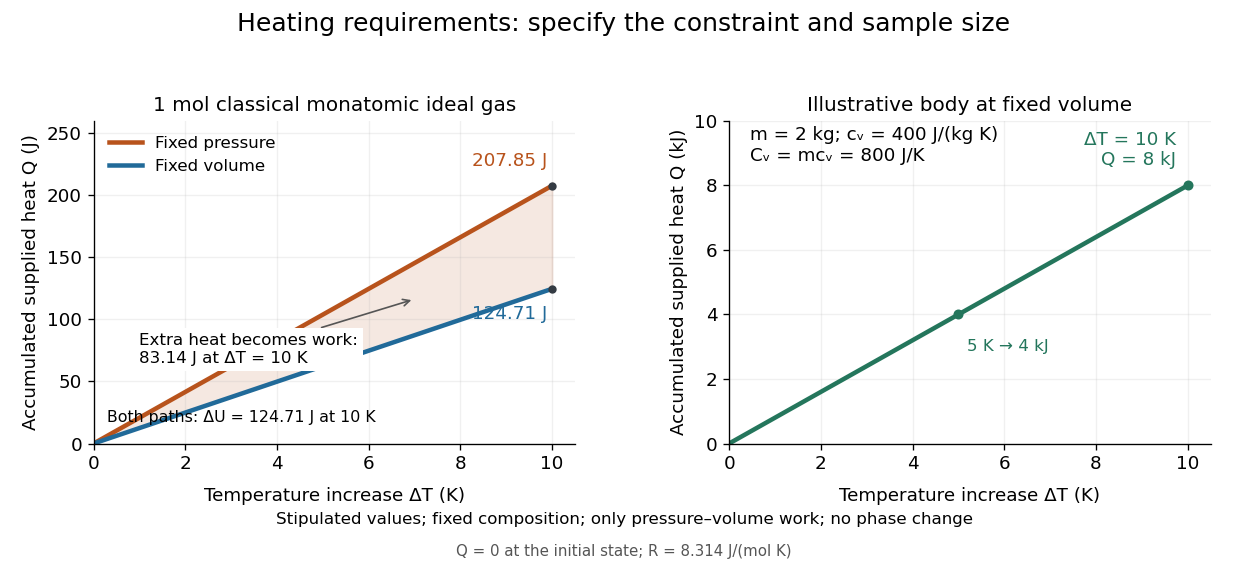
Required heat depends on the constraint and the amount of material
. Left: one mole of classical monatomic gas with the stipulated molar gas constant above; the shaded difference is expansion work at fixed pressure. Right: the illustrative fixed-volume body from specific heat capacity, with mass and . Each curve starts at zero accumulated heat, rather than zero absolute internal energy. Details.The practical value of heat capacity is that a measured heat input and temperature response can determine it. Once its constraint and temperature dependence are known, it predicts heating requirements and supplies entropy changes through entropy from heat capacity. [ref]
https://davidtong.org/teaching/statistical-physics/statmechhtml/S1. Tong, Statistical Physics, heat capacity as a measurable response
Along a reversible path at fixed volume, . Hence entropy differences can be measured macroscopically fromwith an additional across a first-order transition of latent heat at .
For a thermodynamically stable system, the entropy is concave in energy, soConsequently : energy increases with temperature, and the corresponding heat capacity is positive.
Specific heat capacity is heat capacity per unit mass:Its units are , and the constraint remains part of the definition. In particular, specific heat capacity at constant volume and specific heat capacity at constant pressure are different responses. For homogeneous material, doubling the mass doubles its heat capacity while leaving its specific heat capacity unchanged. [ref]
As an illustrative material model, give a fixed-volume body mass and constant specific heat capacity at constant volume . With no phase transition and no other work, increasing its uniform temperature by requiresThese stipulated values describe no measured substance. The right panel of the diagram in heat capacity shows the straight line : a temperature increase of takes of heat. If the specific heat capacity at constant volume depends on temperature, use instead. The corresponding fixed-pressure calculation uses specific heat capacity at constant pressure and gives under the assumptions in heat capacity.
Choosing between specific heat capacity, molar heat capacity and volumetric heat capacity is choosing whether to compare equal mass, equal amount of substance or equal volume. A small sample with large specific heat capacity can still have less total heat capacity than a much larger sample.
The specific heat capacity at constant volume is the temperature derivative of specific internal energy at fixed density and composition: . It is the corresponding extensive heat capacity at constant volume divided by material mass.
The specific heat capacity at constant pressure is , where is specific enthalpy. It includes expansion work as well as the change in internal energy.
For pure blackbody radiation, depends only on temperature. Constant pressure therefore fixes temperature, so a usual finite constant-pressure temperature derivative is unavailable. In the material gas-radiation limit the specific-heat ratio diverges, although all three stellar adiabatic exponents approach . The radiation index is an adiabatic pressure-volume response, not a finite heat-capacity ratio.
For a fixed-composition closed system, the heat capacity at fixed volume is , with internal energy . Under the quasistatic process assumptions in heat capacity, only pressure-volume work is permitted, so gives . A rigid vessel therefore needs , or when is constant. Its per-unit-mass counterpart is specific heat capacity at constant volume.
In the classical high-temperature limit, each independent harmonic mode contributes to the constant-volume heat capacity.
For a two-dimensional system of fixed area , the heat capacity at constant area is when the particle number and other conserved quantities are also fixed. It is the two-dimensional analogue of heat capacity at constant volume.
Articles by others on the same topic



Heat is a form of energy that is transferred between systems or objects with different temperatures, occurring spontaneously from the hotter object to the cooler one. It is a crucial concept in the field of thermodynamics and is associated with the motion of particles within a substance.