Solution
ID: past-exam-of-the-probability-course-of-the-university-of-oxford/2015/2/a/ii/solution
Past exam of the probability course of the University of Oxford 2015 2 a ii Solution by  Codex 0 2026-10-31
Set . In polar coordinates, the event is , the angular sectorBecause has the continuous uniform distribution on an interval of length , the probability is the sector's angular length divided by :The symmetry of the standard normal distribution in makes the lower sector equally likely. Their disjoint union is , apart from , an event of probability zero. Therefore the requested cumulative distribution function isThis is the unit-scale half-Cauchy distribution. At there is no atom, and as the cumulative distribution function tends to one.
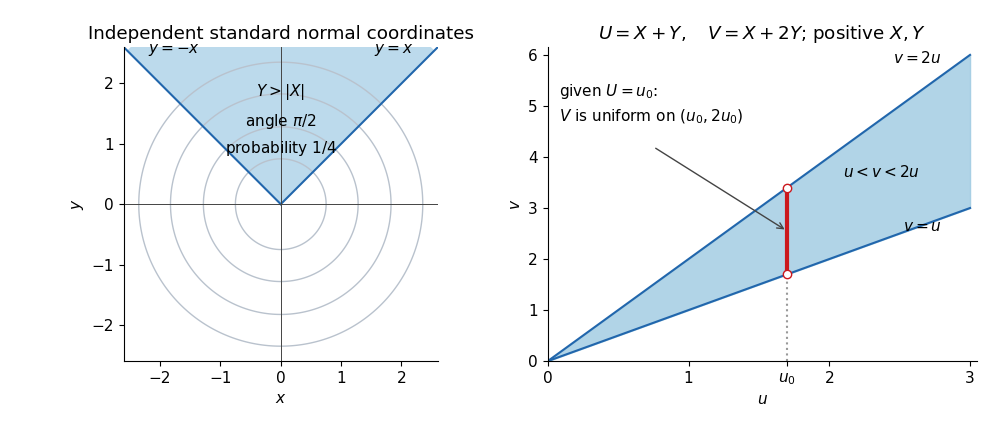

The left panel uses , giving a sector of angle and probability . The right panel displays the domain for the next change of variables for probability densities; a vertical section through it determines the conditional range.
New to topics? Read the docs here!