The standard normal distribution is : the normal distribution with mean zero, variance one and standard deviation one. Its standard normal density integrates to one; its standard normal distribution function records the area accumulated from to a threshold. The distinction matters: , , and for a standard normal random variable .
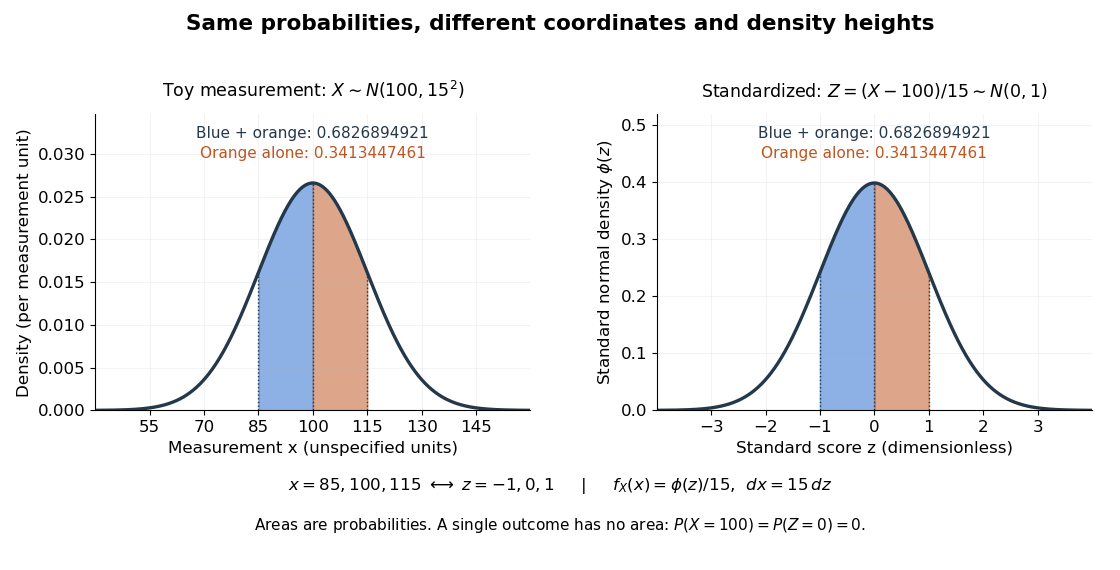
For a toy measurement , leave the measurement unit unspecified. The standardization of a normal random variable converts into standard scores . Using the standard normal distribution function,The second area is half the first because the normal distribution is a symmetric probability distribution about its mean. The numerical heights differ: , yet the corresponding shaded areas are equal because in the change of variables.

Completing the square in the standard normal density gives . Differentiating at zero yields , , and .
For with a standard normal distribution and , split the Gaussian integral at zero and complete the square to obtain , where is the standard normal distribution function. This converts a bound on an absolute Gaussian random variable into a two-sided Gaussian tail bound using Markov inequality.
The standard normal distribution function is the cumulative distribution function of a standard normal random variable :Here is the standard normal density and is the error function. The symmetric probability distribution gives and , while differentiation gives . For with , standardization of a normal random variable gives ; subtracting two values calculates an interval probability.
If with , then has the standard normal distribution. The change-of-variables formula for a probability density gives , the standard normal density. Thus standardization of a normal random variable removes both parameters without changing the probabilities of corresponding events.
Articles by others on the same topic
There are currently no matching articles.