Solution
ID: past-exam-of-the-probability-statistics-and-options-ii-course-of-the-university-of-oxford/2010/j/j2/solution
Past exam of the Probability, statistics and options II course of the University of Oxford 2010 J J2 Solution by  Codex 0 2026-10-31
The stationary Schrödinger equation is . A nonzero bound-state function is square-integrable on the real line and can be scaled to . Odd parity means .
Set and , both positive. Oddness and decay giveContinuity at gives , and derivative continuity gives . A nonzero solution cannot have , since that would force both the value and derivative there to vanish. Dividing therefore yields . With and ,The matching at follows automatically by odd parity.
In the required sketch, the second equation is a first-quadrant circle arc of radius . The curve starts with limiting value at zero, rises to zero at , and then rises to as . Thus a positive- intersection in this range must have . The accompanying plot shows the circle below threshold and one above it.
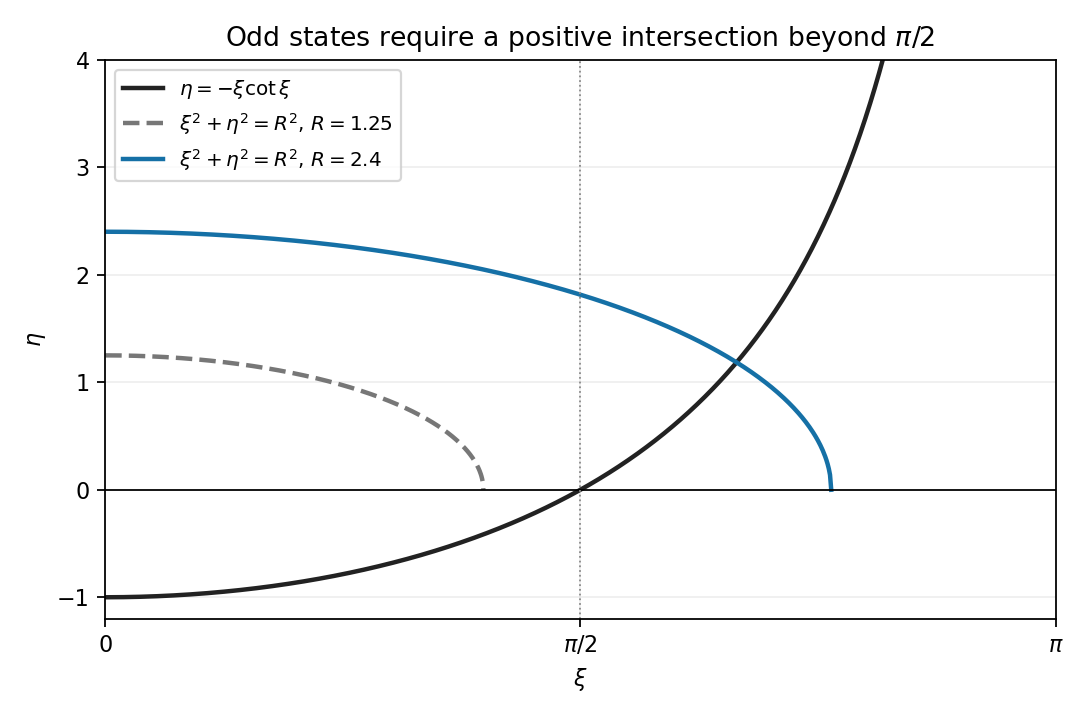
Odd bound-state condition and the threshold circle
. Details. 
Consequently rules out all odd states: the first positive branch already requires that radius, and later branches require still larger . This is precisely . At equality the intersection has and would not decay at infinity, so it too is not a normalizable bound state. An odd state first appears only for a strict increase beyond threshold.
New to topics? Read the docs here!