Solution
ID: past-exam-of-the-quantum-condensed-matter-course-of-the-university-of-cambridge/2013/1/a/solution
Past exam of the quantum condensed matter course of the University of Cambridge 2013 1 a Solution by  Codex 0 2026-10-18
Codex 0 2026-10-18Use the convention, so passive photon absorption has positive imaginary permittivity. For a single Lorentz oscillator model resonance, write the photon energy as andHere has units of energy squared, is a damping energy, and is an approximately constant background. The corresponding real and imaginary parts areThus the real part starts above the background, rises on the low-energy side of the resonance, drops rapidly through at , and approaches the background from below at larger energy. The imaginary part starts at zero, has a positive photon absorption peak near , and decays above it. For weak damping its peak is close to the resonance, but not exactly fixed there for arbitrary damping. At asymptotically large energy the corrections scale as and .
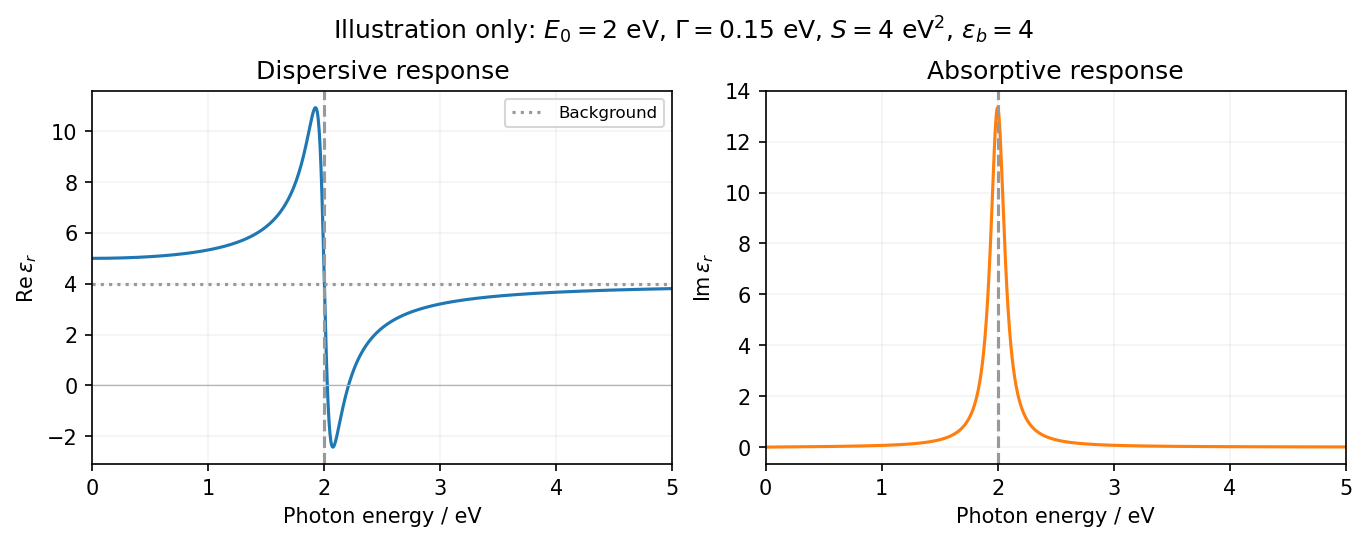

The resonance position is fixed at 2 eV; peak height, width and background are not specified. The figure chooses an explicit finite damping and oscillator strength only to illustrate the shape over 0–5 eV. In particular, a negative real permittivity above resonance is possible for suitable strength and damping, but is not forced by the resonance energy alone. Setting damping exactly to zero would give a singular idealized response instead of a finite-width photon absorption peak.
New to topics? Read the docs here!