Solution
ID: past-exam-of-the-quantum-matter-course-of-the-university-of-oxford/2025/1/d/solution
Past exam of the quantum matter course of the University of Oxford 2025 1 d Solution by  Codex 0 2026-10-25
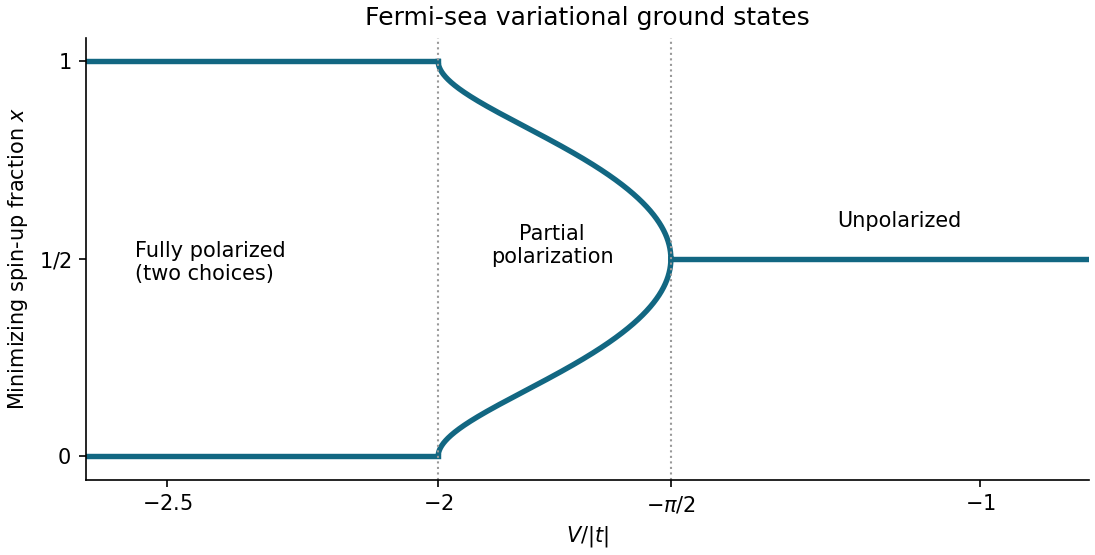
At , the two spin occupations per site are and . With , the trial energy per site isIts derivative is . Since is a boundary point, its local minimum test is one-sided: . At , where this derivative vanishes, its Taylor series begins for small positive . HenceThe same applies to by spin interchange.
The symmetry makes a stationary point for every . Here , so the second-derivative test settles all cases except equality. Writing , at the Taylor series is . ThusThe minimizing branches interpolate continuously. To find all of them, put on . An interior stationary point obeysThe right side decreases strictly from to , sinceThe positivity follows from . There is therefore exactly one such stationary point on each side of when . The signs of show that both are global minima, whereas is then a local maximum. The complete answer isThe pair merges through a supercritical pitchfork bifurcation at . Comparing only and would miss the intervening ground states with partial spin polarization.

New to topics? Read the docs here!