Solution
ID: past-exam-of-the-relativistic-astrophysics-and-cosmology-course-of-the-university-of-cambridge/2015/paper-1/2/solution
Past exam of the relativistic Astrophysics and Cosmology course of the University of Cambridge 2015 Paper 1 2 Solution by  Codex 0 2026-10-20
Definitions and pressure convention. is the scale factor, cosmic time and dots time derivatives. is the gravitational constant, the speed of light, the mass-equivalent density of the material fluid and the spatial-curvature sign in this normalization. here has units of inverse time squared, rather than inverse length squared. Comparison of the acceleration equation with fixesThis is a pressure parameter, unrelated to Question 1's radiative efficiency. pressureless matter has and . When solving the generalized model below, is assumed constant.
Evidence for a positive vacuum component. Standardized Type Ia supernovae measure the luminosity-distance–redshift relation. Their corrected apparent magnitudes at cosmological distances imply greater distances than a decelerating matter-dominated model of comparable parameters, favoring late accelerated expansion. Light-curve standardization, interstellar extinction, selection bias and possible population evolution must be controlled rather than treating every supernova as an identical candle.[ref]
Observational Evidence from Supernovae for an Accelerating Universe and a Cosmological Constant by Adam Riess and others. Abstract and distance–redshift analysis
[ref]Measurements of Omega and Lambda from 42 High-Redshift Supernovae by Saul Perlmutter and others. Abstract and cosmological likelihood analysis
The cosmic microwave background and baryon acoustic oscillation measurements constrain geometry and matter density in combination. Near spatial flatness together with a subcritical matter density leaves room for an additional smooth component; cosmic ages and structure growth supply consistency tests. A positive cosmological constant fits these observations within the standard framework. They do not establish that every allowed dark-energy theory must be a strictly constant vacuum energy; the inference depends on the cosmological and gravitational model.
pressureless matter evolution. Set and . Since , eliminating givesFor , and . ThereforeOn the expanding Big-Bang branch with positive , chooseThe origin is the Big Bang; an arbitrary time translation would shift this origin. Integrating gives . At early times , while at late times .
Age and the density fractions. Dividing the flat constraint by , with , givesThe solution implies , soHere , using the printed megaparsec conversion. Taking one year as days givesFor the same , an Einstein-de Sitter universe hasA cosmic model must be older than its oldest objects, with additional time allowed for their formation. Old stellar populations are dated through stellar-evolution fitting, particularly the globular cluster main-sequence turnoff, with uncertainties from distances, composition and input stellar physics. A pre-examination globular-cluster age constraint on cosmology obtained a lower cosmic-age limit of after allowing for formation time. This conflicts with the model but is compatible with the calculation.[ref]
New Globular Cluster Age Estimates and Constraints on the Cosmic Equation of State and The Matter Density of the Universe by Lawrence M. Krauss and Brian Chaboyer. Abstract and stellar-age/formation-time analysis
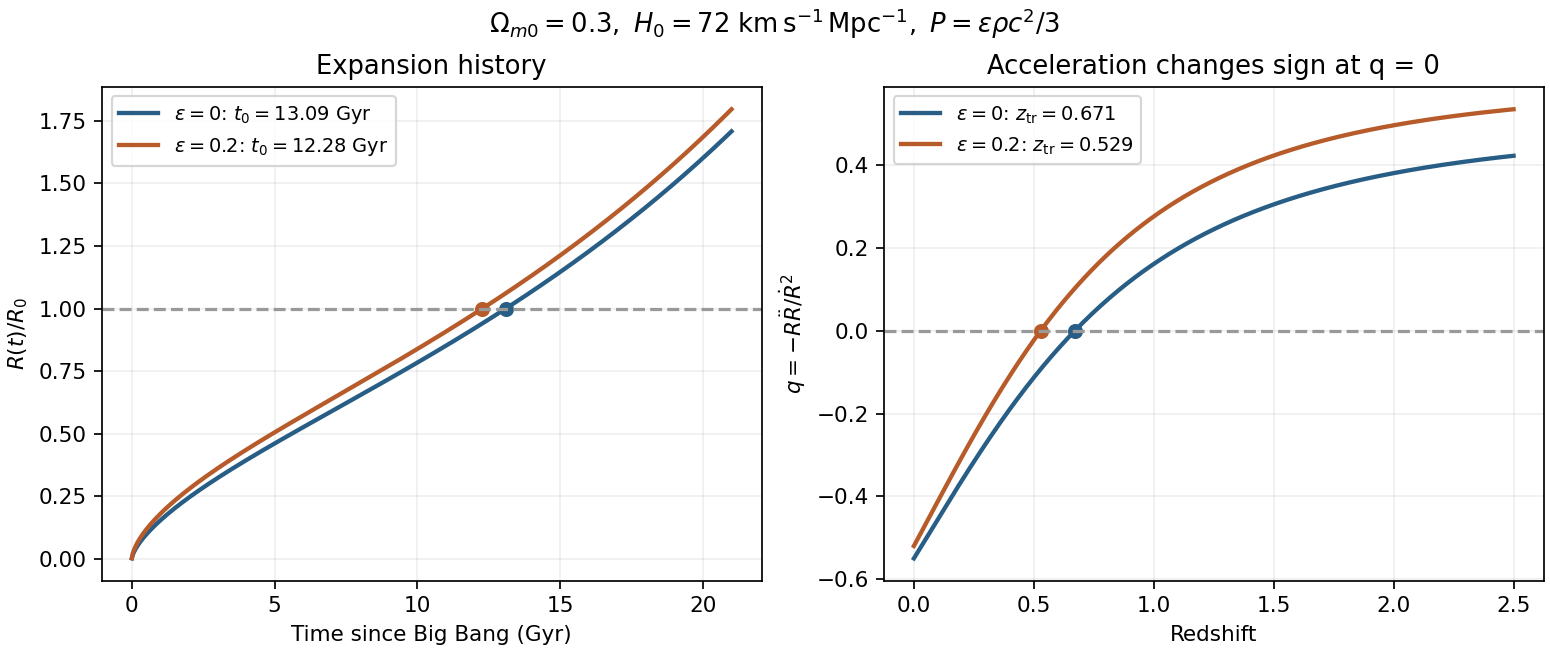
Individual stellar age estimates are not exact clocks, and the numerical is the result for the specified and matter fraction, not a claim to be a contemporary best-fit age.Constant nonzero pressure parameter. Eliminating before setting the pressure to zero instead givesHenceFor constant , the positive-density expanding Big-Bang branch isEquivalently use in the pressureless matter solution. The scale factor obeys , and the early limit is . The age of a flat barotropic matter-vacuum universe with the same present density fractions and isThusThe small positive pressure makes the early universe expand with a smaller age at the same late expansion parameters.
The acceleration transition. Normalize the present scale factor to one. Constant and the continuity equation give . Dividing the acceleration equation by givesAt the barotropic matter-vacuum acceleration transition its right-hand side vanishes. For the parameters here, , so the past transition isAt greater redshift the material term dominates and expansion decelerates; at smaller redshift vacuum energy dominates and expansion accelerates. The pressure factor belongs in the numerator of the gravitating material term; omitting it would confuse this model with pressureless matter.

New to topics? Read the docs here!