Solution
ID: past-exam-of-the-relativity-course-of-the-university-of-cambridge/2015/paper-1/4/solution
Past exam of the relativity course of the University of Cambridge 2015 Paper 1 4 Solution by  Codex 0 2026-10-20
Put , where , and work in the orbital plane. A dot denotes an affine-parameter derivative; for a material particle choose that parameter to be proper time.
First integrals and normalization. The geodesic Lagrangian isTime translation and axial rotation make and cyclic, givingThe tangent norm is constant along an affine geodesic because the Levi-Civita connection preserves the metric. ThereforeFor proper-time parametrization of a timelike worldline this norm is . For a null geodesic it is zero, for every affine normalization. Thus for the chosen material-particle normalization and for light. Proper time cannot itself parametrize a null ray, despite the same printed symbol being used for its affine parameter.
Null normalization and impact parameter. Under with , both and scale as , while the null path is unchanged. Their ratio is invariant. At large radius the spatial speed with respect to asymptotic time is , and orbital angular momentum per affine tangent givesFor an orientation chosen with , this is . Setting is a choice of affine scale, not a claim that all photons have equal measured energy. Once a tangent is identified with a physically normalized four-momentum, its energy fixes that scale.
Orbit shape. Substituting the constants in the norm and multiplying by givesFor and , . HenceThe radial orbit must be treated with the radial equation, because azimuth is then constant.
Circular photons and stability. For a null ray define . Its radial equation becomesThe circular orbit requires and , soIt is at a maximum of the null effective potential and is unstable. Equivalently the Binet equation linearizes about to , admitting exponentially growing radial deviations in azimuth.
Capture from infinity. Divide the null radial equation by . The quantity opposing inward motion is , whose exterior maximum is . There is no outer radial turning point precisely whenAt equality an exactly critical ray from infinity asymptotes to the photon sphere; it does not cross the horizon at a finite affine parameter. Above the threshold an initially inward ray from infinity reaches an outer turning point and scatters. The radial case is also captured. These statements refer to inward rays launched from the asymptotically flat exterior, not arbitrary initial data inside the angular-momentum barrier.
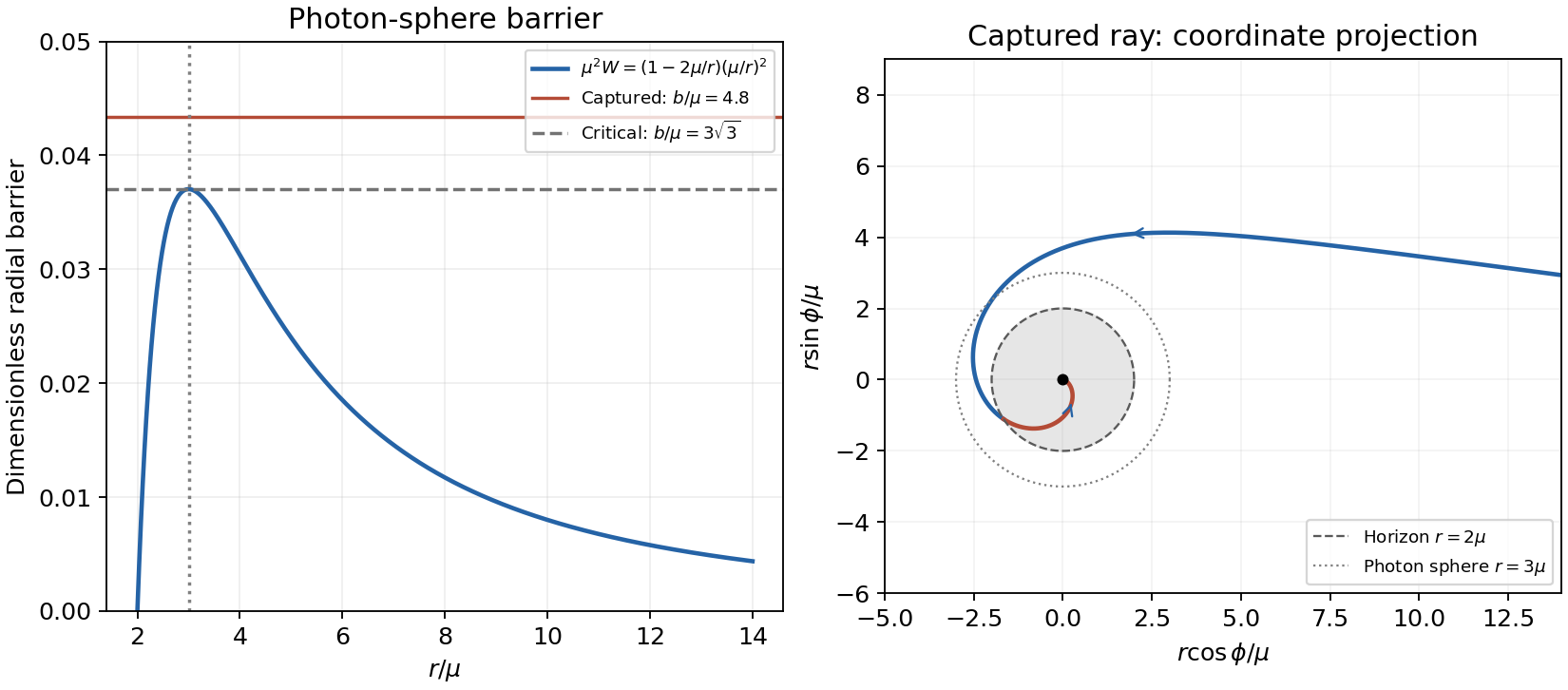
Original Schwarzschild capture calculation: the null-potential barrier and a captured equatorial ray crossing the horizon and ending at finite azimuth
. Details. 
Approach to the singularity. A captured nonradial ray bends inward, crosses and then the event horizon , and continues toward the curvature singularity. A plot in is only a coordinate projection, not a Euclidean spatial slice inside the horizon. For large the cubic term in the shape equation dominates:for the inward branch with . Its integral isThus the azimuth tends to a finite limit at the singularity, rather than winding infinitely often there. Near-critical rays can accumulate many turns near before capture, which is a separate phenomenon. A strictly radial ray has constant azimuth and does not admit this azimuthal asymptotic form. The radial equation also gives for a nonradial null ray, confirming finite remaining affine parameter.
Material capture and the condition at infinity. To recover the quoted threshold, take the usual marginally bound orbit, initially at rest at infinity: . With ,The turning-point quadratic has discriminant . It is positive for large and has no real positive root when , while the radial case also falls in. ThereforeAt equality the quadratic is proportional to and the orbit asymptotes to the unstable marginally bound circular orbit at . For larger , an incoming marginally bound particle encounters the outer turning point and scatters.
The source says only “from infinity”, without explicitly fixing the asymptotic speed. For a general incoming speed , andThe same bound remains sufficient for capture, since the added constant is nonnegative. It is the exact threshold only for . At fixed , the critical unstable orbit satisfiesThen . This states both the printed sufficient condition and the additional assumption needed to call it a sharp capture boundary.
New to topics? Read the docs here!