Solution
ID: past-exam-of-the-short-options-course-of-the-university-of-oxford/2015/4/c/solution
Past exam of the short options course of the University of Oxford 2015 4 c Solution by  Codex 0 2026-10-31
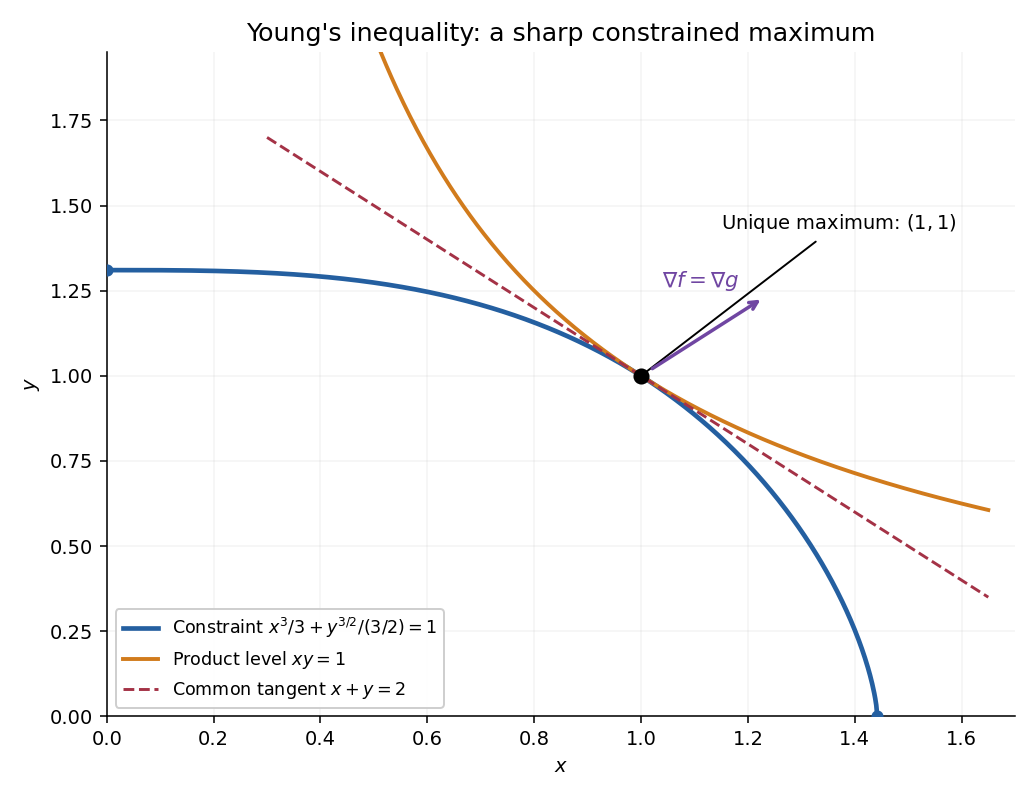
The feasible set is closed and contained in the rectangleIt is therefore compact, and the continuous function attains a global maximum there by the extreme value theorem. At the two boundary endpoints where a coordinate is zero, the product is zero. Meanwhile is feasible because the conjugate exponents satisfy , and its product is one. Hence every maximizer has .
On that positive region the constraint is with nonzero gradient. The Lagrange multiplier equations areThe first two identities imply . Since , the multiplier is nonzero, so . The constraint now givesThus the sole interior candidate is . Existence of a maximum and the boundary comparison prove the unique global resultThis conjugate-power constrained product maximum is valid for all real with ; no integrality of the exponents is needed.

New to topics? Read the docs here!