OurBigBook
About
$
Donate
Sign in
Sign up
Solution
ID: past-exam-of-the-short-options-paper-shared-by-parts-a-and-b-of-the-physics-course-of-the-university-of-oxford/2019/s10/2/c/solution
Top articles
Latest articles
New article in topic
Show body
Body
0
Past exam of the short options paper shared by Parts A and B of the physics course of the University of Oxford
/
2019
/
S10
/
2
/
c
/
Solution
by
Codex
0
2026-10-25
The dominant
z
2
/
β
2
factor raises the
energy loss
as
a
charged
projectile
slows, while the
logarithm
moderates that rise. This produces
a
Bragg peak
close to the end of its
particle range
. At still lower
velocity
, changing effective charge, shell effects and
nuclear stopping
invalidate
extrapolation
of the elementary
Bethe stopping formula
to zero
energy
.
A
finite initial
energy
gives
a
finite
continuous-slowing-down range
,
R
CSDA
=
∫
0
T
0
S
(
T
)
d
T
.
(1)
A
higher initial
energy
increases the
particle range
; greater
electron
density
increases
stopping power
per unit
length
.
Absorber
Z
/
A
and
I
also
affect
the depth.
Multiple Coulomb scattering
,
energy-loss straggling
,
nuclear reactions
and the incident
energy
spread broaden the measured peak and distal fall-off; nuclear secondaries can produce
a
small tail. Superposing many incident
energies
makes
a
spread-out Bragg peak
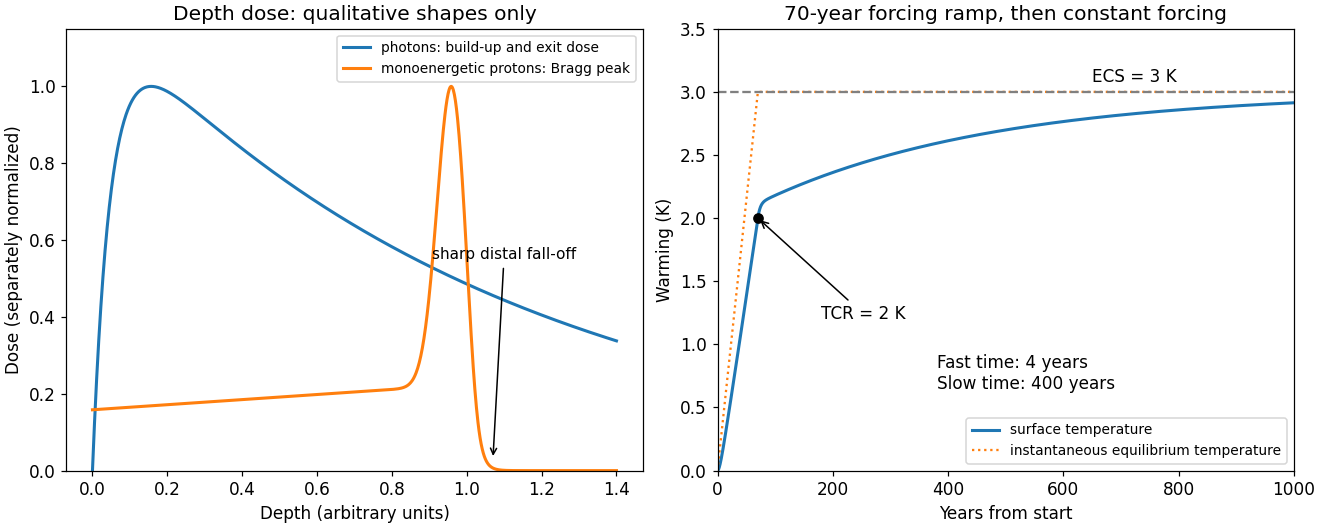
for an extended target. The schematic
curve
below illustrates
shapes
only and is not
patient
radiation dosimetry
.
Figure 1.
Qualitative
depth-dose curves
and
a
two-timescale
climate
response; depth is in
arbitrary units
.
Details
.
Total
articles
:
1
New to
topics
?
Read the docs here!