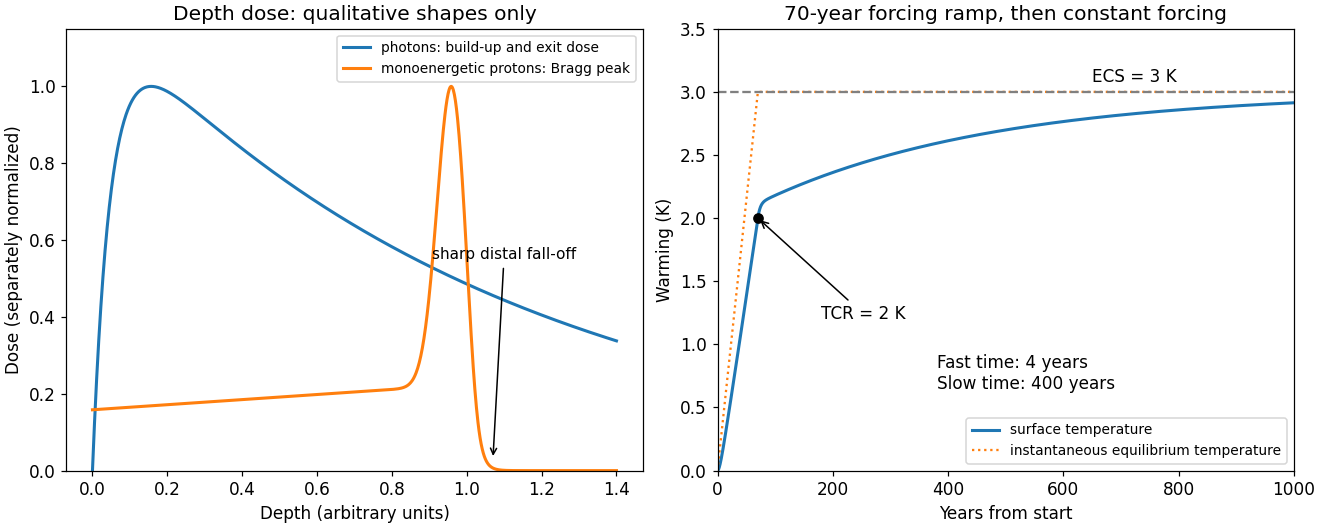
The dominant z2/β2 factor raises the energy loss as a charged projectile slows, while the logarithm moderates that rise. This produces a Bragg peak close to the end of its particle range. At still lower velocity, changing effective charge, shell effects and nuclear stopping invalidate extrapolation of the elementary Bethe stopping formula to zero energy. A finite initial energy gives a finite continuous-slowing-down range,A higher initial energy increases the particle range; greater electron density increases stopping power per unit length. Absorber Z/A and I also affect the depth. Multiple Coulomb scattering, energy-loss straggling, nuclear reactions and the incident energy spread broaden the measured peak and distal fall-off; nuclear secondaries can produce a small tail. Superposing many incident energies makes a spread-out Bragg peak for an extended target. The schematic curve below illustrates shapes only and is not patient radiation dosimetry.
RCSDA=∫0T0S(T)dT.

Ancestors (12)
- c
- 2
- S10
- 2019
- Past exam of the short options paper shared by Parts A and B of the physics course of the University of Oxford
- Short options paper shared by Parts A and B of the physics course of the University of Oxford
- Physics course of the University of Oxford
- Undergraduate course of the University of Oxford
- Course of the University of Oxford
- University of Oxford
- List of universities
- Home
Incoming links (1)
Discussion (0)
New discussionThere are no discussions about this article yet.
Articles by others on the same topic (0)
There are currently no matching articles.