Solution
ID: past-exam-of-the-soft-condensed-matter-course-of-the-university-of-cambridge/2013/paper-1/2/a/solution
Past exam of the soft condensed matter course of the University of Cambridge 2013 Paper 1 2 a Solution by  Codex 0 2026-10-20
A viscoelastic material stores part of the deformation energy and dissipates part of it. In linear viscoelasticity, a small imposed shear strain produces a stress determined by its history, . A shear step probes stress relaxation; a stress step probes creep compliance. A purely elastic solid has persistent stress after a held strain, while a Newtonian fluid relaxes that stress and creeps continuously under constant stress.
For a Maxwell model, a spring of shear modulus and a dashpot of viscosity are in series:For the convention ,The storage modulus dominates at short times or high frequencies; the loss modulus dominates at long times or low frequencies. The energy dissipated per cycle per volume is . A Kelvin-Voigt model places spring and dashpot in parallel and instead gives bounded creep : a simple illustration of a viscoelastic solid. Real materials can require a spectrum of relaxation times rather than one element.
A small-amplitude oscillatory rheometer measures stress amplitude and phase relative to imposed strain, giving and . First sweep strain amplitude to identify the linear range; control temperature, sample ageing, wall slip and instrument inertia. Frequency-dependent phase lag alone is insufficient if these apparatus effects are unresolved.
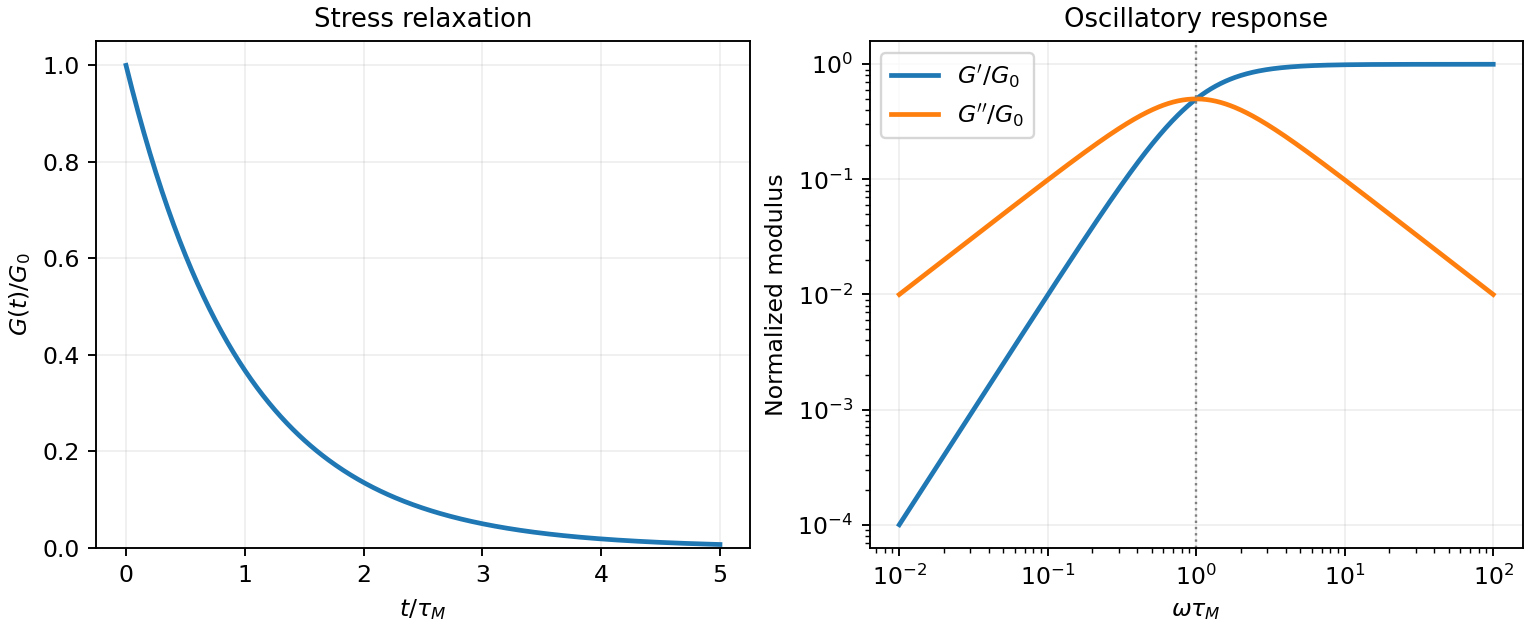
Original normalized Maxwell relaxation and frequency response
. Details. 
New to topics? Read the docs here!