Solution
ID: past-exam-of-the-soft-condensed-matter-course-of-the-university-of-cambridge/2014/paper-1/4/solution
Past exam of the soft condensed matter course of the University of Cambridge 2014 Paper 1 4 Solution by  Codex 0 2026-10-20
Balancing buoyant weight with Stokes drag givesThis needs isolated spherical particles, low Reynolds number and negligible wall corrections. The supplied settling measurement gives , hence . Its Reynolds number is about , consistent with the approximation.
Compare gravitational work over one radius with thermal energy, or use with . The gravitational Peclet number givesBelow this sedimentation-Brownian crossover radius Brownian motion dominates settling on the particle-size scale. It does not eliminate gravity: the sedimentation scale height is . For negligible concentration gradients across a sample height , the stronger condition is . No universal permanently nonsedimenting size follows without a length/time criterion.
Brownian encounters bring small particles into contact; van der Waals attraction can then bind them. Surface charge can create a repulsive barrier through Debye screening of colloid repulsion. For a monovalent salt reservoir with number density of each ionic species, Poisson–Boltzmann theory hasFor , linearization gives , with . If instead means total ion density, the factor two is absent. The planar potential decays as ; a sphere has an additional factor. This mean-field approximation neglects specific adsorption, ion correlations and finite ion size.
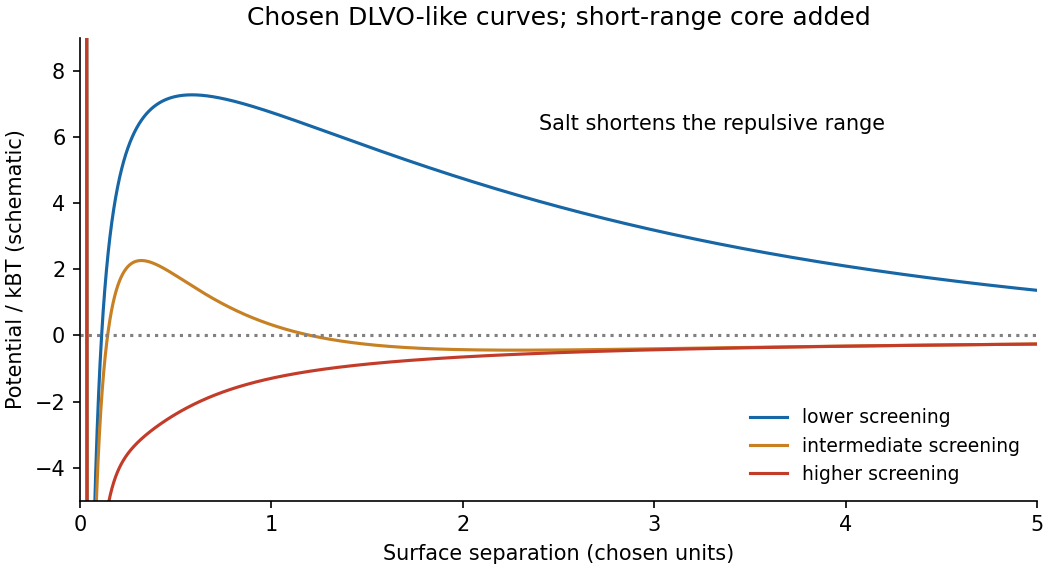
DLVO theory adds screened repulsion to dispersion attraction. At small surface separation for equal spheres of radius , a useful schematic form iswith a short-range repulsive core needed outside the continuum model. Low salt can leave a barrier many times , giving kinetic stability. Higher salt shortens the repulsion and can lower or remove the barrier, allowing coagulation into a deep primary minimum. The primary and secondary DLVO minima have different consequences: a shallow secondary minimum permits looser, sometimes reversible aggregation. The surface boundary condition affects ; screening length alone is not a complete measured interaction law. Non-DLVO hydration or steric forces can matter at contact.

New to topics? Read the docs here!