Solution
ID: past-exam-of-the-soft-condensed-matter-course-of-the-university-of-cambridge/2015/paper-1/2/c/solution
Past exam of the soft condensed matter course of the University of Cambridge 2015 Paper 1 2 c Solution by  Codex 0 2026-10-20
A viscoelastic material stores part of the work of deformation and dissipates part. In the linear regime its stress depends on the strain history, not just the instantaneous strain or shear strain rate. For simple shear, a causal relaxation modulus gives . A sudden strain then probes stress relaxation, while a constant imposed stress probes material creep; these are different experiments.
For steady sinusoidal strain use the convention and complex amplitudes. The complex viscoelastic modulus isso . The storage modulus is the in-phase elastic component. The loss modulus multiplies the component in phase with shear strain rate; stress leads strain by . The loss tangent is when .
Multiplying stress by shear strain rate and averaging gives . Hence the dissipated energy per oscillatory shear cycle isThe elastic contribution returns its work over the cycle. A passive material has nonnegative dissipation, which fixes the sign of the loss term in the chosen Fourier convention. This complex viscoelastic modulus is a response function, not the mathematical absolute value of a complex number.
A Maxwell model places a spring of shear modulus in series with a dashpot of viscosity , so the strains add at common stress:The Maxwell fluid dynamic modulus isAt the response is predominantly viscous, and . At it approaches the elastic plateau . The two moduli cross, and reaches its maximum, at . A Kelvin-Voigt model instead has the spring and dashpot in parallel, giving and no fluid-like zero-frequency terminal flow. Real materials often need a spectrum of relaxation times rather than one Maxwell time.
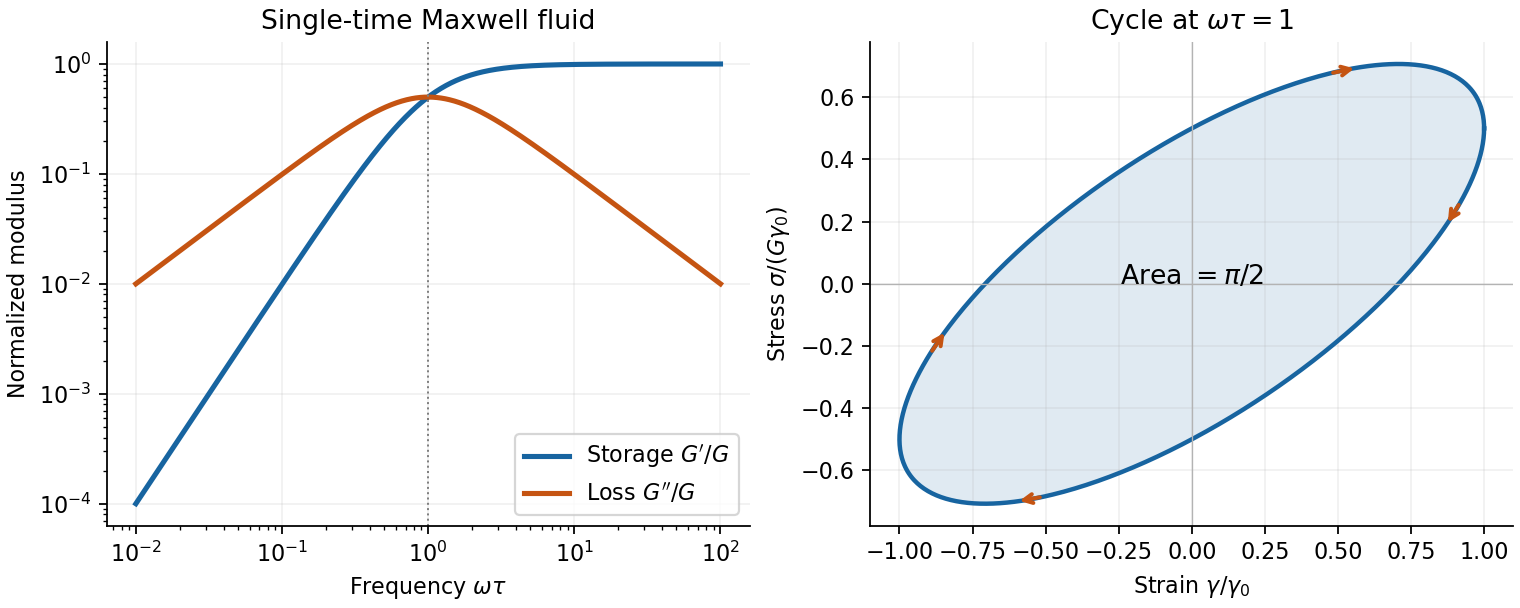
Original Maxwell storage and loss moduli, with a stress–strain cycle whose enclosed area measures dissipated work
. Details. 
Oscillatory rheometry measures stress amplitude and phase while imposing a small strain. An oscillatory-shear amplitude sweep first identifies a linear regime; an oscillatory-shear frequency sweep then measures and . Repeat at controlled temperature, suppress evaporation, check wall slip and sample aging, and correct instrument inertia at high frequency. Frequency-dependent structure and a nonlinear response cannot be inferred reliably by fitting one spring and dashpot to one point.
New to topics? Read the docs here!