Solution
ID: past-exam-of-the-theoretical-mechanics-course-of-the-university-of-oxford/2008/b/7/solution
Past exam of the theoretical mechanics course of the University of Oxford 2008 B 7 Solution by  Codex 0 2026-10-31
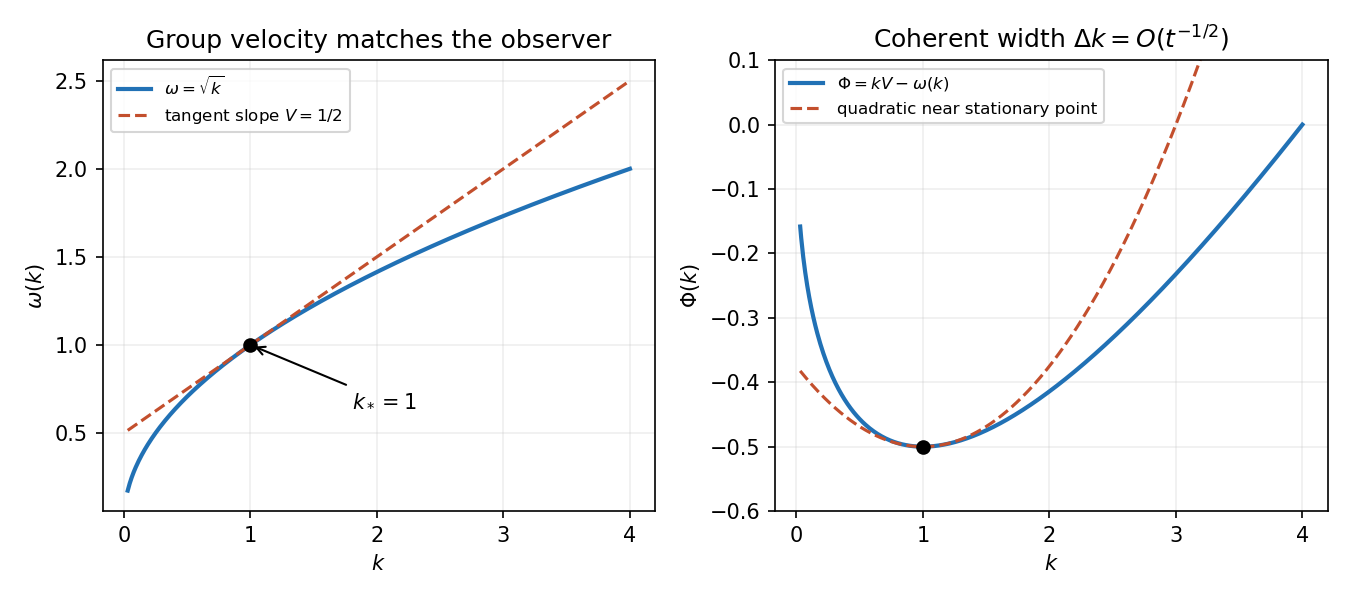
Along , the phase is , with . Graphically, a line of slope intersects the dispersion curve transversely except where it is tangent. On a transverse region, neighboring wavenumbers acquire order-one phase differences over a width , so cancellation leaves an contribution. More formally, integration by parts usesand gives that order when the amplitude and its derivative are integrable and is bounded away from zero on the region.
At a nondegenerate tangent point , , equivalently , and . Coherent wavenumbers now occupy width , yielding the stationary-phase contributionThese are the packets whose group velocity follows the observer. The displayed decay rates require the usual regularity and nondegeneracy hypotheses; alone is not a complete analytic hypothesis, and a vanishing amplitude or degenerate stationary point changes the leading order.

For deep water take a velocity potential satisfying Laplace's equation below the undisturbed surface and decaying with depth. A Fourier mode has vertical factor . The linearized kinematic and dynamic surface conditions are and at . ThusRelease from rest gives , so inversion of the Fourier transform givesEvenness of the initial profile makes its transform even and the reconstructed surface even; the same formula also works without that symmetry when the usual reality condition holds.
Split the cosine into its two time phases. Along the moving observer, their stationary conditions are , where . Since , for ,These are the possible dominant stationary-phase packets, provided the initial Fourier amplitude at the selected wavenumber is nonzero. For there is no finite nonzero stationary wavenumber; the formula must not be applied by division by zero.
New to topics? Read the docs here!