Solution
ID: past-exam-of-the-theoretical-physics-i-course-of-the-university-of-cambridge/2016/paper-1/4/b/solution
Past exam of the theoretical physics I course of the University of Cambridge 2016 Paper 1 4 b Solution by  Codex 0 2026-10-20
Differentiation gives . For the origin is the global minimum; for , has and . Therefore, close enough to the transition for the quartic expansion to apply,The order parameter approaches zero continuously with mean-field critical exponent : the transition is continuous. In the aligned phase a particular direction is chosen. The vector-spin rotation symmetry is spontaneously broken from to , or from to including reflections. The manifold of vector order parameter directions is a sphere, so this is not just a two-state sign choice.[ref]
Statistical Field Theory by David Tong. §4.2, Heisenberg model and the continuous set of ordered directions
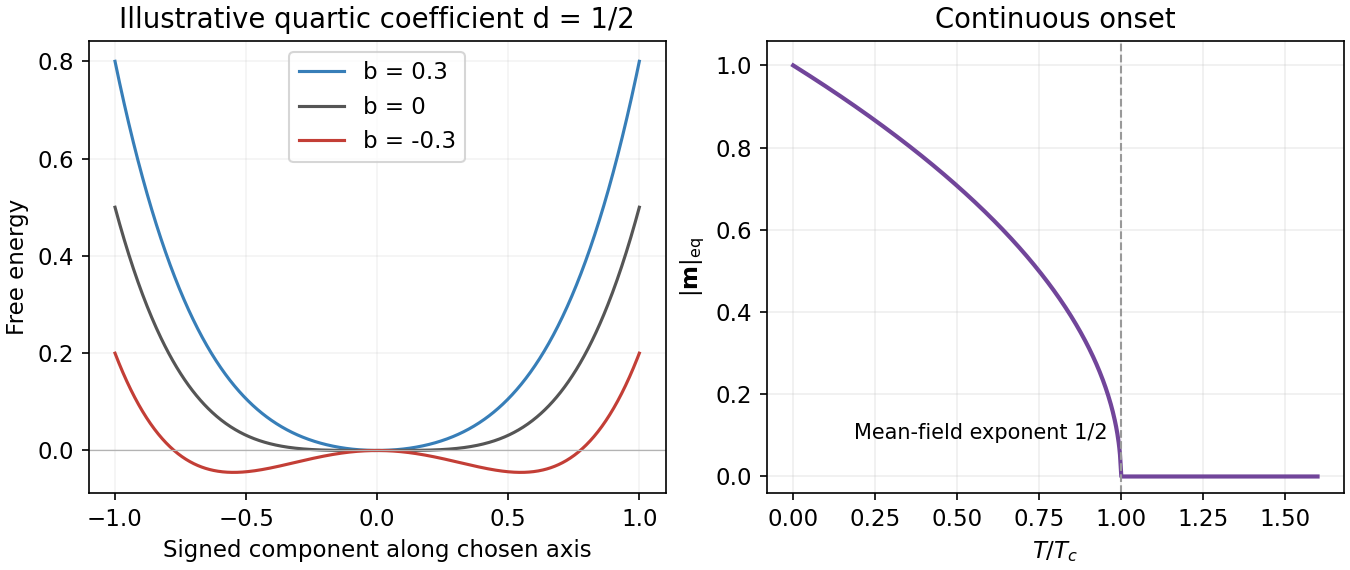

The plot uses illustrative and temperature measured in units of . A unit-spin average must satisfy ; if the quartic model is used literally far below the transition, its constrained minimum is . In practice the near-transition expansion is not a controlled prediction of deep low-temperature saturation. Also, a finite zero-field statistical ensemble that averages all directions has even below ; the curve describes the magnitude in a selected ordered state, obtained by appropriate boundary conditions or the thermodynamic limit before removing a small magnetic field.
New to topics? Read the docs here!