Solution
ID: past-exam-of-the-thermal-and-statistical-physics-course-of-the-university-of-cambridge/2012/paper-1/2/c/solution
Past exam of the thermal and statistical physics course of the University of Cambridge 2012 Paper 1 2 c Solution by  Codex 0 2026-10-20
Bose-Einstein condensation is macroscopic occupation of a single lowest-energy one-particle state. For a homogeneous three-dimensional ideal gas of conserved massive bosons, set that energy to zero. The excited-state population isHere . As , the excited states can hold only particles. Additional particles occupy the ground state. ThusThe isolated ground state must be counted separately from the continuum density of states; otherwise one misses the condensate. A dilute atomic gas is a physical realization of the quantum-degeneracy regime, but trapping geometry and interactions modify the homogeneous ideal-gas formulas.[ref]
Statistical Physics by David Tong. §3.5.3: saturation of excited states, separate ground-state occupation and ideal-gas condensation temperature
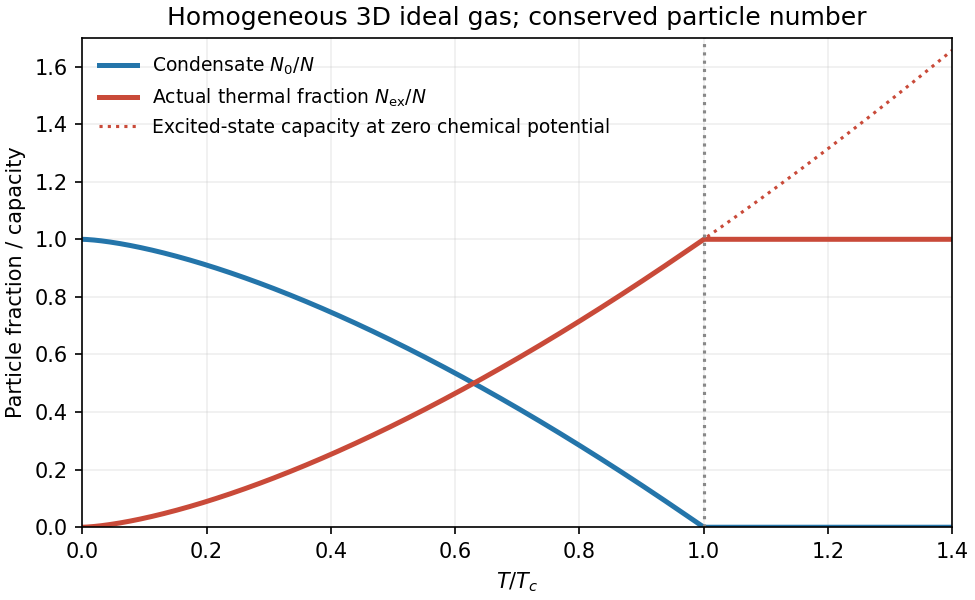
Ideal Bose condensate fraction
. Original homogeneous three-dimensional ideal-gas condensate fraction and maximum thermal population, normalized to the critical temperature. No trapped-gas or experimental data are implied. Details.
In the homogeneous ideal gas, one and two dimensions do not have finite-temperature condensation in the thermodynamic limit because the low-energy population integral diverges. Finite size or a trap changes that conclusion's assumptions. Condensation and superfluidity are distinct: the ideal quadratic gas has zero Landau critical velocity, while interactions can support a sound mode and superfluid flow. Neither zero viscosity nor phase-rigid flow follows from the occupation formula alone.
New to topics? Read the docs here!