Superfluidity is a quantum-fluid response with phase stiffness and flow without viscous dissipation in an appropriate low-speed regime. A superfluid supports a phase-gradient current; defects and excitations can limit that flow. Bose-Einstein condensation concerns macroscopic one-particle occupation and is a distinct criterion: the Gaussian phase stiffness theory can have divergent absolute-phase fluctuations while retaining a cost for gradients.
Why does cooling a liquid make it flow more freely through a tiny gap? Helium-4 supplies an experimental entrance to this question: the helium slit-flow experiment compares the motion of liquid levels on opposite sides of the transition into superfluidity. A flow measurement probes resistance to motion; a measurement of Bose-Einstein condensation probes occupation of a quantum state. The two-fluid model of superfluidity and the Landau criterion connect these questions to entropy transport and to the energy required to create an excitation.
Two weakly linked Bose-Einstein condensates form a bosonic Josephson junction. Their relative phase controls a particle current through the weak link, analogous to the pair current of a superconducting Josephson junction. For neutral reservoirs the phase evolution follows a chemical-potential difference rather than an electric voltage. Interactions can make the tunneling dynamics nonlinear, including self-trapping at sufficiently large imbalance.
Two weakly coupled condensates in a double-well potential realize one bosonic Josephson junction. The 2005 experiment measured the density distribution in situ and inferred the evolving relative phase from interference fringes. It distinguished tunneling oscillations from nonlinear suppression of large-amplitude transfer, called macroscopic quantum self-trapping.[ref]
A repulsive optical obstacle probes dissipation by being moved through a condensate. Heating as a function of speed tests low-speed flow stability; stationary-obstacle and thermal-cloud controls help separate other heating mechanisms. The measured onset need not equal the homogeneous critical velocity of a homogeneous condensate because density gradients, obstacle shape and vortex nucleation matter.
The lambda point is the temperature of the transition between ordinary liquid helium-4 and its superfluid phase, named after the sharp lambda-shaped heat capacity feature. At saturated vapor pressure it lies near . Its value varies with pressure.
The particle-number density associated with the superfluid response. In two dimensions it is a number per unit area and gives the phase stiffness for particles of mass . It differs from total density and need not equal condensate density.
In the two-fluid model of superfluidity, the superfluid fraction is , where is the superfluid mass density and the total mass density. For a one-component fluid of particles of the same mass this also equals , using the superfluid number density and total number density . It measures the superfluid response and is distinct from the condensate fraction, which measures occupation of a single-particle state. Interactions can make the two fractions very different.
A superfluid exhibits superfluidity, with phase stiffness and a phase-gradient current. In an appropriate ordered or quasi-ordered regime it supports low-speed flow without viscous dissipation, and its long-wavelength Goldstone boson has a sound-like dispersion. True thermodynamic phase selection and Bose-Einstein condensation need separate infrared conditions.
The normal component of a superfluid describes the momentum and entropy carried by excitations rather than the phase-gradient condensate current. Its velocity need not equal the superfluid velocity. In phenomenological condensate equations, prescribing its motion supplies a reference flow for dissipation; a full two-component fluid theory would also evolve its momentum and energy.
These are two responses of one liquid, not separable kinds of atoms. Their fractions need not equal the Bose-Einstein condensation fraction.[ref]
The Theory of Superfluidity of Helium II by Lev Davidovich Landau. Landau (1941), reprint §5, p.506
The two-fluid model of superfluidity gives the normal component of a superfluid and the superfluid independent velocities.
An elementary uniform-flow example makes the distinction operational. Write the mass flux per unit area and the ideal entropy flux asHere is specific entropy, in , and are response mass densities. The mass density used here gives the three-dimensional phase stiffness coefficient when is substituted into the kinetic energy density . For a stipulated , and along a channel, zero net mass flux requires . Yet is positive. Opposing velocities can therefore transport entropy while transporting no net mass.
This example explains why excellent apparent heat transport need not be ordinary diffusion of heat through a stationary liquid. In the ideal zero-net-mass-flux limit, the heat flux associated with this entropy transport is . Viscous losses, quantum vortices and external heat exchange require additional terms. The model also supports second sound.
Closely spaced disks undergo torsional oscillations in He-II. Viscous entrainment of the normal component contributes a temperature-dependent moment of inertia, while vortex-free superfluid need not rotate with the disks. The interpretation requires the normal component to follow the drive under the apparatus's spacing and frequency conditions. The experiment is associated with Elephter Andronikashvili.
Second sound is an entropy and temperature wave. At negligible thermal expansion, it has almost zero net mass flux. Lev Davidovich Landau predicted two sound modes in 1941.[ref]
The Theory of Superfluidity of Helium II by Lev Davidovich Landau. Landau, §8, pp.515–516
The thermomechanical effect couples a temperature difference to a pressure difference across a superleak. For the closed-chamber model in the apparatus figure, consider neighboring equilibrium states with small velocities, negligible height difference and pure helium-4. Let be chemical potential per unit mass, in . The Gibbs free energy differential per unit mass givesThe superleak allows the superfluid to redistribute until the two sides have equal . Setting therefore givesThe sign matters: heating one side at initially equal pressure lowers its ; inflow raises its pressure until chemical balance is restored. The hotter side has the higher pressure. The integral follows the constant- path; it need not be evaluated at fixed pressure when material properties vary appreciably.
For an original local example, stipulate constant , and . The predicted pressure difference is . These are teaching assumptions, not helium measurements. This static thermodynamics relation predicts neither the required heater power nor the filling time: those require heat leakage, channel conductance and chamber heat capacity. An outlet would introduce kinetic energy and a flowing balance, so the static is not a predicted fountain height.
A superleak is a narrow or porous connection that strongly suppresses the viscous normal component of a superfluid while allowing appreciable superfluid flow. Treating is a regime assumption, not a perfect material filter for particular atoms. The thermomechanical effect uses that distinction to maintain a temperature difference during chemical equilibration. The idealization fails when normal leakage or dissipative quantum vortex motion becomes appreciable.
For a condensate with kinetic operator , its particle current is with the displayed velocity. This follows by subtracting the Gross–Pitaevskii equation from its complex conjugate. More generally, in units where the kinetic operator is , the current velocity is . The complex argument gradient and current velocity coincide only when .
Stationary one-dimensional flow has constant particle current . A lower-density segment must flow faster at the same current and also has smaller local speed of sound . It can therefore lose local phonon energetic stability before a denser segment.
Combining zero-current bulk densities with quantized circulation gives an approximate winding bound. If equal halves have densities and , , the more restrictive local condition is . A self-consistent finite-current calculation must also allow kinetic pressure to change those densities.
For a complex superfluid order parameter , the nonrelativistic Landau-Ginzburg kinetic term contains . Thus number density and phase are canonically conjugate, so a phase-selected state necessarily fluctuates in particle number.
In a first-order condensate action, density and phase are canonically paired variables. Linear density and phase oscillations are therefore coupled components of a single Bogoliubov branch, rather than two independent positive-frequency particles. For , writing gives and , hence .
Number-phase conjugacy is the canonical relation between a conserved charge and the phase of its order parameter. A state of sharp number cannot also have a sharply selected broken-symmetry phase.
A thermal phase fluctuation is a finite-temperature fluctuation of the phase of a complex order parameter. For a linearly dispersing phase mode, its infrared variance is proportional to , which prevents true finite-temperature long-range order when .
The Landau criterion asks whether creating an excitation can lower a moving superfluid's energy. For a weakly coupled, heavy obstacle moving through a uniform liquid initially at zero temperature, let be the excitation energy in the fluid rest frame, with momentum magnitude . Transferring momentum from an obstacle moving at velocity supplies, to leading order in its negligible recoil, energy . Emission requiresFor an isotropic dispersion relation, the easiest direction is parallel to , giving the necessary kinematic conditionAn infimum includes cases in which the limiting slope occurs only as . A finite-mass obstacle of mass instead loses , so the corresponding emission inequality includes the extra positive recoil term on the left. This is an energy and momentum balance, not a calculation of an emission rate.
The Landau criterion excludes spontaneous emission into the specified spectrum below its threshold. Above it, kinematic permission alone does not guarantee strong coupling or rapid decay. It is not a universal observed flow threshold: walls, channel geometry and quantum vortex nucleation can enable other decay routes, and finite temperature permits scattering from existing excitations. Using only bulk phonons and rotons leaves those processes outside the model.
Landau's 1941 energy and momentum argument used a roton approximation different from the finite-momentum minimum illustrated below.[ref]
The Theory of Superfluidity of Helium II by Lev Davidovich Landau. Landau, §§2,4, pp.500–504
Landau received his Nobel Prize in Physics in 1962 while hospitalized in Moscow after a car accident.[ref]
Soviet Jewish Scientist Presented with Nobel Prize in Hospital Bed by Jewish Telegraphic Agency. Contemporary report, 12 December 1962, opening paragraph
For a deliberately simple Bose-Einstein condensation comparison, stipulate an ideal free-particle excitation law . Then has infimum zero. Macroscopic one-particle occupation therefore supplies no positive emission threshold by this argument alone. By contrast a linear phonon law yields . The dispersion relation and the collective response contain information that the occupation criterion alone does not supply; Bose-Einstein condensation and thermodynamic superfluidity must be tested separately.
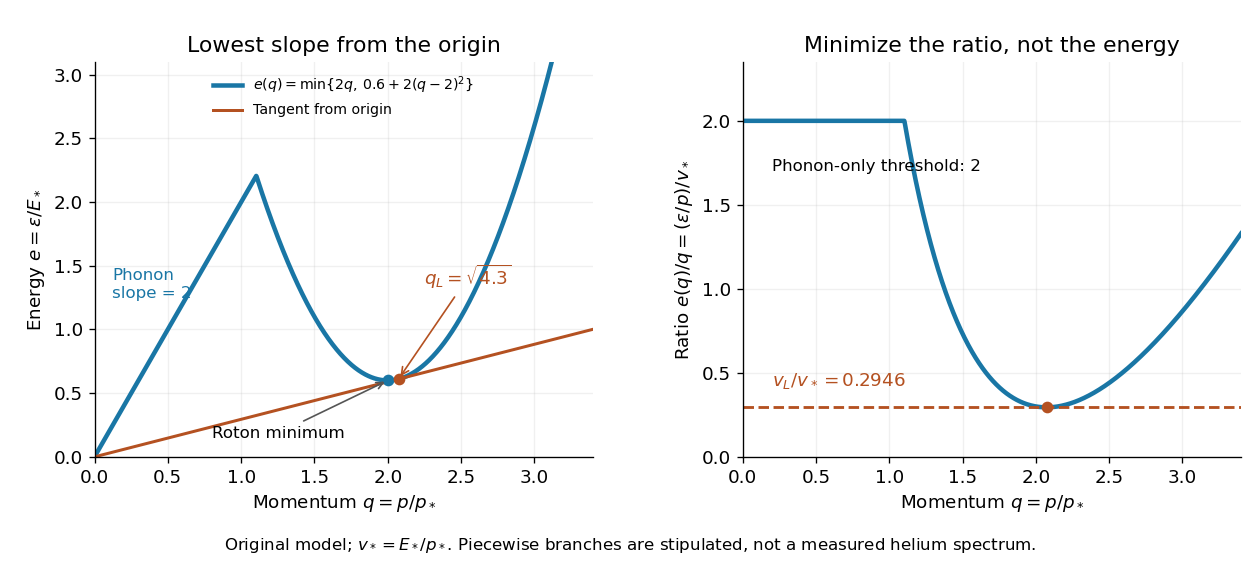
To check the picture algebraically, on the stipulated roton branch,Thus tangency occurs at , slightly above the roton energy minimum. At an energy minimum , but a tangent through the origin needs . Minimizing energy and minimizing the energy-to-momentum ratio are different operations. This geometric construction makes the criterion useful even when the full dispersion relation is supplied numerically rather than by a simple formula.
In a parabolic condensate in the Thomas–Fermi approximation for a condensate, the local sound speed is . Equating it to the obstacle speed gives the displayed threshold. This is the stipulated local phonon estimate; a finite strongly depleting obstacle can modify flow and nucleate vortices, so the inequality is not a universal exact onset law for every stirring experiment.
For a two-dimensional Thomas–Fermi condensate at fixed coupling, , so . Slow exponential atom loss shrinks the cloud while a fixed stirring radius becomes a larger fraction of its size. At and initial , the local-sound-speed threshold is reached at , before the shrinking cloud edge reaches the beam.
The excitation-based kinematic velocity bound in the Landau criterion. For a heavy weak obstacle and an isotropic excitation spectrum, emitting momentum parallel to the obstacle's motion costs ; requiring this to remain positive for every excitation gives the displayed infimum. Vortex nucleation or other dynamical processes can make a measured critical velocity lower than this bound.
The contact-gas spectrum gives . This energetic homogeneous-flow bound need not equal a measured critical speed when vortices or boundaries enable other dissipation.
For a repulsive homogeneous condensate with Bogoliubov energy , the infimum of is the speed of sound . This is energetic stability against the given bulk modes, not a universal measured dissipation threshold.
A roton is an excitation near a local minimum of a superfluid's dispersion relation at nonzero momentum . The displayed local approximation defines a positive energy gap and positive curvature effective mass ; it is not a free helium atom or a macroscopic quantum vortex.[ref]
On the Theory of Superfluidity of Helium II by Lev Davidovich Landau. Landau, On the Theory of Superfluidity of Helium II (1947), p.91, Fig.1
In the stipulated plot, these correspond to , and . The plot illustrates how a low energy at appreciable momentum can lower the Landau criterion below the speed of sound, without assigning any measured parameter to real helium.Landau's 1947 revision joined the low-momentum linear part to a spectrum with a finite-momentum minimum, retaining the macroscopic superfluid theory while changing its excitation model.[ref]
On the Theory of Superfluidity of Helium II by Lev Davidovich Landau. Landau (1947), p.91, spectrum revision
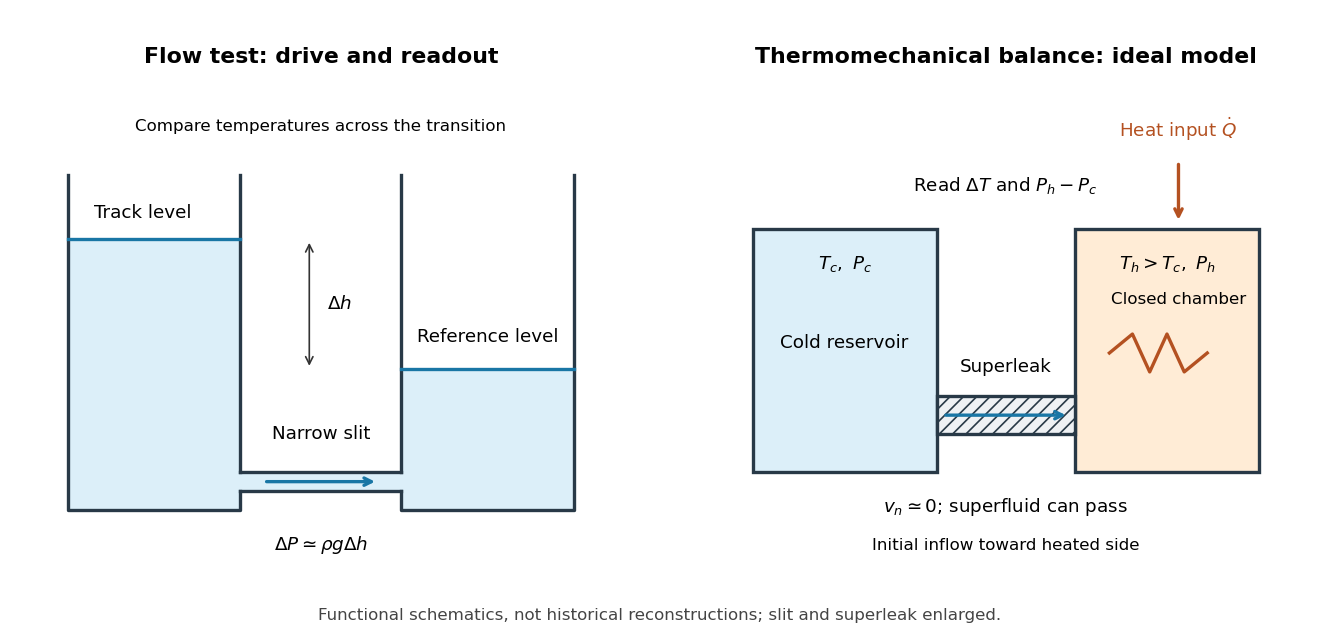
Pyotr Leonidovich Kapitza's 1938 test compared helium flow through optically flat glass disks. Suspension set the tube-to-bath level difference; a cathetometer read levels. The gap was estimated as . Levels barely moved over minutes above the transition, but equalized in seconds below. A laminar flow viscosity calculation gave only an upper bound.[ref]
Viscosity of Liquid Helium below the λ-Point by Pyotr Leonidovich Kapitza. Kapitza, 1938 viscosity paper, reprint chapter 34, pp.506–507
The essential control is to compare the same restriction and level readout at different temperatures. A changed pressure head is not itself evidence for a changed material response: the driving head must be included when interpreting the flow. For an idealized comparison at equal vapor pressure, negligible surface tension corrections and nearly constant mass density , hydrostatic equilibrium givesHere is the difference in free-surface heights and is gravitational acceleration. This explains why following a liquid level provides both a driving pressure and a transported volume; it does not turn a finite-resolution observation into proof of zero viscosity.
Helium-3 superfluidity involves Cooper pairs of fermions; helium-4 atoms are bosons. Individual helium-3 atoms do not undergo Bose-Einstein condensation. [ref]
The Extraordinary Phases of Liquid 3He by David Morris Lee. Lee, 1996 lecture; 1997 reprint pp.645–647
The helium-3 superfluid discovery experiment connects an unexpected pressure feature to a change in the state of a liquid. Its lesson is unusually instructive: finding a reproducible anomaly and identifying the material that changed are separate experimental achievements. Pomeranchuk cooling explains how the experiment reached its operating regime; an independent nuclear magnetic resonance channel distinguishes the phases.
David Morris Lee, Douglas Dean Osheroff and Robert Coleman Richardson compressed coexisting liquid and solid helium-3 in a cell precooled by a dilution refrigerator. Helium-4 pressure drove coupled bellows and a piston; a capacitance diaphragm gauge read pressure and platinum nuclear magnetic resonance supplied thermometry. Uniform compression revealed a slope break A and a small pressure drop B; decompression and varied solid fraction checked reproducibility. Their April 1972 paper, Evidence for a New Phase of Solid He3, interpreted a new solid phase, without establishing liquid superfluidity. [ref]
Evidence for a New Phase of Solid He3 by Douglas Dean Osheroff and others. 1972, pp.885–888, Figs.1–3
The October follow-up replaced the thermometer assembly with a sample nuclear magnetic resonance coil. An applied magnetic field gradient selected different sample layers, separating strong solid signals from the liquid background. At A the liquid resonance shifted; at B its shift disappeared and its magnetic susceptibility fell. Removing the gradient resolved the frequency shift directly. Independence from solid fraction and distinct relaxation times supported the liquid assignment. Thus the reinterpretation rested on phase-selective evidence, rather than relabeling the first paper's title. These magnetic observations identify changed liquid phases; they do not directly measure frictionless flow. [ref]
New Magnetic Phenomena in Liquid He3 below 3 mK by Douglas Dean Osheroff and others. 1972, pp.920–923, Figs.1–3
Douglas Dean Osheroff recalls the subsequent p-wave interpretation. [ref]
Superfluidity in 3He: Discovery and Understanding by Douglas Dean Osheroff. 1996 lecture, p.73
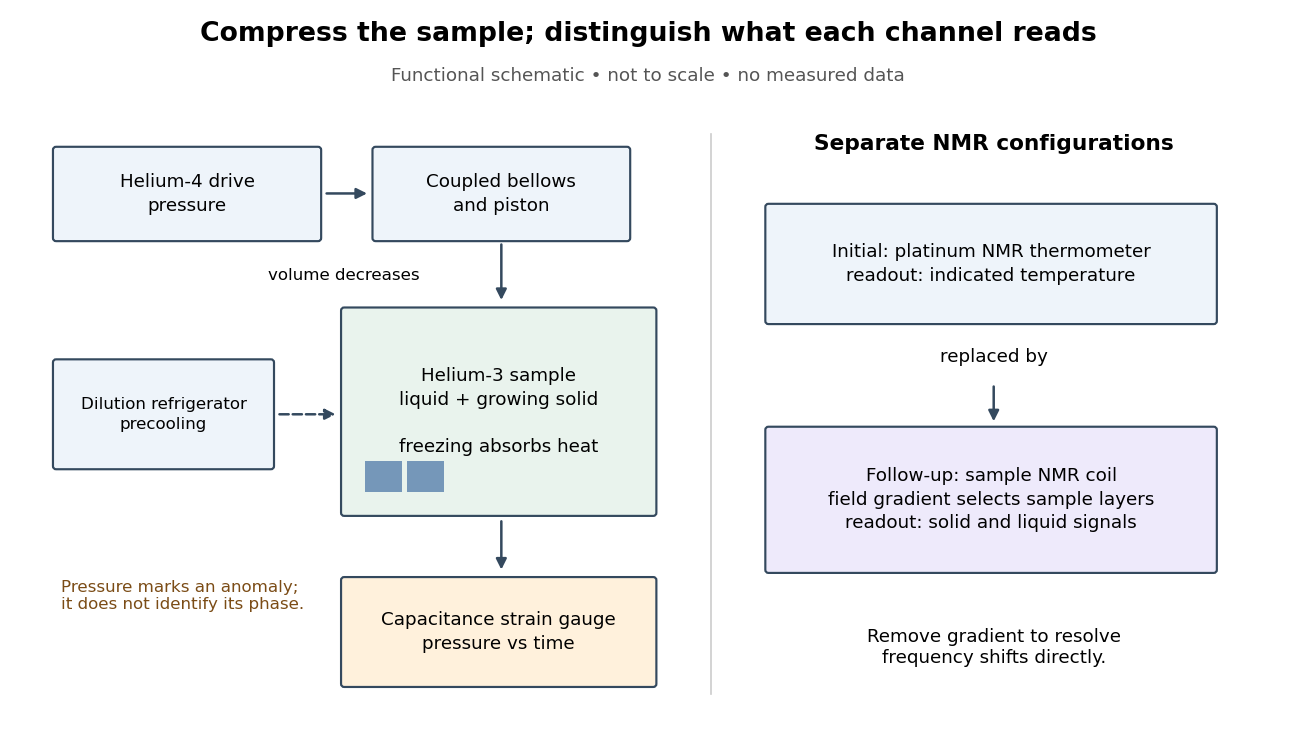
Compression and independent readout channels in the helium-3 superfluid discovery experiment
. Original functional diagram, not a reconstruction to scale. Left: drive, sample and pressure channel. Right: separate thermometer and sample nuclear magnetic resonance configurations; the latter replaces the former in the follow-up. Connections indicate function, not historical wiring. Details.The inference has a useful limit. A pressure anomaly in two coexisting phases cannot, by itself, identify which phase changed: both contribute to the common phase coexistence curve. Thermometer lag, a temperature gradient or slow equilibration can also separate indicated temperature from the sample state. Correlating another response with the anomaly provides information that repeating the same pressure trace cannot supply. Conversely, a shifted magnetic resonance alone does not measure a frictionless flow rate.
Low-temperature solid helium-3 can have greater entropy than the liquid through disordered nuclear spins, enabling compression cooling. [ref]
The Pomeranchuk Effect by Robert Coleman Richardson. Richardson, 1996 lecture, p.91, introduction and Fig.1
The sign follows from the Clapeyron equation. Let be molar entropies and molar volumes of liquid and solid, respectively, on their phase coexistence curve. Equality of their chemical potentials, with , givesWith and , the slope is negative. Reversibly freezing one mole at fixed temperature requires heat into the sample,Here uses the melting convention for latent heat of fusion. This is the opposite sign from ordinary ice melting. The inequalities specify the regime; freezing does not universally cool a substance. In an approximately isolated sample, the growing higher-entropy phase draws on the sample's thermal energy instead of an external heater. Irreversible losses and incoming heat oppose the cooling.
An original deliberately local model makes the cooling quantitative. Fix a total amount of material, let be the mole fraction of solid, and stipulate molar entropiesThe constants and have units of molar entropy per temperature and molar entropy, respectively. Ignore their pressure dependence and the cell's own heat capacity. This is a local thermodynamics model, not an extrapolation to zero temperature. A constant positive cannot remain valid once the solid's spins order.
For a reversible thermodynamic process with no heat exchange, total entropy is constant. Differentiating giveswhen and . Define ; solving between two states givesIn particular, stipulate , and . ThenThe last expression is the local reversible heat requirement per mole frozen at the final state, divided by ; it is not the heat exchanged during the isolated compression. That compression exchanges no heat. This distinction separates the latent-heat sign from the actual boundary heat budget.
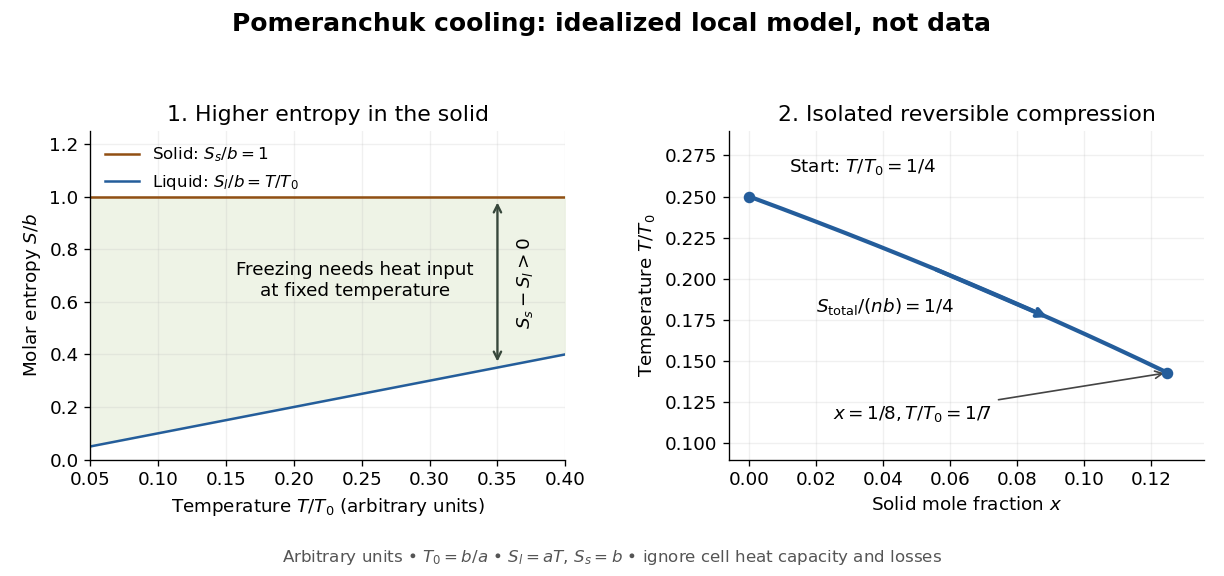
The utility of the model is its explicit condition: makes , while positive total heat capacity supplies a stable thermal response. More generally, for molar entropies depending only on temperature, let be the molar heat capacities. Then . Incoming heat or entropy production adds terms to the balance and can overwhelm the ideal cooling. Neither the numerical ratios above nor the straight entropy lines are measurements of helium-3.
Spin-triplet p-wave pairing has pair spin and orbital angular momentum , allowing multiple order parameters beyond conventional BCS theory with zero orbital angular momentum. [ref]
The Extraordinary Phases of Liquid 3He by David Morris Lee. Lee, 1996 lecture; 1997 reprint p.658
Specifying this symmetry does not determine its microscopic attraction mechanism. A short exchange-symmetry check explains why these quantum numbers fit fermions. The spin-one-half triplet states , and are symmetric under exchange. A stipulated orbital factor proportional to relative momentum changes sign under . Multiplying any symmetric spin function by that odd orbital factor gives an antisymmetric pair wave function, as required by Fermi-Dirac statistics. By comparison, an even s-wave orbital factor needs the antisymmetric spin singlet state. This checks compatibility with exchange statistics; it neither selects a stable phase nor derives its transition temperature.
For a simple spin-triplet p-wave pairing description, let the matrix , with complex number entries, map an orbital direction on the Fermi surface into a triplet gap vector . The indices refer to spin and orbital components. A scalar amplitude cannot retain all these relative orientations. Anthony James Leggett's account connects that extra structure to the magnetic responses of the different phases.[ref]
Nobel Lecture: Superfluid 3He: the early days as seen by a theorist by Anthony James Leggett. pp.1004–1008, broken spin-orbit symmetry and pairing-state response
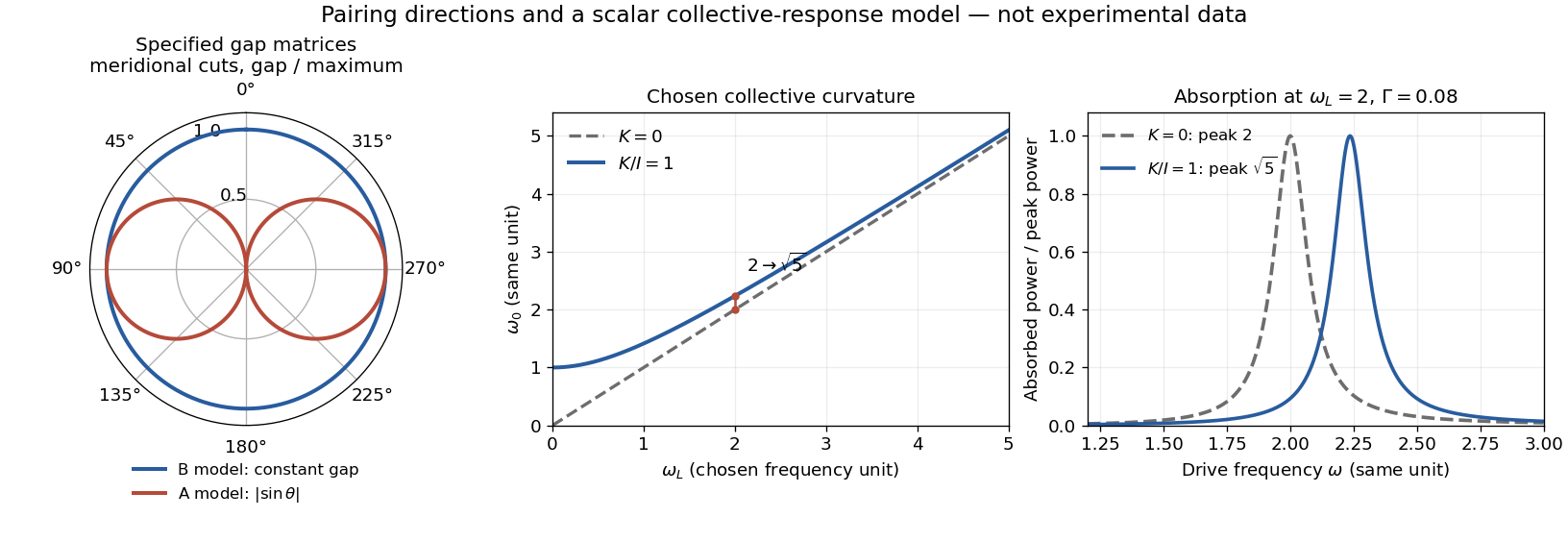
Here are two explicit idealizations, with a common positive scale and an overall quantum phase omitted. They show how odd orbital pairing can have either nodes or an isotropic gap. They do not calculate which state has the lower Helmholtz free energy.
Take a real unit vector in spin space and choose orthogonal orbital axes. The model hasIt vanishes at the two polar directions and is largest at the equator. The orbital factor changes sign when is reversed, as required for the odd orbital part of spin-triplet p-wave pairing. Calling the phase A does not mean its order parameter is one real number.
Take a proper rotation matrix with real number entries. Then hasThis odd linear orbital model has an isotropic gap magnitude. Isotropic gap magnitude does not require s-wave pairing: the spin components can rotate together with the orbital direction. Nor does the magnitude fix the relative spin-orbit orientation represented by .
For both displayed models, . The triplet gap matrix , written with Pauli matrices, satisfiesThus these models give the same gap magnitude for the two spin branches. That last simplification would fail for a general complex triplet vector with a nonzero cross product. The displayed angular curves illustrate these specified matrices; they are not a microscopic derivation of the phase diagram.
Transverse nuclear magnetic resonance measures absorption from a radio-frequency magnetic field perpendicular to the static field. In the A phase, the resonance moved above the Larmor frequency; in the B phase it returned to that frequency despite the changed state. Anthony James Leggett connected the shift to collective spin-orbit structure. A predicted longitudinal resonance, driven parallel to the static field, supplied a further B-phase test.[ref]
Nobel Lecture: Superfluid 3He: the early days as seen by a theorist by Anthony James Leggett. pp.1002–1003 and1009, transverse geometry and longitudinal test
The helium-3 superfluid discovery experiment establishes why a new phase was inferred; comparing response channels then tests its internal structure. An unchanged peak in one geometry cannot, by itself, establish that nothing ordered.
Consider an original scalar response model for a small collective angle . Stipulate effective inertia , restoring curvature , damping rate , and a drive torque :The undamped resonance scale is , where . This illustrates the role of an additional collective restoring energy. It is not the full coupled spin dynamics of either helium phase, and its parameters are not fitted to historical observations.
The steady response and mean absorbed power follow directly:With constant damping, differentiating this last expression places its positive-frequency maximum exactly at . Setting chosen and moves the peak from to , about . At the same curvature moves it only to , about . At large , the shift is to leading order. A smaller shift at larger field therefore need not mean that the restoring curvature vanished.
Articles by others on the same topic

Superfluidity is a phase of matter characterized by the ability of a fluid to flow with zero viscosity. This means that a superfluid can flow without dissipating energy, allowing it to move through small openings and along surfaces without friction. The phenomenon is most commonly observed in liquid helium at very low temperatures, specifically in helium-4 (He-4) and helium-3 (He-3).


Alfred Leitner - Liquid Helium II the Superfluid by Alfred Leitner (1963)
Source. Original source: www.alfredleitner.com.