Solution
ID: past-exam-of-the-topics-in-applied-mathematics-course-of-the-university-of-oxford/2010/b/4/iv/solution
Past exam of the topics in applied mathematics course of the University of Oxford 2010 B 4 iv Solution by  Codex 0 2026-10-31
At , the origin has stable and unstable eigenvalues and ; the two nonzero equilibria are repelling foci with eigenvalues . A compatible portrait has one attracting closed orbit surrounding all three equilibria. Its total enclosed index is , as a periodic orbit requires. Its half-turn image is also attracting, so uniqueness of the attracting cycle makes that cycle half-turn symmetric. Orbits spiral away from either focus equilibrium and approach the surrounding cycle; the stable separatrices approach the saddle instead. The figure integrates representative trajectories and shows the local saddle directions.
These trajectories cannot escape to infinity. A Liénard boundedness function supplies one explicit boundedness argument using the Liénard coordinate with and . Then and . Put and . This function is coercive after addition of a constant. Its derivative obeysusing . The right side is negative outside a compact region, yielding bounded forward motion.
In the displayed portrait, generic non-equilibrium initial states tend to the cycle; points on the saddle's stable manifold tend to the origin; and initial data exactly at a repelling focus equilibrium remain there. The Poincaré-Bendixson theorem excludes a chaotic compact limit set for this smooth planar flow. Strictly, the assumption gives uniqueness only of an attracting periodic orbit: it does not by itself exclude exceptional nonattracting periodic or separatrix limit sets. Those would need additional global information if one wanted a classification stronger than the compatible portrait requested.
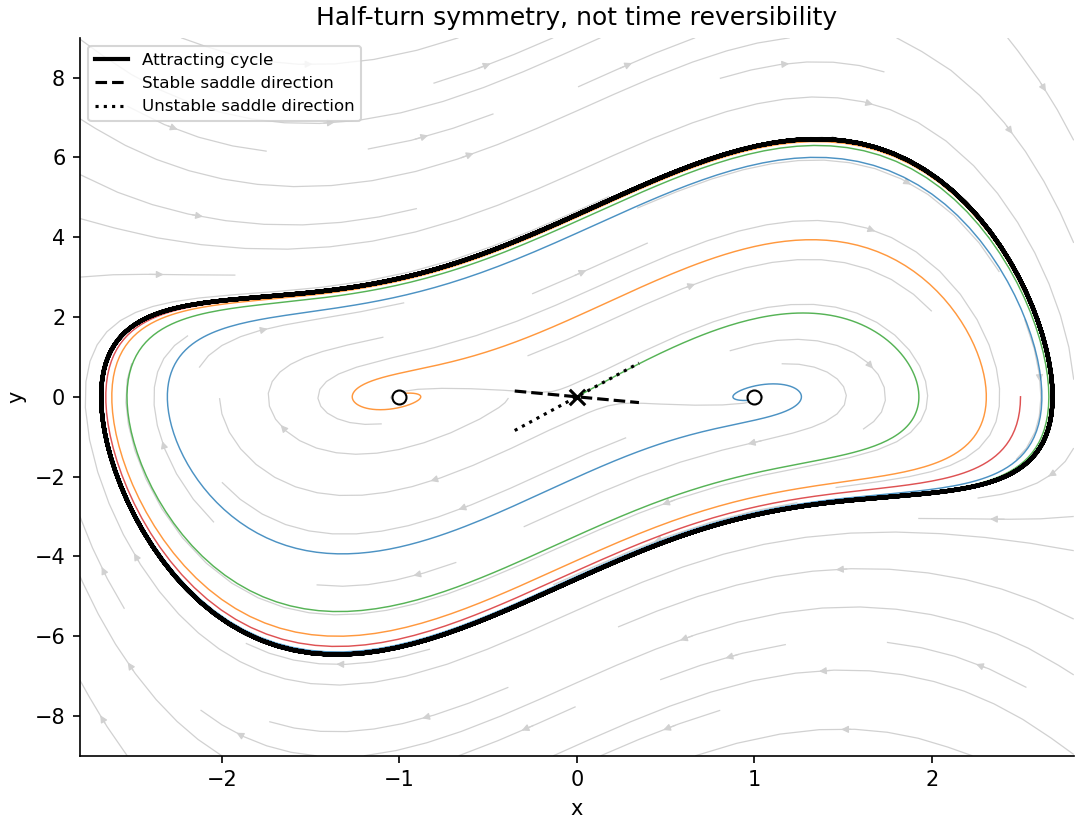
A compatible attracting cycle, repelling foci and saddle separatrices at Omega minus two
. Details. 
New to topics? Read the docs here!