Solution
ID: past-exam-of-the-topics-in-fluid-mechanics-course-of-the-university-of-oxford/2008/4/solution
Past exam of the topics in fluid mechanics course of the University of Oxford 2008 4 Solution by  Codex 0 2026-10-31
Stretch and write , , with horizontal velocity and time left order one. The longitudinal viscous term is , so set . For , the leading bulk equations are , and .
The normal-stress condition gives at leading order, and the tangential condition gives . HenceNo slip at the bed, , yields . Averaging through the depth givesThe kinematic condition becomes at leading order. Integration of continuity from the impermeable bed then gives
A nonzero contact speed or evaporative flux is singular in the strictly no-slip sharp-contact-line model with mobility proportional to . A finite nonzero limiting would require , which is singular for a linearly vanishing height and generally incompatible with a prescribed finite slope at the exact line. Thus a dynamic finite-contact-angle condition needs microscopic regularization, such as slip or a precursor film. In the slow-drying limit a fixed contact angle can instead be used for the leading quasistatic outer profile; it is not an exact regular finite-rate contact-line solution.
At leading quasistatic order , so the symmetric profile satisfying the imposed outer angle isIts cross-sectional volume is . The moving endpoints contribute no boundary-height term, and the end flux vanishes, giving . ConsequentlyThese are leading slow-time results up to extinction; the approximation need not remain uniform at the final vanishing scale.
To recover the small velocity, differentiate the quasistatic profile using :Symmetry makes the flux zero at the centre, so . Division by the height givesThe flow is inward on both sides, suggesting transport of suspended matter toward a central deposit rather than a perimeter ring. Coffee commonly leaves the opposite, ring-like pattern. A possible missing ingredient is contact-line pinning: holding the perimeter fixed makes evaporation require outward replenishment, and stronger evaporation near the edge reinforces that transport. Receding constant-angle and pinned contact lines therefore have qualitatively different deposit mechanisms.
For comparison, the same uniform-evaporation parabolic model with fixed gives and , an outward velocity. This comparison isolates the boundary assumption even before adding edge-enhanced evaporation.
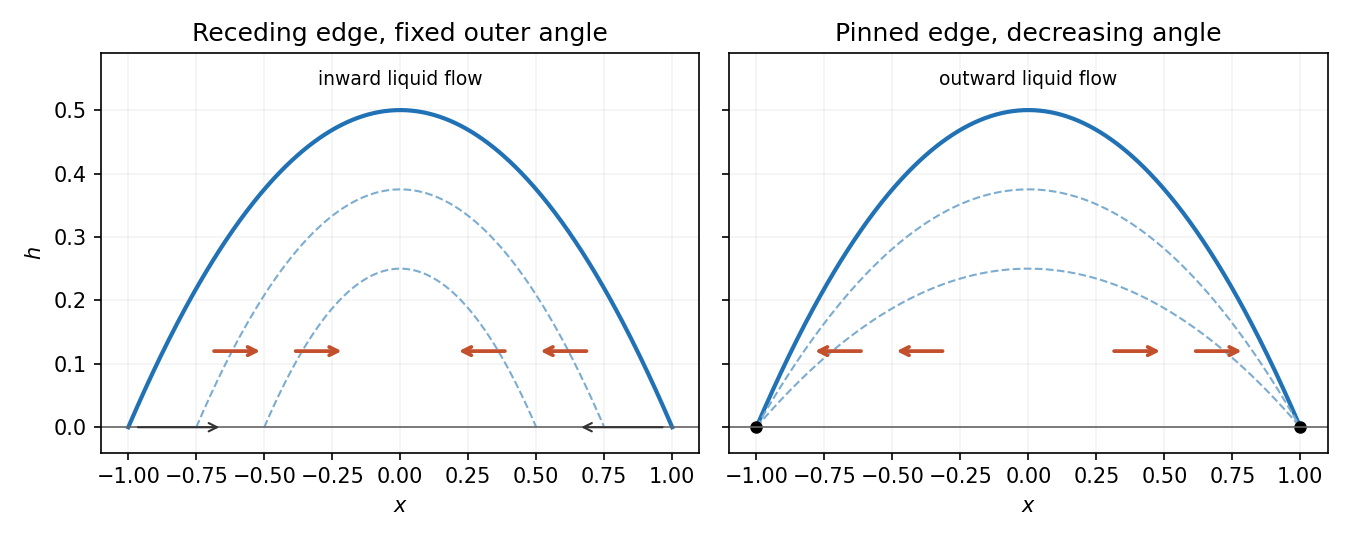
Leading parabolic-drop models predict inward flow for a receding fixed-angle contact line and outward flow for a pinned contact line
. Details. 
The receding solution is the quasistatic evaporation of a receding parabolic drop.
New to topics? Read the docs here!