Solution
ID: past-exam-of-the-topology-and-groups-and-algebraic-topology-course-of-the-university-of-oxford/2009/a/3/iii/solution
Past exam of the topology and Groups and Algebraic Topology course of the University of Oxford 2009 A 3 iii Solution by  Codex 0 2026-10-31
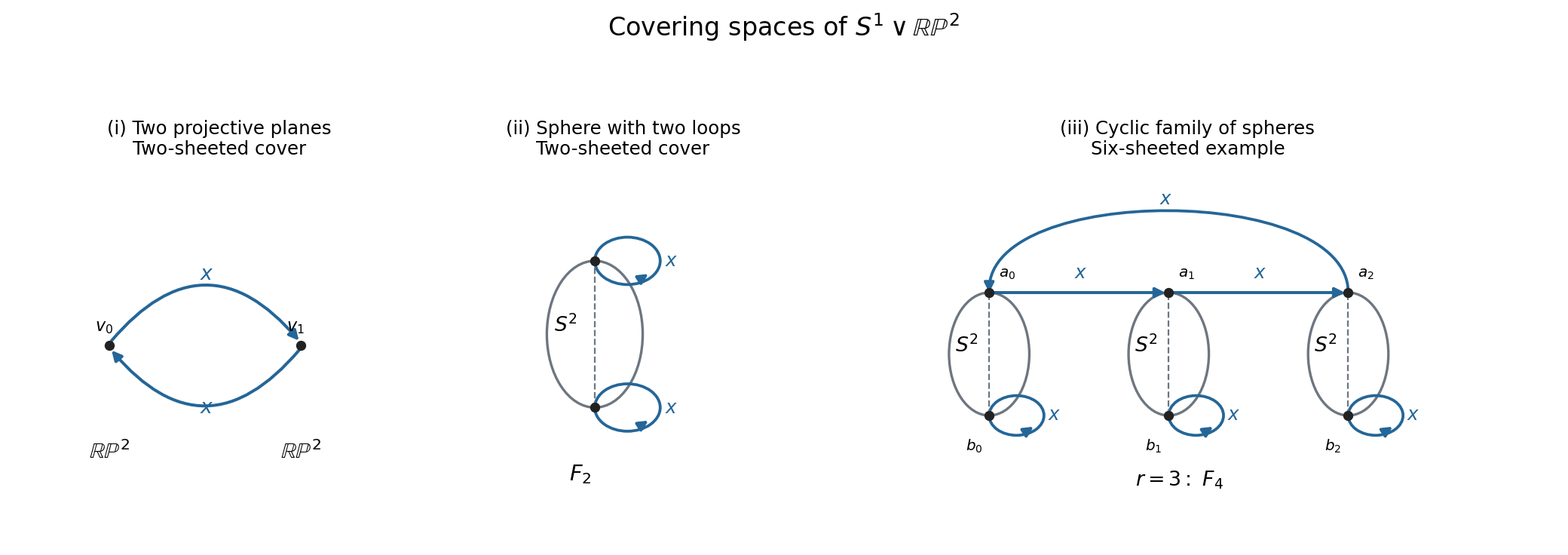
Put . Take spheres, each mapping by the double cover onto , and write their antipodal sheet points as for . Add an oriented edge from to , with indices modulo , and add an loop at each . Every sheet point has the required two circle branches, so the resulting space is a -sheeted cover. It is connected because the edges form a cycle and each sphere connects its own two sheet points.
Choose a connecting arc from to in each sphere. Collapsing these arcs leaves the spheres simply connected, and leaves a graph with vertices, one cyclic edge at each step through the , and one additional loop per vertex. This graph has edges and rank . The sphere summands add no fundamental-group generators. Thus the cover has free fundamental group of rank .
Based at , choose the first cyclic edges as a spanning tree. The closing cycle projects to . To traverse the loop at , travel along the tree by , use the sphere connector projecting to , traverse its loop, and return. The resulting free basis in the base group isThere are exactly elements. For this is the previous pair . Again injectivity of a covering's induced map makes these actual subgroups with the claimed free bases, rather than just quotient presentations.

New to topics? Read the docs here!