Solution
ID: past-exam-of-the-year-1-of-the-computer-science-course-of-the-university-of-oxford/2015/digital-systems-linear-algebra-introduction-to-formal-proof/4/a/solution
Past exam of the year 1 of the computer science course of the University of Oxford 2015 Digital systems, linear algebra, introduction to formal proof 4 a Solution by  Codex 0 2026-10-31
Use three positive-edge-triggered D flip-flops, all driven by the same clock signal . Write the current binary representation as , with the least significant bit. The next state is the current value plus one when and minus one when , in each case modulo eight. A bit toggles under exclusive or with a one.
For upward counting, toggles when , while toggles when , the respective carry conditions. For downward counting the corresponding borrow conditions are and . Define the shared inverted direction and the two direction-match signalsEach is one exactly when : it equals for upward counting and for downward counting. Thus the Boolean functions for the three D inputs areImplement this with two NOT gates for , four two-input exclusive or gates for , and one two-input AND gate. Connect to the D flip-flop whose output is ; feed the three outputs back into the indicated gates. All three flip-flops capture simultaneously, so each equation uses the old state.
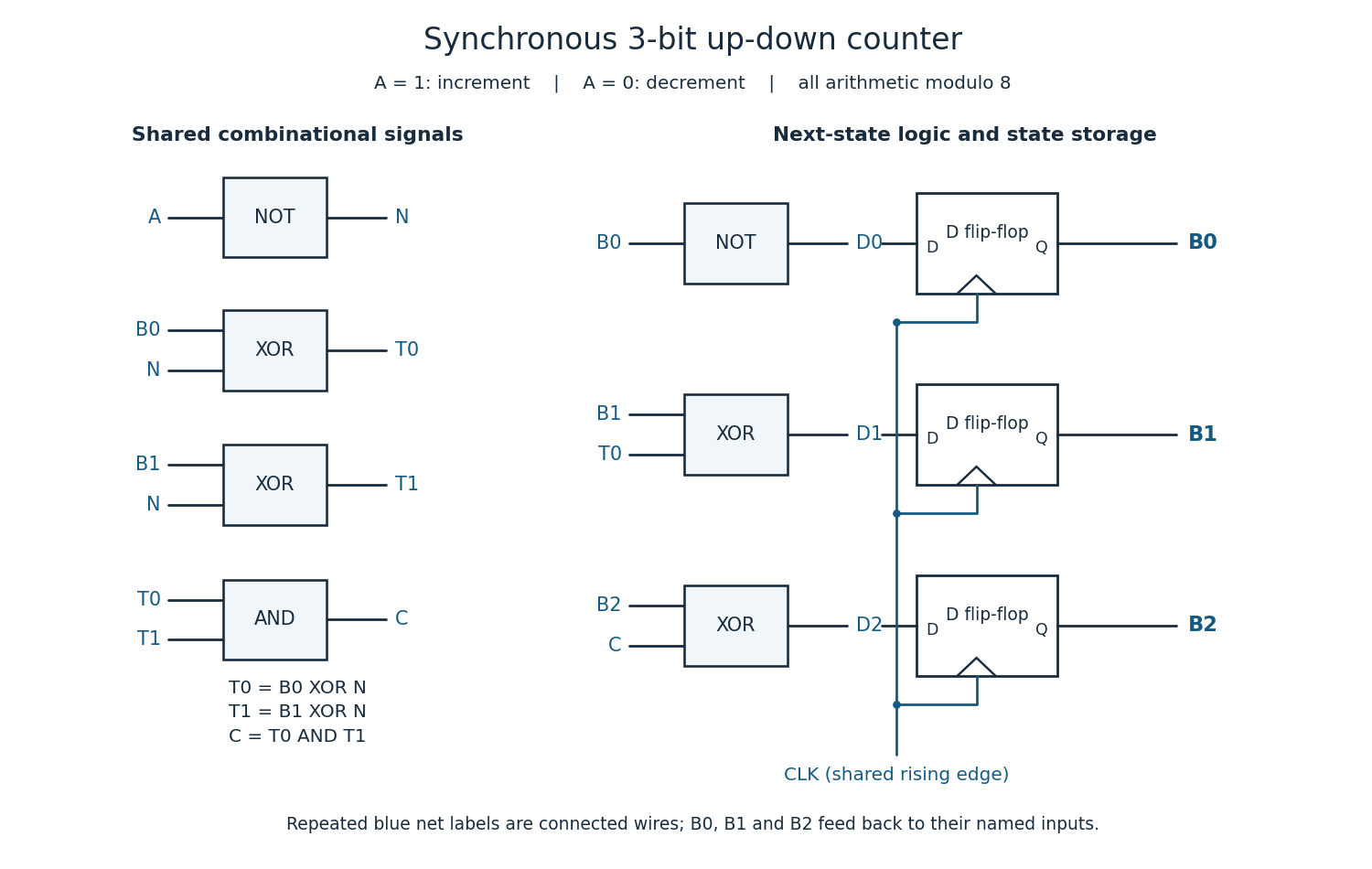

For completeness, the state transition table is
| Current | Next for | Next for |
|---|---|---|
000 | 001 | 111 |
001 | 010 | 000 |
010 | 011 | 001 |
011 | 100 | 010 |
100 | 101 | 011 |
101 | 110 | 100 |
110 | 111 | 101 |
111 | 000 | 110 |
Every three-bit state is valid. A reset may initialize the binary counter to zero if required; counting itself needs no extra state. The direction input must meet the setup time and hold time requirements at the active clock edge.
New to topics? Read the docs here!