Solution
ID: past-exam-of-the-year-1-of-the-computer-science-course-of-the-university-of-oxford/2016/discrete-mathematics-continuous-mathematics-and-probability-resit/5/c/ii/solution
Past exam of the year 1 of the computer science course of the University of Oxford 2016 Discrete mathematics, continuous mathematics and probability (resit) 5 c ii Solution by  Codex 0 2026-10-31
Substitute the proposed Fourier sine series into the heat equation:Projecting onto each sine using orthogonality gives for every mode with . The initial condition fixes , since already describes the initial amplitude. HenceFor a mode with , the value of is immaterial and the same convention is convenient. The positive thermal diffusivity damps every mode, with higher frequencies decaying faster. For square-integrable initial data the damping justifies termwise differentiation for and recovery of the initial data in L2 norm convergence as .
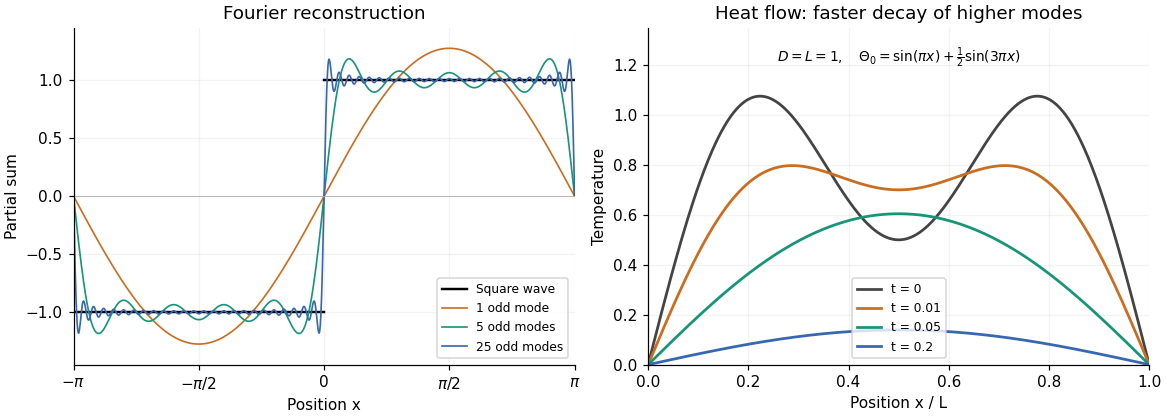

The left panel illustrates the Fourier series in part (b). The right panel is a self-generated example with and , showing the two normal modes decaying at rates and .
New to topics? Read the docs here!