Solution
ID: past-exam-of-the-year-1-of-the-computer-science-course-of-the-university-of-oxford/2019/digital-systems-linear-algebra-introduction-to-formal-proof-resit/3/a/solution
Past exam of the year 1 of the computer science course of the University of Oxford 2019 Digital systems, linear algebra, introduction to formal proof resit 3 a Solution by  Codex 0 2026-10-25
The two lower conducting branches are the series pairs controlled by and by . Their overall NMOS transistor conduction condition is . Apply complementary CMOS network duality: the upper network has the parallel pair of PMOS transistors controlled by , in series with the parallel pair controlled by . Its first end connects to the high rail, its last end connects to , and the junction between the two pairs is internal to the upper network.
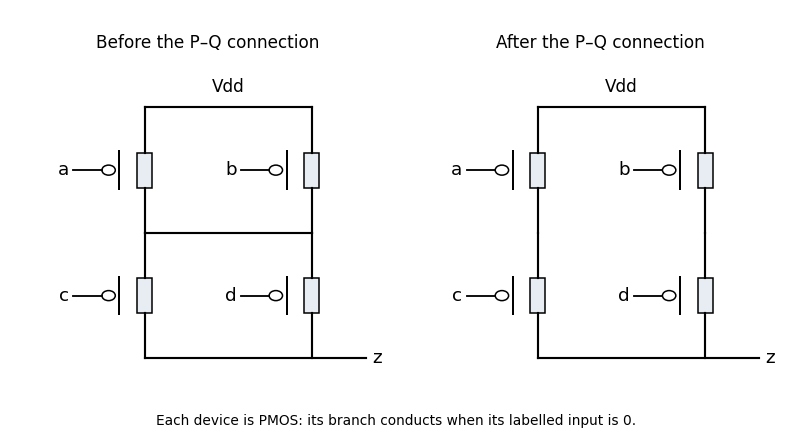
Original completed pull-up networks derived by complementary CMOS network duality
. Details. 
The left panel gives that completion. Every upper transistor uses its correspondingly named input and conducts when that input is low. Its conducting condition is , exactly the complement of the lower condition. Thus the ideal static circuit connects the output to one supply rail for every stable binary input.
New to topics? Read the docs here!