Penzias-Wilson microwave background experiment
ID: penzias-wilson-microwave-background-experiment

In 1965, Arno Penzias and Robert Woodrow Wilson reported measurements with a 20-foot horn-reflector antenna at . They manually switched a traveling-wave maser receiver between the horn and a helium-cooled reference. From zenith antenna temperature, atmospheric and antenna/ground contributions left an excess .[ref]
A Measurement of Excess Antenna Temperature at 4080 Mc per Second by Arno Allan Penzias and Robert Woodrow Wilson. pp.419–420: apparatus, temperature contributions and residual
Elevation scans estimated the atmospheric term. Taping horn seams produced no measurable change; a nearby transmitter tested ground response. These controls addressed distinct possible contaminations.[ref]
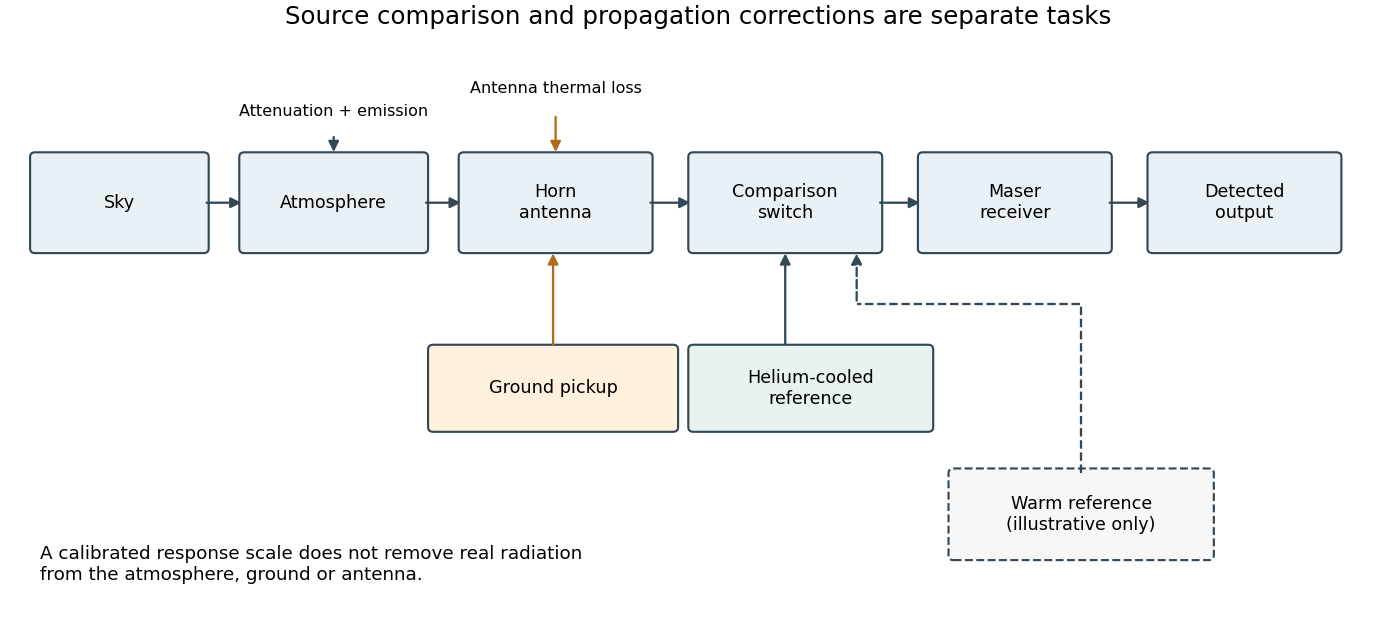

The comparison does not make all nuisance contributions disappear. A reference can establish a response scale, but atmospheric emission and pickup through unwanted antenna directions are also real incident radiation. In his later account, Robert Woodrow Wilson describes these competing contributions as central to a radio astronomy measurement.[ref]
The Cosmic Microwave Background Radiation by Robert Woodrow Wilson. 1978 lecture, introduction and sectionII: sky, ground, atmosphere and instrument contributions
The Princeton group proposed primordial thermal radiation as an interpretation and called for more wavelength measurements. Their separate radiometer had not yet produced results.[ref]
Cosmic Black-Body Radiation by R. H. Dicke and others. pp.415–416: interpretation, Princeton apparatus and need for further wavelengths
A single-frequency excess therefore does not by itself establish a complete Planck spectrum. Reproducibility across independent instruments, observing directions and frequencies tests the interpretation further. New to topics? Read the docs here!