
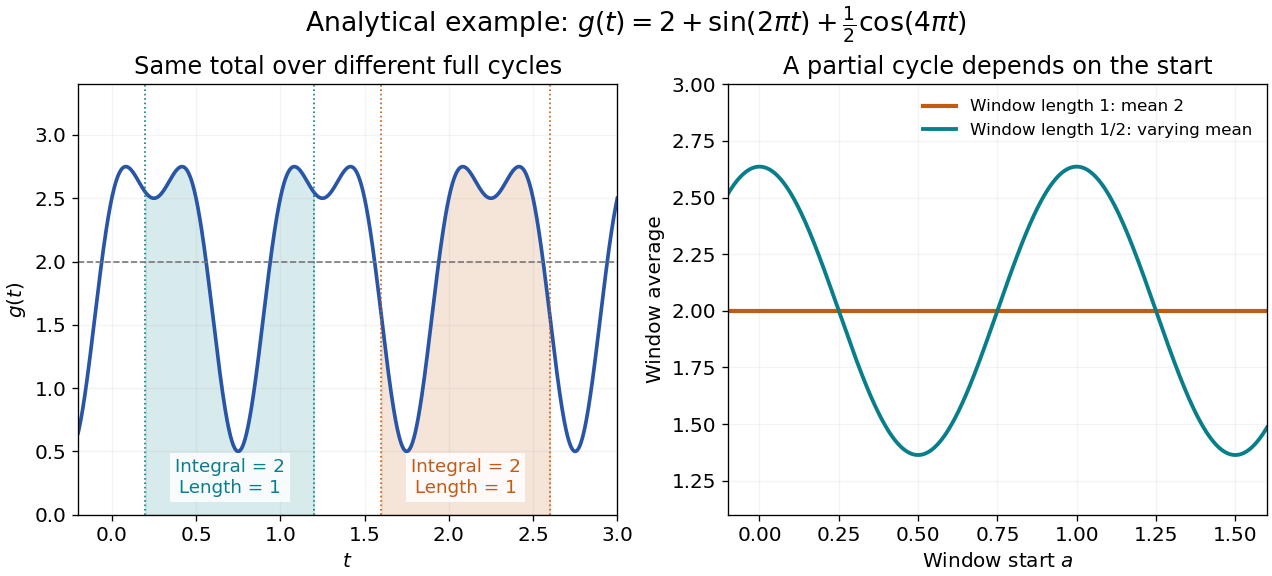
The period average extracts the reference level of an integrable function that repeats. For a real- or complex-valued periodic function with positive period of a function , assume is Lebesgue integrable on every bounded interval. Its average isThe answer is independent of the starting point . Splitting a shifted interval at the old endpoint and using moves its extra piece back into the missing piece. The interval length must be a period; an arbitrary window can give a different average.
For , every length-one window has average : both oscillating integrals vanish over that window. A half-unit window instead has average , which depends on its start. Thus a short sample of an oscillation can bias an estimate of its reference level even when the full-cycle average is known exactly.

In the complex Fourier series convention with basis , the zero-frequency Fourier coefficient is . This assertion defines the coefficient even when an additional convergence theorem is needed to reconstruct from its series. Strang's §4.1 explicitly identifies that constant coefficient with the average.[ref]
Fourier Series for Periodic Functions. §4.1; pp. 317
Averaging a square measures something different from averaging its original function. For the illustrated , orthogonality of the trigonometric terms gives , whereas . Its root mean square is therefore . Similarly, the period average of is . A zero mean need not imply a zero mean square.
New to topics? Read the docs here!