A periodic function repeats exactly after a nonzero shift of its input. For , a positive period of a function satisfiesOne interval of length therefore determines the whole function. For another domain of a function , a period must also preserve the domain, ; equality only where two domains happen to overlap is weaker. Periodicity is an exact translation of a function symmetry, rather than merely two similar-looking pieces of its graph.
The sine has fundamental period one. The function repeats after half a unit: the sine changes sign under that shift, but squaring removes the sign. The mixed function again has fundamental period one. All positive integer multiples of a period are periods, so specifying one period need not identify the shortest repetition.
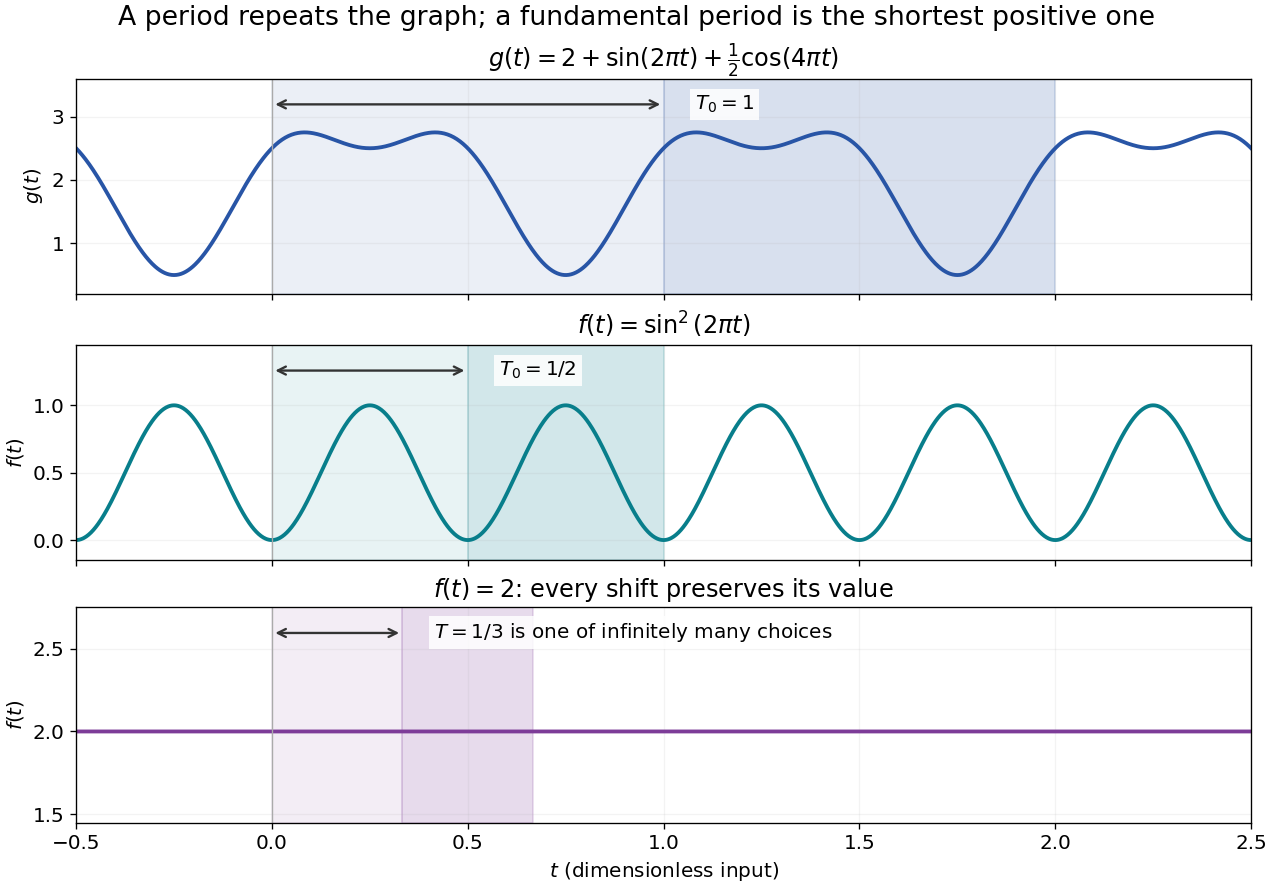
If the input is time and is the fundamental period, the frequency is and the angular frequency is . Repetition lets a Fourier series describe a cycle using sines and cosines; the period average separates the reference level from the oscillating terms. Strang develops this representation and its Fourier coefficients in §4.1 of Computational Science and Engineering by Gilbert Strang.[ref]
Fourier Series for Periodic Functions. §4.1; pp. 317
This connection grew out of a physical problem. In his 1822 book Théorie analytique de la chaleur by Joseph Fourier, Joseph Fourier used periodic functions to extend profiles beyond their initial interval while treating heat conduction. Chapter III, §§233–234 combines even functions and odd functions into sine–cosine expansions and rescales their period.[ref] A modern Fourier series interpretation still requires the appropriate convergence conditions.
A constant function has every real shift as a period and no fundamental period. Without continuity, even a nonconstant periodic function can lack a smallest positive period; periodic function without a least positive period gives a concrete example. The period group of a function organizes all these possibilities.
For an integrable periodic function of period , its integral over an interval of length is independent of the starting point. Write with an integer and . By a change of variables and the defining identity of a periodic function,No differentiability is required. This also allows the Fourier coefficients of a periodic function to be computed on any interval of one full period.
Periodicity is invariance under translation by a nonzero period : a periodic function satisfies at every point in its domain, with translation preserving the domain. For an angular coordinate on a full circle, single valuedness requires -periodicity. The sine and cosine factors and are -periodic for nonzero real precisely when is an integer. Their Fourier series supply the angular modes for the harmonic expansion on a disk.
For , values of a function on a half-open interval determine its periodic extension to the real line: choose the unique integer with and set . The resulting periodic function has period . If the endpoint limits of differ, the extension has a jump discontinuity at every period boundary. Under the usual piecewise-smooth convergence hypotheses, its Fourier series takes the average of the two one-sided limits there; an assigned value at an isolated endpoint does not change the Fourier coefficients.
For with integral zero, is the unique absolutely continuous function with , equal endpoint values, and integral zero. The first formula gives the derivative; zero integral of gives equal endpoint values, while the added constant makes the mean zero. Uniqueness follows because the difference of two such primitives has zero weak derivative and therefore is constant, then its mean is zero. Its periodic extension has distributional derivative , with no endpoint Dirac delta distribution.
Writing , the same operator on zero-mean inputs is . For arbitrary ,The first inequality follows from the integral kernel , whose absolute value has integral in . The second follows by the triangle inequality. This bound permits arbitrarily many iterations without increasing the L1 space norm.
Target: Rapid distributional decay of periodic oscillations. Parent: Weak convergence of distributions. Intended file: distribution-theory.bigb.The fundamental period is the least positive period of a function, when one exists. For it is one; for it is . A periodic function need not have a fundamental period: a constant function has every positive period, and periodic function without a least positive period is a nonconstant exception. Every nonconstant real-valued function that is continuous and periodic on the real line does have a least positive period.
For a real-valued continuous function, the period group of a function is a closed subgroup: if periods tend to , continuity passes to the limit. If positive periods could tend to zero, integer multiples of those periods would approach any prescribed displacement , forcing . A nonconstant function therefore has a positive lower bound for its positive periods. Their infimum is itself a period by closedness. Subtracting an integer multiple of from any other period leaves a period in , which must be zero. This proves the stated structure without assuming differentiability.
Define the indicator function of the rational numbers on the real line by for rational and otherwise. Every rational shift preserves rationality and irrationality, so every nonzero rational number is a period of a function. Conversely, an irrational shift sends from value one to value zero, so it is not a period. The period group of a function is exactly , and the positive periods approach zero without a smallest one. The function is nonconstant and discontinuous everywhere; this is why continuity matters in continuous periodic functions have a least positive period.
Include zero when forming this set, even though a period of a function is normally required to be nonzero. For , is a subgroup of the additive group of the real numbers: composing two preserving shifts adds them, and reversing a preserving shift negates it. A constant function has period group . A nonconstant continuous real-valued function that is periodic has period group , where is its fundamental period.
A nonconstant meromorphic function on the complex plane is simply periodic when its group of periods is generated by one nonzero complex number. It is distinct from a doubly periodic elliptic function, whose period lattice has two real-linearly independent generators. Single periodicity alone imposes no algebraic addition law.
For fixed positive integer period , integer-valued periodic functions on are in bijection with and hence form a countable set. Their union over periods is a countable union of countable sets. In contrast, period-one integer-valued functions on can prescribe arbitrary binary values on its infinitely many distinct classes modulo . The power set of a countably infinite set injects into them, proving uncountability.
The period average extracts the reference level of an integrable function that repeats. For a real- or complex-valued periodic function with positive period of a function , assume is Lebesgue integrable on every bounded interval. Its average isThe answer is independent of the starting point . Splitting a shifted interval at the old endpoint and using moves its extra piece back into the missing piece. The interval length must be a period; an arbitrary window can give a different average.
For , every length-one window has average : both oscillating integrals vanish over that window. A half-unit window instead has average , which depends on its start. Thus a short sample of an oscillation can bias an estimate of its reference level even when the full-cycle average is known exactly.
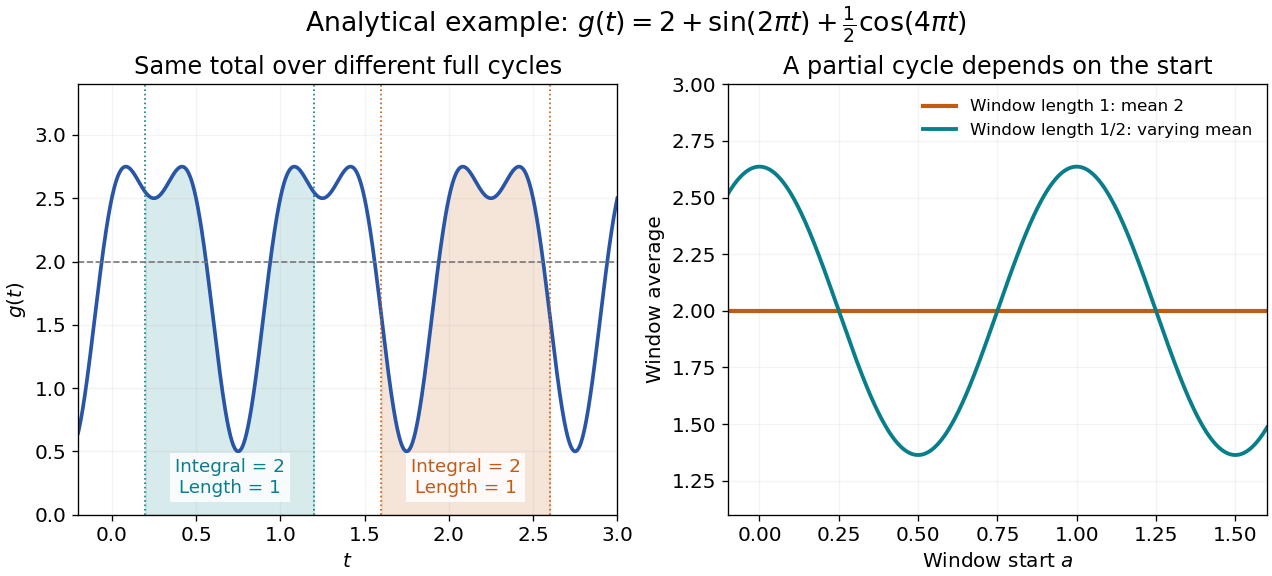
In the complex Fourier series convention with basis , the zero-frequency Fourier coefficient is . This assertion defines the coefficient even when an additional convergence theorem is needed to reconstruct from its series. Strang's §4.1 explicitly identifies that constant coefficient with the average.[ref]
Fourier Series for Periodic Functions. §4.1; pp. 317
Averaging a square measures something different from averaging its original function. For the illustrated , orthogonality of the trigonometric terms gives , whereas . Its root mean square is therefore . Similarly, the period average of is . A zero mean need not imply a zero mean square.
A triangular wave is a continuous piecewise linear periodic function whose slope alternates between two values. The even -periodic extension of from is for . Its Fourier cosine series contains a constant term and odd modes with coefficients proportional to the inverse square of the mode number. Such extensions describe reflection under Neumann boundary conditions.
The period-two extension of on is even. Its Fourier cosine series has and by integration by parts. This proves the displayed series, with only odd nonconstant harmonics. Continuity and piecewise smoothness give pointwise equality through the Dirichlet-Jordan convergence theorem; the summable coefficient magnitudes also imply uniform convergence by the Weierstrass M-test. At , it gives .



