Point-mass gravitational lens
ID: point-mass-gravitational-lens

A point-mass gravitational lens is the ideal gravitational lens obtained by concentrating a positive mass at one location. Use geometrical optics, the weak-field approximation, small angles in radians, and a stationary lens whose deflecting region is short compared with the observer-lens and lens-source distances. At impact parameter , require , the Schwarzschild radius, and a ray passing outside any opaque body. The physical bend has magnitude from Schwarzschild light deflection; is the gravitational constant and the speed of light. Multiple images can occur within this weak-field approximation: strong gravitational lensing does not require a ray to approach a black hole closely.[ref]
Gravitational Lensing by Matthias Bartelmann. Section 1.2, printed p. 2: geometrical optics, weak fields and slowly moving lenses; compact-object near-field propagation excluded
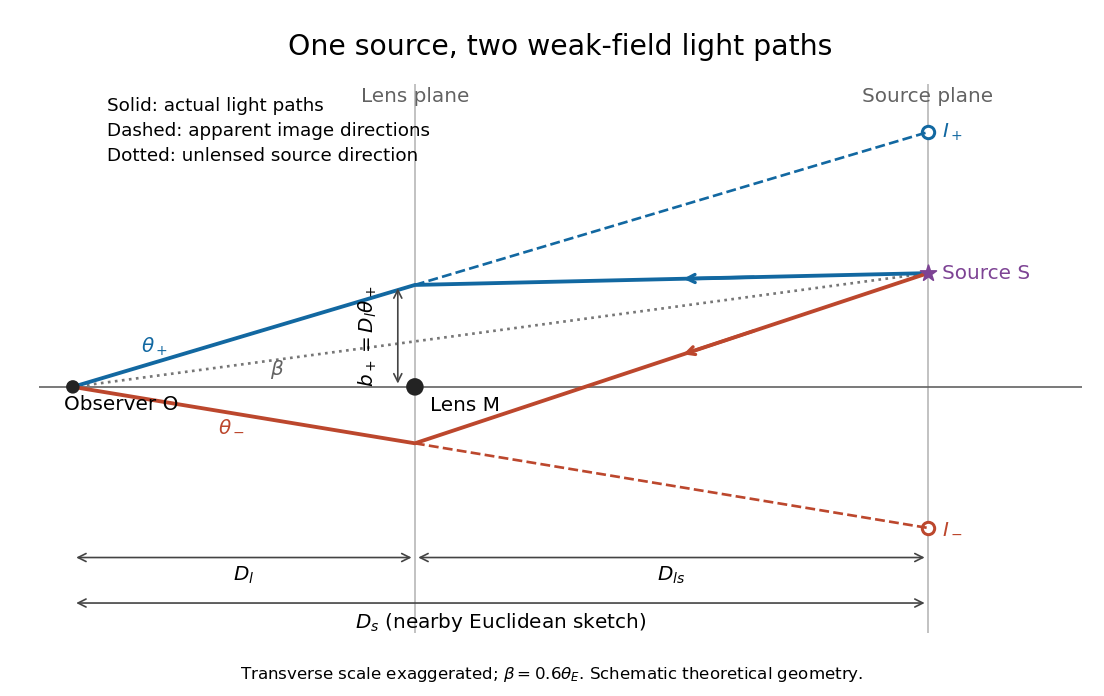
Let , and be angular diameter distances from observer to lens, observer to source, and lens to source, respectively. They refer to the background geometry used in the thin gravitational lens equation. In nearby Euclidean geometry, ; in cosmology, do not make that subtraction. The angular source coordinate is the direction the source would have without this lens; the observed image coordinate is . Both are measured relative to the observer-lens optical axis.[ref]
Lectures on Gravitational Lensing by Ramesh Narayan and Matthias Bartelmann. Section 2.1.3, pp. 8-9, equations (13)-(15), including the warning that lens-source angular diameter distance is not the difference of the observer distances
For the flat sketch below, extend the observer-side light ray backwards to the source plane. Its transverse position would be , whereas the actual source is at . Their separation is . Here is defined outward along the lens-plane impact vector, as in the thin gravitational lens equation; the physical ray bends toward the mass. Substituting givesThe same thin gravitational lens equation uses angular diameter distances in the cosmological setting. The factor converts the physical bend into the reduced angular deflection; these are different angles.

New to topics? Read the docs here!