Geometrical optics describes propagation by rays and Snell's law, neglecting diffraction on scales much larger than the wavelength.
A light ray is a path in an approximation, not a physical thread of zero width. In a transparent, homogeneous, isotropic medium it is straight and perpendicular to a wavefront; boundaries redirect it by the law of reflection or Snell's law. The approximation is useful when the wavelength is small compared with relevant apertures, surface curvature scales, and distances over which the refractive index changes. For an illustrative wavelength of and a aperture, their ratio is . That small ratio supports ray tracing for image location, but does not eliminate diffraction when calculating the fine structure of a focused spot. At a wave caustic, geometrical optics can fail despite large optical elements. [ref].
The mechanism of refraction is a change in phase velocity. For transparent isotropic media at the chosen frequency, the refractive index iswhere is the vacuum speed of light and the angles are measured from the interface normal vector. At a stationary planar interface the frequency and tangential wavevector match across the boundary. Since the wavenumber is , that matching gives Snell's law. The transmitted wavelength changes while the frequency stays fixed. Here uses phase velocity, which need not equal group velocity. [ref]. [ref].
Choose model air with and model glass with , without claiming these are exact values for every sample or wavelength. At , Snell's law givesThe transmitted light ray bends toward the normal vector; its phase velocity is , and its wavelength is two thirds of the air value. By reversibility of an optical ray, incidence from glass at returns the outgoing air angle .
Incidence from glass at is a different experiment. It would require , so there is no real transmitted angle. The critical angle for total internal reflection isAbove this angle, an ideal lossless glass-air boundary produces total internal reflection. The physical optics description still permits an evanescent wave in the air, although no propagating transmitted light ray crosses the boundary. [ref]
https://openstax.org/books/university-physics-volume-3/pages/1-4-total-internal-reflection. OpenStax: Total internal reflection
. [ref].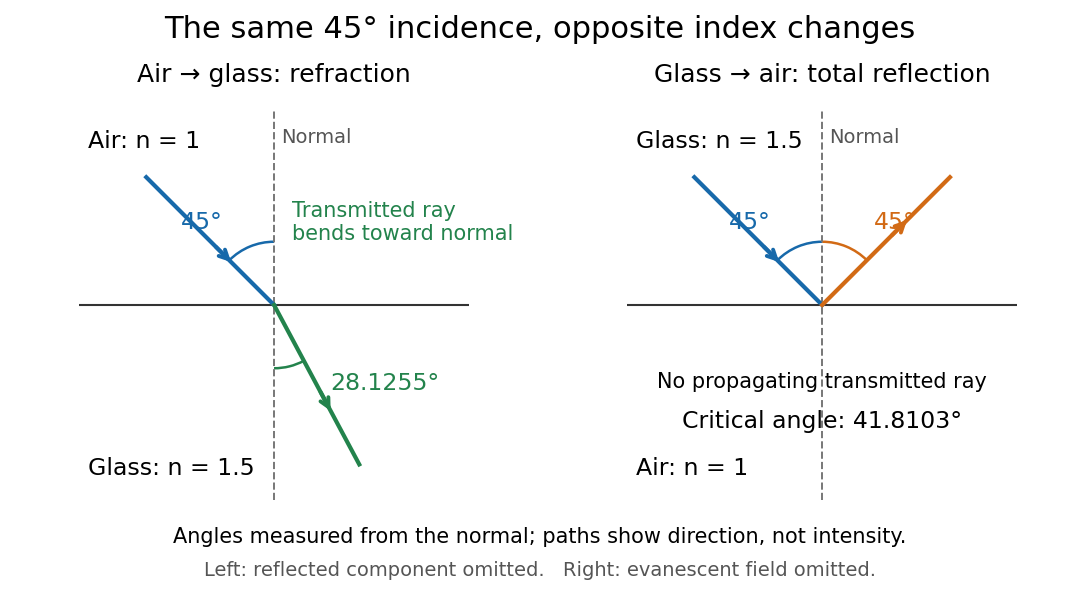
Refraction into glass and total internal reflection on incidence from glass; all angles are measured from the normal
. Details. The usefulness of geometrical optics is that complicated instruments can be assembled from these local rules. Applying Snell's law at successive curved surfaces changes a spreading bundle into a converging one. The Fermat principle unifies the construction through stationary optical path length; stationarity does not require a global minimum. [ref]
https://www.feynmanlectures.caltech.edu/I_26.html. Feynman Lectures: The principle of least time, section 26-5
. Fang's MIT notes explicitly connect this principle to specular reflection, refraction, and thin lens imaging, providing a route from individual paths to complete instruments. [ref].The angle through which an optical element changes a light ray's propagation direction, with the chosen branch and convention specified. For the one-internal-reflection branch through a spherical drop, entry refraction, internal specular reflection, and exit refraction give , with . The corresponding primary rainbow radius about the antisolar direction is .
For a light ray in a spherically stratified refractive index , is constant, where is the angle to the radius. Approximate the medium by concentric homogeneous shells. Straight propagation within each shell conserves , the line's distance from the centre; Snell's law at each shell boundary conserves . Passing to the smooth limit proves the result. In an exterior region with , is the distance of the asymptotic straight light ray from the centre. Consequently a surface-tangent light ray at radius and refractive index has vacuum asymptote at altitude , provided the light ray reaches the exterior without trapping.
Ray transfer matrix analysis propagates paraxial ray height and slope with a two-by-two matrix. Free propagation through uses , a thin optical lens uses , and an unfolded concave-mirror reflection uses . Multiply matrices in propagation order, with the first operation at the right.
For forward paraxial slopes and a lossless same-index optical system with and , Fermat's principle gives endpoint derivatives and . Substituting and and integrating proves the displayed optical path. Free space has and increases path length by , fixing the sign. Its quadratic phase generates the associated linear canonical transform; is a separate imaging limit.
The rapidly varying real phase of a short-wavelength field written . Its derivatives define the local wavevector and angular frequency . The WKB approximation assumes that and background parameters vary little across one wavelength.
The accumulated phase along a one-dimensional ray. In an oscillatory WKB approximation, the two travelling waves have phases . In an evanescent region, the positive local decay rate replaces , producing exponents .
For the refractive index on the upper half-plane, Fermat principle and the Beltrami identity give . The nonvertical rays are arcs of circles centered on ; vertical lines are the remaining rays. These are also geodesics of the Poincaré half-plane model. A ray entering the strip toward decreasing at angle to the vertical has limiting horizontal displacement , at most one. The line is approached only after infinite optical path length because the refractive index diverges there.
For a light ray parametrized by arc length , with unit tangent vector in a smooth positive refractive index , the optical momentum is . This is the momentum for optical path-length normalization. The Euler-Lagrange equation for Fermat principle, , gives . Therefore an index independent of conserves . In coordinates this is , the first integral supplied by the Beltrami identity for several dependent variables.
For a positive refractive index in cylindrical coordinates, a light ray with constant radius and varying axial coordinate has the form when it exists. Fermat principle makes stationary. Conservation of the momentum conjugate to the cyclic angle makes constant along a constant-radius path. The radial Euler-Lagrange equation is thengiving the displayed formula. A nonzero real helix requires . If , gives a straight axial light ray; a generic radial profile need not support a constant-radius helix. Its helical pitch is . This ray model is useful for a graded-index optical fiber when the refractive index varies smoothly and geometrical optics applies; it does not by itself impose wave-mode quantization or boundary confinement.
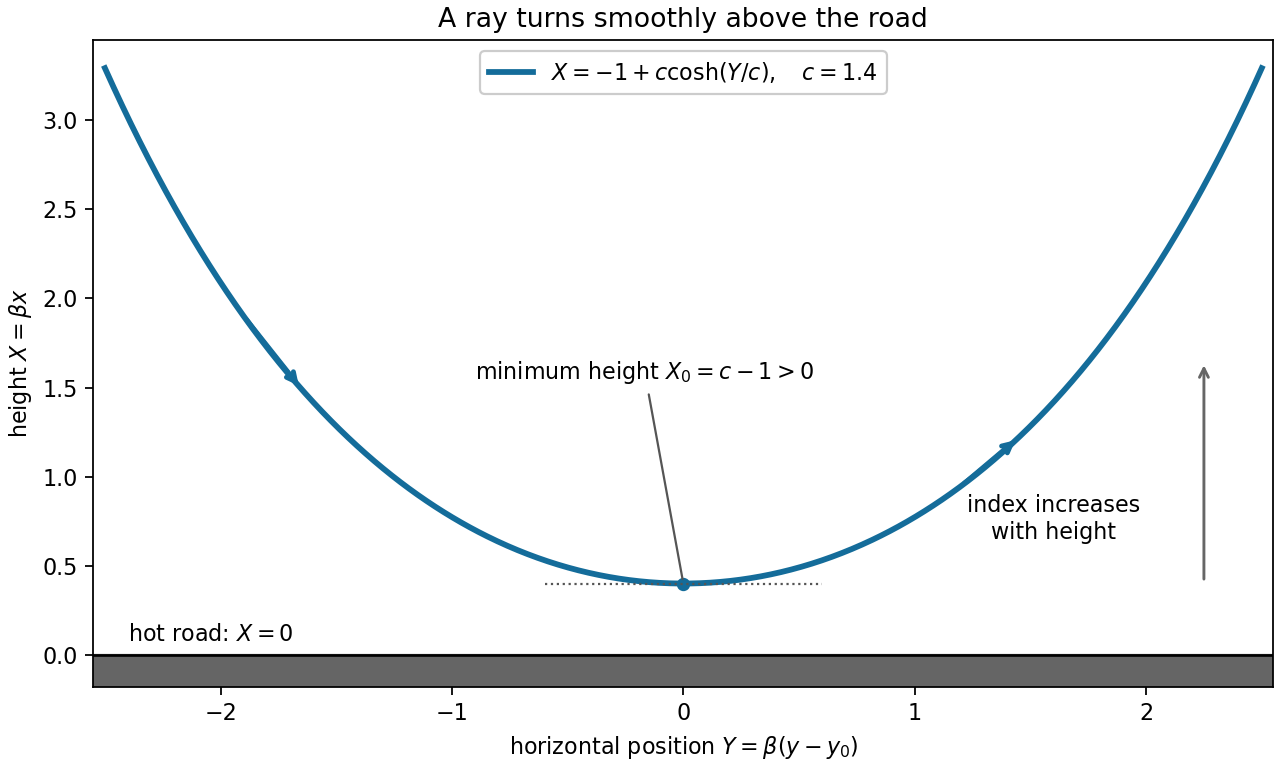
A mirage is an apparent displaced image caused by refraction through a spatially varying refractive index. Above a hot surface, low-index air near the ground can bend a light ray back upwards before it reaches the surface. An observer tracing the arriving ray backwards along its local tangent can then infer an apparent image below the turning region. This explains the appearance of a distant reflective surface without requiring reflection at the road itself.
For height and horizontal position , Fermat principle in a positive index profile , , conserves on a graph . For positive magnitude of the horizontal optical momentum, integration gives the displayed catenary. Its minimum height is , at . Thus produces a smooth turning ray wholly above a road at . The two graph branches have opposite signs of ; continues smoothly through their common horizontal tangent. For a signed negative graph constant, use in the prefactor; gives a vertical ray separately.
For speed in , Fermat principle gives the elapsed-time integrand . Its symmetric stationary light rays through are the displayed catenaries. Set . The endpoint equation is . This function decreases and then increases, with unique minimum where . Thus above the minimum there are two stationary rays, at the minimum one, and below it none. The travel time on either ray is , and its minimum height is .
For and , one solution is , with . A second has , with . Hence these endpoints do not uniquely specify the ray. Stationarity is distinct from global minimization: paths descending almost to have limiting travel time , below either stationary value in this example.
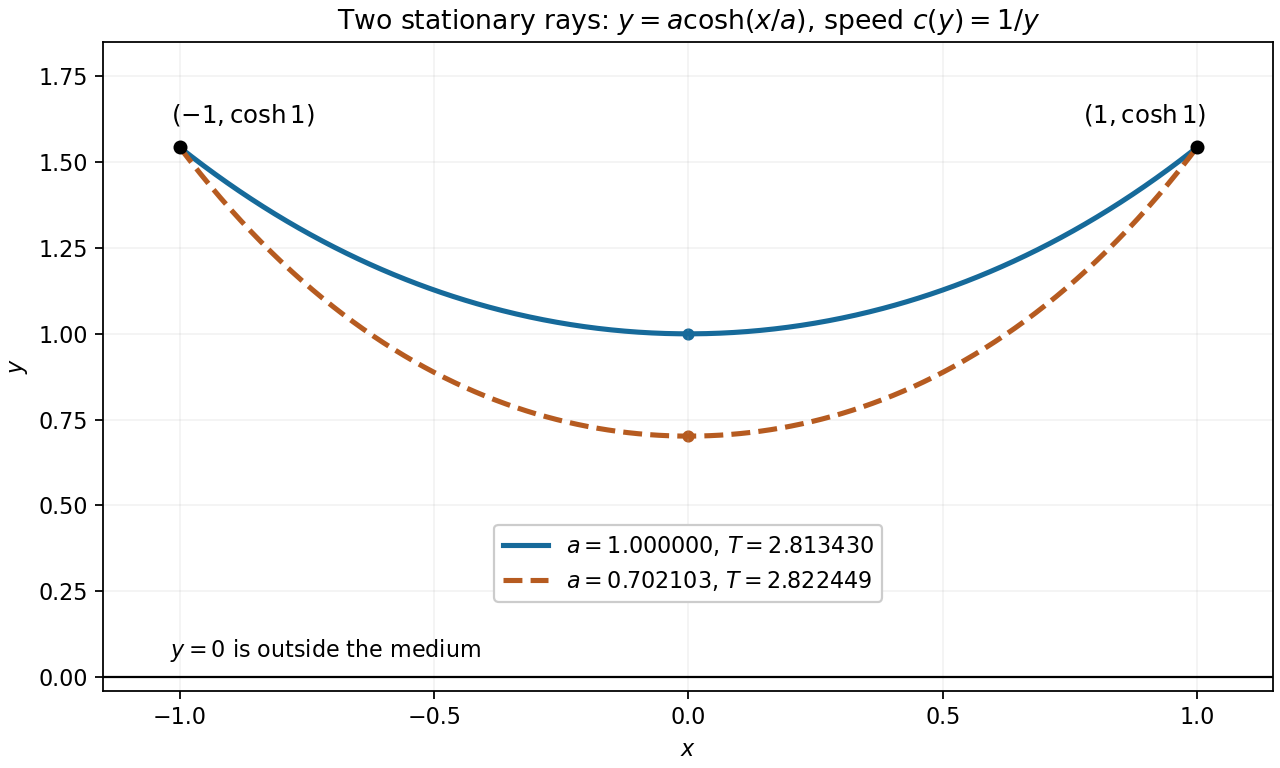
Two stationary catenary rays connect the same endpoints
. For speed , the endpoints and admit stationary light rays with minimum heights and . Their different travel times illustrate that Fermat principle is a stationarity condition. Details.An angular readout using a reflected light ray: rotating a mirror by rotates the reflected light ray by , giving spot displacement at distance for small angles.
A wave caustic is a locus where the projection of a family of rays or wavefronts becomes singular. Several ray paths may coalesce there, and the geometrical approximation can predict divergent intensity. Finite-wavelength diffraction replaces that ideal divergence by a resolved wave pattern. The construction applies to acoustic as well as optical waves.
A path of light propagation in the geometrical optics approximation. In a smoothly varying propagation speed, Fermat principle makes its travel time stationary.
For speed , Fermat principle and the Beltrami identity yield circular light rays whose centres lie on . The ray between in the upper half-plane is .
A light ray whose path remains in a plane containing the optical axis. In a straight step-index optical fiber, this geometry gives the complementary axis and interface-normal angles used to derive the optical fiber acceptance angle.
For the wave equation with slow variables and phase , define and . The leading balance is . Its positive-frequency dispersion relation is , and the group velocity is .
The first-order imaginary balance of the wave equation in geometrical optics gives for a real leading amplitude. The action density travels with the group velocity . For a complex amplitude replace by .
For an individual monochromatic component in , conserved give . With amplitude independent of , wave-action transport for a variable-speed wave conserves on a positive- branch, hence . The divergence at signals failure of the outer WKB approximation.
A smooth phase gives and . These mixed-derivative identities allow the spatially differentiated dispersion relation to be rewritten as Hamiltonian ray equations for a local dispersion relation. Away from phase singularities they express the curl-free character of a local wavevector.
For a smooth phase , define local wavenumber and local angular frequency . Equality of mixed derivatives gives . Dividing by expresses conservation of signed crest count with density and flux . When a homogeneous local dispersion relation gives , the equation becomes ; its characteristic curves move at the group velocity. This phase compatibility is distinct from energy or wave-action conservation.
For paraxial rays, the Lagrange optical invariant is . Lossless paraxial ray transfer preserves this quantity: in coordinates , free propagation and a thin lens act by matrices with determinant one, which preserve the oriented area of two ray vectors. Consequently a full angular optical slit width at an optical pupil diameter satisfies for its image width and optical camera optical pupil width in the same meridional plane.
Etendue measures how much position-and-direction space a bundle of light rays occupies. A small spot accepting a wide range of directions can have the same etendue as a large spot accepting a narrow range. This makes etendue useful for deciding whether an optical instrument can deliver an extended source's entire admitted radiant flux to a small receiver. For forward crossings of a surface, the geometrical optics definition iswhere is the occupied set of surface positions and directions, is the local refractive index, is actual surface area, is solid angle, and is the angle to the forward unit normal. The cosine supplies the projected area. Opposite crossing directions must be counted separately with positive projected area, rather than cancelling them in a signed integral. [ref]
Étendue (Photon Snacks) by R. John Koshel. Étendue, p. 1, equation (1.1): refractive-index-weighted projected-area integral
The shorthand assumes constant refractive index, a narrow nearly normal bundle, and the same admitted directions across the whole area . At larger angles, use the cosine-weighted integral; a position-dependent angular acceptance cannot generally be replaced by the product of two independent extents.
Lossless reversible propagation preserves the etendue of the same bundle of light rays. Here the model uses stationary isotropic media, specular reflection and refraction, with every selected light ray reaching the output and with no optical gain or scattering of light. An aperture that blocks some incident light rays changes which bundle is counted; the full incident and transmitted etendue need not be equal. [ref]
Étendue (Photon Snacks) by R. John Koshel. Étendue, pp. 1–2, lossless-system and entrance-pupil restrictions; p. 3, Figure 1, preserved generalized phase-space element
The underlying phase space has four coordinates. In a planar section with constant refractive index, let locate a light ray and setThe Jacobian determinant from spherical coordinates givesThus etendue is a four-dimensional volume, preserved by the optical counterpart of Liouville theorem in Hamiltonian mechanics. Individual position and direction extents may change, and correlations between them matter. The Lagrange optical invariant is a related paraxial approximation invariant for pairs of light rays, rather than the full four-dimensional measure.
Basic radiance is radiance divided by the square of the refractive index. For radiance at a fixed wavelength,Lossless propagation conserves reduced radiance along each light ray; itself is conserved only when the endpoint refractive indices agree. A larger irradiance at a smaller image can result from admitting more directions without increasing reduced radiance. Uniform wave absorption can lower radiant flux while leaving the occupied geometric etendue unchanged; an opaque aperture removes part of that occupied set. [ref]
Radiative Transfer lecture notes by John E. Greivenkamp. Section 22, slides 22-18 and 22-20: lossless radiance conservation and invariant basic radiance L/n²
Consider a planar circular aperture of diameter in constant refractive index . Suppose every position in its area is filled with directions inside the same rotationally symmetric cone about the unit normal, with half-angle . Using spherical coordinates, the exact etendue iswhere is the appropriate side's numerical aperture. The ordinary cone solid angle is ; its cosine-weighted value is . A full forward hemisphere therefore gives , rather than . [ref]
Radiative Transfer lecture notes by John E. Greivenkamp. Section 22, slides 22-3–22-4, solid-angle element and exact cone solid angle; slide 22-7, projected-area hemisphere factor
For an original model example, choose , , and . ThenIf the radiance is uniform across this filled bundle and equals , its radiant flux is . Neither the geometry nor the chosen radiance is an experimental measurement.
When both endpoint bundles have the filled circular-cone geometry of etendue of a circular aperture and cone, conservation of etendue givesFor the same refractive index, quadrupling the area halves the sine of the cone half-angle. In the , example, an ideal output of diameter must have , so . The exact result differs from simply halving . Conversely, reducing the diameter to requires a complete forward hemisphere, , as a limiting case.
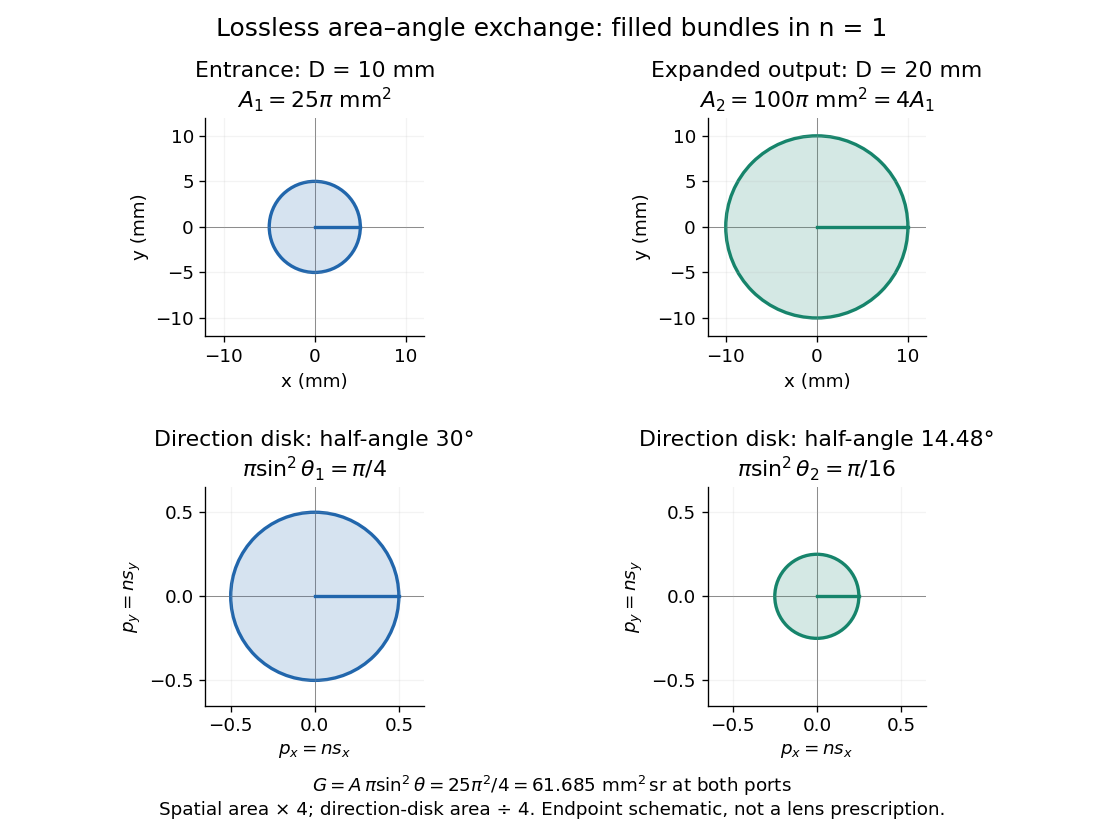
Equal bounding area and solid angle do not alone prove equal etendue: an actual output can have unoccupied directions or position-direction correlations. The filled-cone equation is an exact model of the specified bundles and a capacity constraint on an optical instrument, not a guarantee of an aberration-free implementation.
Insert a centred opaque circular stop of diameter directly in the plane of the bundle. It transmits the same directions at every surviving position, but discards the surrounding annulus. ThereforeWith the uniform radiance of etendue of a circular aperture and cone, the transmitted radiant flux is and the blocked fraction is . Surviving light rays retain their radiance; the stop has not concentrated them. Lossless propagation after the stop preserves the etendue of this surviving subset, not that of the original incident bundle. A stop placed elsewhere can select positions and directions together, so its physical area ratio alone need not give the transmitted radiant flux fraction.
An optical concentrator redirects light from an entrance area to a smaller receiver area . Its geometric concentration ratio is . Specify the admitted angular distribution and losses before interpreting as an irradiance gain: if a fraction of incident radiant flux reaches the receiver, the ratio of mean receiver to mean entrance irradiance is .
Suppose an extended source fills every position of the entrance aperture with a cone of half-angle , and all these light rays must reach a one-sided planar receiver. If the receiver accepts at most a cone of half-angle , its available etendue bounds the admitted etendue:ConsequentlyThis original derivation combines conservation of etendue with the exact cone integral; the second inequality allows the complete output hemisphere. It bounds capacity and does not prove that a chosen shape attains the bound.
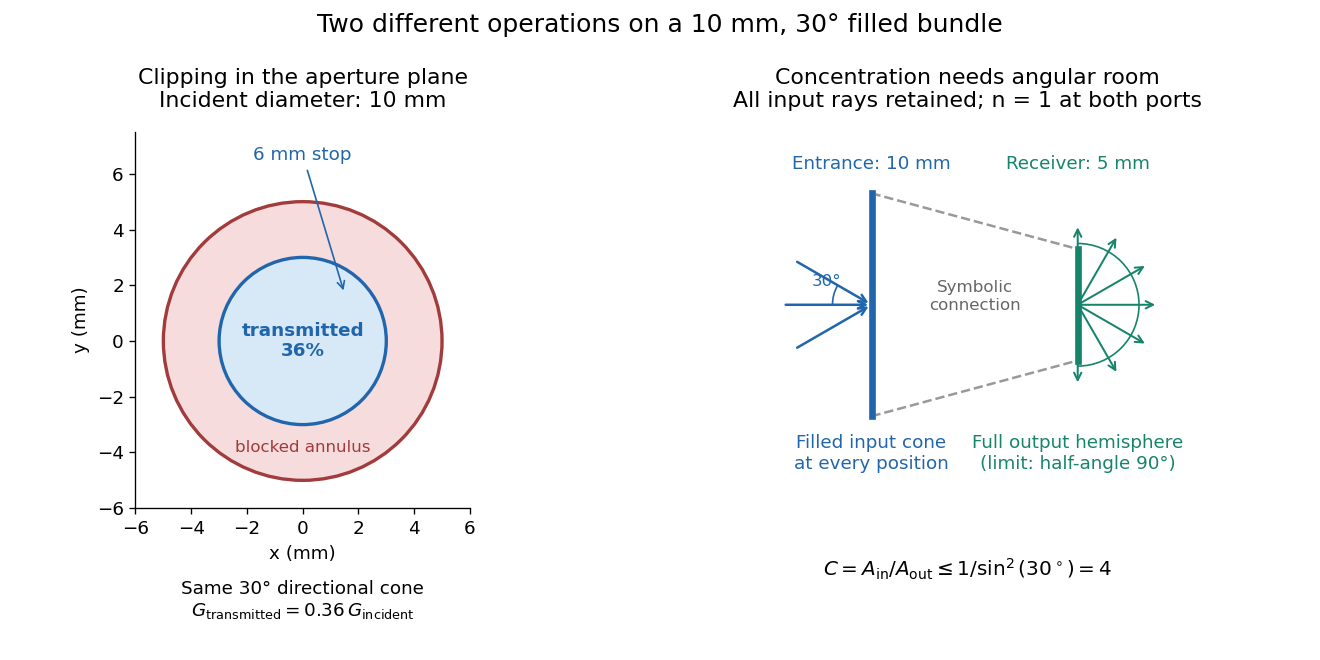
For the input cone with , : a entrance cannot deliver the entire filled bundle to a circular receiver smaller than in diameter. If the output half-angle is restricted to , and the receiver diameter must be at least . For a receiver medium with model refractive index , the full-hemisphere capacity bound instead gives ; that larger value also depends on transmitting the bundle into that medium.
Attempting in the air-to-air example forces rejection of some input. For the uniform radiance already specified, even filling the entire output hemisphere givesThe maximum mean irradiance gain remains . With nonuniform radiance, rejecting a given fraction of geometric etendue need not reject the same fraction of radiant flux.
These bounds use a filled extended-source bundle in passive reversible geometrical optics, comparing the same wavelength and the same radiation channels. An ideal optical point source does not fill that four-dimensional set. Diffraction, optical coherence, or coupling a Gaussian beam into an optical fiber require a physical optics calculation; the cone bound is not a universal guarantee for a single wave mode. Likewise, optical gain or fluorescence changes the propagation assumptions.
A proposed optical bench test uses a steady illuminated diffuse patch, a relay made from two optical lens elements, interchangeable centred circular stops, and a calibrated optical power meter large enough to collect the whole output bundle. Start with small cone angles so an ordinary relay approximates the area-angle tradeoff. Measure the patch's image diameter and the accepted angular extent at both conjugate planes; the transverse magnification gives the spatial scale, but does not by itself measure etendue.
Map the local radiance with a baffled photodiode on translation and rotation stages, using two small aligned holes to select a narrow known solid angle. Keep the sampled position fixed while scanning direction, calibrate the sampling footprint and angular response, and repeat at several positions. Numerically integrate over the occupied samples, and integrate to predict the collected radiant flux. This checks the filled-cone assumption instead of inferring it from two outer dimensions.
Compare the relay without a stop and with a stop of times the illuminated diameter in the same plane. The uniform-bundle prediction is a radiant flux ratio of , with unchanged local radiance in the surviving samples. Cover the input for a dark reading, monitor source drift, repeat the open-stop reading, check detector linearity with calibrated optical attenuators, and enlarge the collecting detector or scan it to check for missed light rays. Lens losses, angular response, illumination gradients, alignment errors and diffraction can spoil the ideal prediction; their effects must be measured separately. This is a procedure to try, with predicted readouts, not purported experimental data.
An optical axis is the reference line through the centres of rotational symmetry of an optical system. A folded system can have successive axis segments related by reflection.
The incident ray, reflected ray and surface normal lie in one plane; incidence and reflection angles measured from the normal are equal. For a unit incident direction and unit normal , reflection gives .
In a stationary reciprocal optical medium, reversing the direction of a ray produces a ray along the same path. Snell's law is unchanged when its two media and ray directions are interchanged.
An optical lens is a transparent element, or assembly of elements, that redirects a bundle of light rays to form images or change how the bundle spreads. In an ordinary glass optical lens, refraction at the surfaces provides the redirection: their changing normal vectors make Snell's law bend different light rays by different amounts. A converging optical lens brings incoming light rays parallel to its optical axis toward an optical focus; a diverging optical lens makes them spread as if from an optical focus on the incoming side. [ref]
https://openstax.org/books/university-physics-volume-3/pages/2-4-thin-lenses. Ling, Sanny and Moebs, OpenStax University Physics Volume 3, §2.4: Thin lenses
.For a usual glass thin lens in air, a form thicker at the centre than at the edges normally converges, with positive focal length; one thinner at the centre normally diverges. Shape alone is insufficient: the refractive index relative to the surroundings also matters, as the lensmaker's equation shows. An aperture selects which light rays pass; an optical lens also changes their directions. The distinction explains how an optical camera can gather light from one object point over many incoming directions and deliver it to one image location.
The beautiful simplification is that an entire bundle can be characterized by a focal length, and two constructed light rays can locate an image. The thin lens examples below turn that geometry into a prediction of image position, orientation and transverse magnification. A real optical lens retains optical aberrations and diffraction, so the construction is a useful leading model rather than an exact solution of Maxwell's equations.[ref]
Early mathematical treatments include Johannes Kepler's 1611 Dioptrice, whose title explicitly concerns vision through newly invented instruments using transparent glass, and René Descartes's 1637 La Dioptrique, whose seventh discourse discusses improving vision with shaped glass. These are landmarks in explaining and designing optical instruments, rather than dates for the invention of the optical lens. [ref]
https://www.e-rara.ch/zut/content/titleinfo/120202. Kepler, Dioptrice, 1611, original edition digitized by ETH-Bibliothek
; [ref]https://classiques.uqam.ca/classiques/Descartes/dioptrique/dioptrique.html. Descartes, La Dioptrique, 1637, seventh discourse, UQAM text edition
.An optical focus is a point where a specified bundle of light rays converges, or where its backward extensions meet. For a converging thin lens receiving light rays parallel to the optical axis, the rear optical focus is when the thin lens is at ; its front optical focus is . An object's image is generally elsewhere: the optical focus describes the parallel incoming bundle, while the thin lens equation locates the image for a finite object distance.
The focal length specifies the signed distance from an ideal thin lens to its optical focus for incident light rays parallel to the optical axis. A converging thin lens has , with a rear optical focus beyond the thin lens; a diverging thin lens has , with a virtual optical focus on the incoming side. The focal length is a property of the optical lens in its specified surroundings, not the image distance for every object. For example, a converging thin lens with images an object away at , as computed below. [ref]
https://www.feynmanlectures.caltech.edu/I_27.html. Feynman, Leighton and Sands, The Feynman Lectures on Physics I, §§27-3–27-4
.The optical power is reciprocal signed focal length, . With expressed in metres, optical power is expressed in dioptres: gives , while gives . The sign distinguishes converging and diverging optical lens elements; the magnitude measures how strongly they change the direction of a light ray at a given height. [ref]
https://openstax.org/books/college-physics-2e/pages/25-6-image-formation-by-lenses. Urone and Hinrichs, OpenStax College Physics 2e, §25.6: Optical power and diopters
.For two ideal thin lens elements in contact in air, optical powers add: . Thus and combine to give , or . Separation changes the rule: for two ideal thin lens elements separated by in air, their equivalent optical power is . The contact rule is the case.[ref]
Lecture Notes on Geometrical Optics. §J: Composite lenses
A dioptre, also spelled diopter, is the unit of optical power equal to one reciprocal metre. In , convert focal length to metres before taking the reciprocal: gives , not . A dioptre measures focusing strength, distinct from the transverse magnification of an image.
A thick lens retains the separation of its refracting surfaces when predicting image formation. In the paraxial approximation with air on both sides, object and image distances measured from the respective principal planes satisfy the familiar imaging equation. Measuring instead from one mechanical centre generally introduces an error.[ref]
Refracting systems (details), University of Tennessee physics teaching resource. University of Tennessee physics teaching resource, Refracting systems (details), final paragraph: object and image distances must refer to the principal planes
The two principal planes are reference planes that represent a centred imaging system in the paraxial approximation. In air on both sides, measure object distance from the front principal plane, image distance from the rear principal plane, and focal length from each principal plane to its corresponding optical focus. They need not coincide with a surface or mechanical centre. Their signed separation matters in the Bessel lens displacement method.[ref]
Refracting systems (details), University of Tennessee physics teaching resource. Refracting systems (details), definition of principal planes, unit lateral magnification, and final imaging equation
A thin lens models an optical lens by collapsing its refracting surfaces into one plane, neglecting thickness relative to the relevant radius of curvature values and object and image distances. Here use an ideal converging thin lens in air and the paraxial approximation: light rays make small angles with the optical axis, so Snell's law can be linearized using the small-angle approximation. Equal surrounding refractive indices on both sides give the familiar symmetric equation.[ref]
Put the thin lens at , with incident light travelling to the right. An object at has . The image coordinate is : for a real image and for a virtual image. The converging thin lens has focal length , and heights are signed relative to the optical axis. The thin lens equation and transverse magnification areThe expression for requires . Negative transverse magnification means inverted; positive transverse magnification means upright. Remember that the positive distance differs in sign from the object's coordinate . [ref]
https://openstax.org/books/university-physics-volume-3/pages/2-4-thin-lenses. Ling, Sanny and Moebs, OpenStax University Physics Volume 3, §2.4: Sign conventions
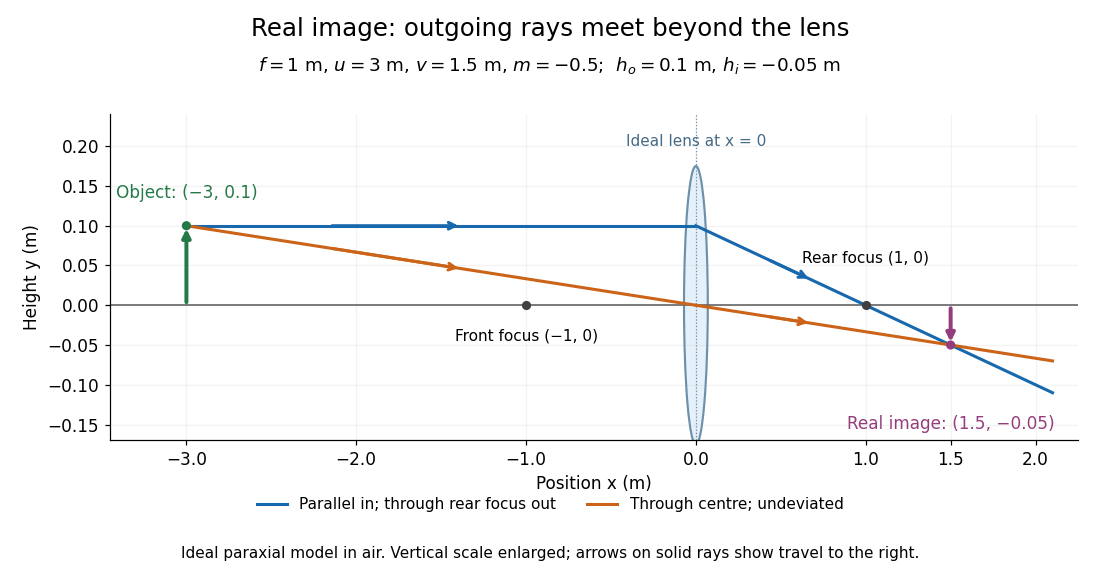
.For focal length , object distance , and object height , calculation givesThe real image is inverted, half as tall, and located to the right of the thin lens. A screen at that position receives the image because the outgoing light rays actually meet there.
For the same focal length and object height , move the object inside the front optical focus, to . ThenThe virtual image is upright, twice as tall, and apparently to the left of the thin lens. Outgoing light rays still travel to the right; only their backward extensions intersect at the virtual image. A screen there cannot collect that image from the outgoing bundle. This geometry explains why a converging optical lens can act as a magnifier when held close to an object. [ref]
https://openstax.org/books/college-physics-2e/pages/25-6-image-formation-by-lenses. Urone and Hinrichs, OpenStax College Physics 2e, §25.6: Virtual images inside the focus
.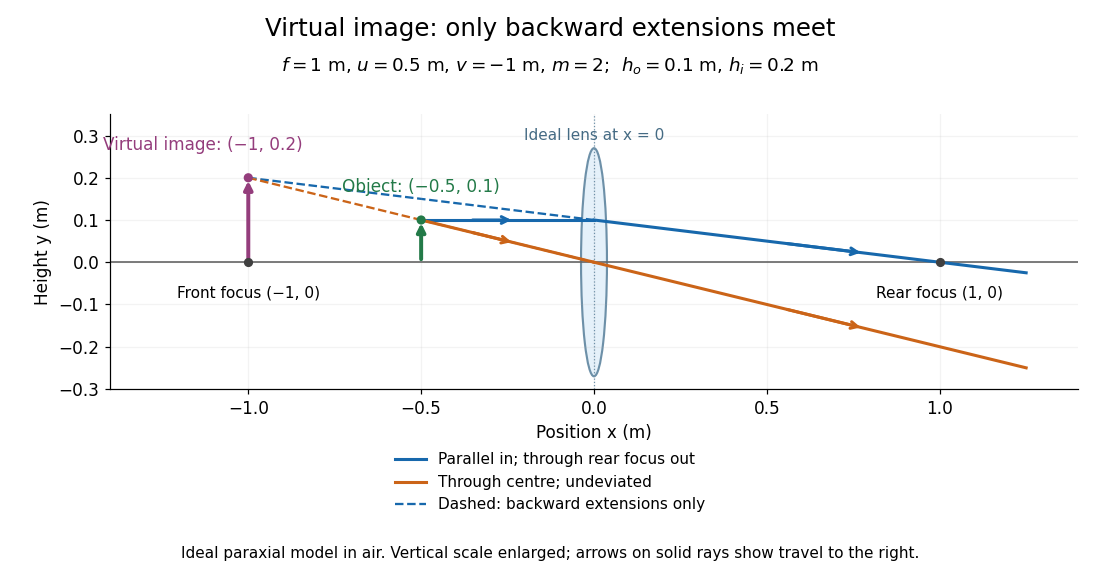
Both diagrams use two rules for ray tracing. A light ray from the object's tip parallel to the optical axis reaches the thin lens at and exits along the straight line through the rear optical focus . Another light ray through the centre continues undeviated in the ideal thin lens model. Their intersection, or the intersection of their backward extensions, locates the image tip. [ref]
https://openstax.org/books/university-physics-volume-3/pages/2-4-thin-lenses. Ling, Sanny and Moebs, OpenStax University Physics Volume 3, §2.4: Ray tracing
.A short geometric proof outline makes the signs transparent. The two outgoing straight lines areFor nonzero , equating their heights at gives , hence the thin lens equation; the centre light ray gives , hence the transverse magnification. This derives the image equations from the ideal ray tracing rules, whose physical justification comes from Snell's law in the paraxial approximation.
At , the two outgoing straight lines are parallel: there is no finite image position. For the real image has ; for the virtual image has . These cases let an optical camera designer choose a receiving position and let a user understand a magnifier. An actual optical lens has finite apertures, which cause diffraction and impose diffraction-limited resolution; optical aberrations can further blur the image. The diagrams are ideal geometrical optics, with exact coordinates within that model, rather than exact predictions of Maxwell's equations. [ref].
Use positive distances for a real incident object and a real outgoing image. The first thin lens makes an image at . The second has object distance , possibly negative, and the thin lens equation gives the displayed expression. At it becomes with . For , a real final image requires both and ; the inequality alone is insufficient when .
For two thin converging lenses, the first lens may form its would-be image beyond the second lens. The rays entering lens 2 then converge, so its Cartesian real-object distance is negative. Apply separately at each lens rather than treating that intermediate focus as an object upstream. In the example with separation , and . Multiplying the two signed transverse magnifications determines final inversion; a positive outgoing image distance means a real image.
For an optical element, a virtual object is a point toward which incident rays already converge, so they would meet beyond the element if it were removed. It is distinct from a virtual image, which is an apparent origin of outgoing rays. In the real-is-positive thin-lens convention, a virtual object beyond the lens has , and . Thus gives a real image in the rear focal plane of a converging lens.
For a converging thin lens forming a real image of a real object, let be positive distances from the lens and the focal length. Set and , measuring from the neighboring focal points. Substituting into gives , so . Other object-image geometries require an explicitly consistent signed-distance convention.
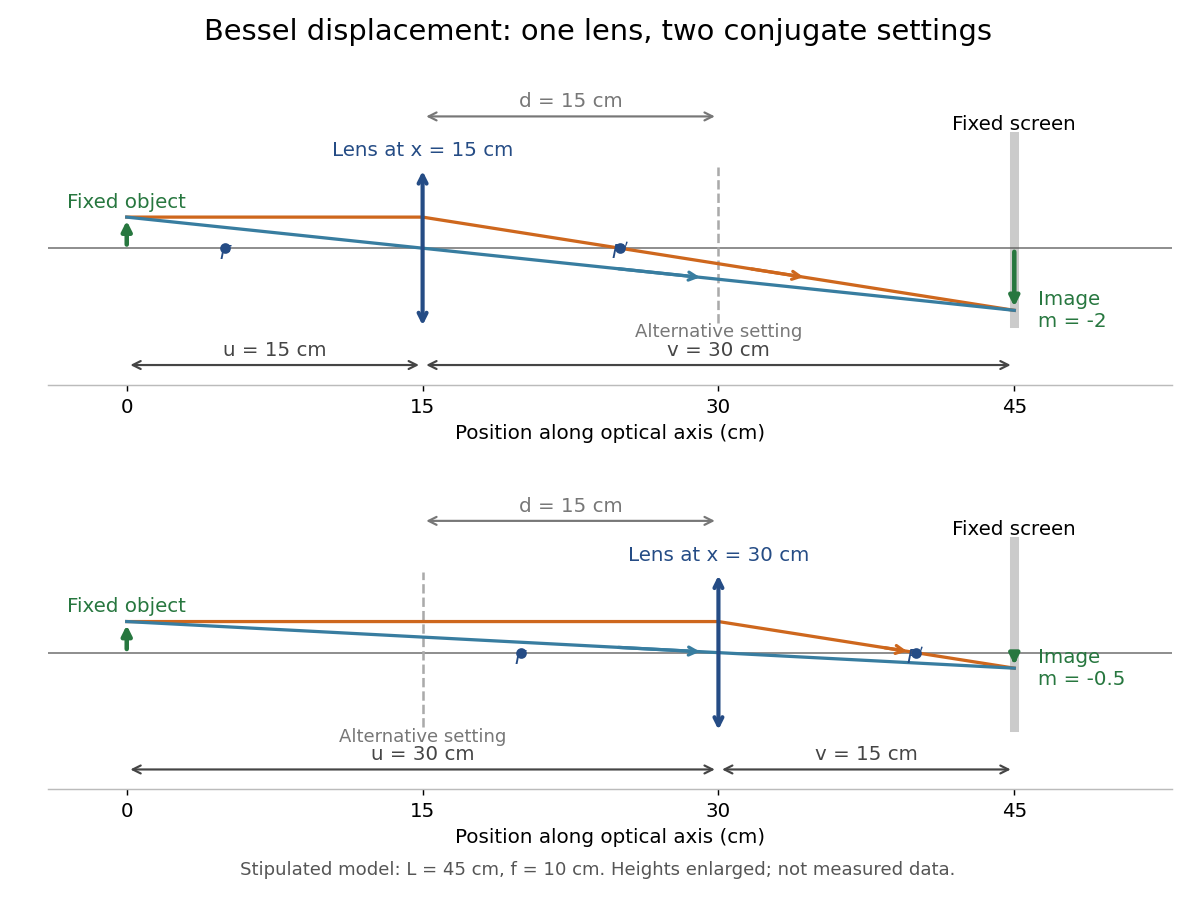
The Bessel lens displacement method measures a converging thin lens's focal length by moving only the optical lens between a fixed object and screen. If their separation is , two settings give sharp real images: one enlarged, the other reduced. Read their separation on an optical bench, then calculateThe two settings exchange object and image distances, so their signed transverse magnifications are reciprocals. This makes the experiment a visible test of conjugate optical planes as well as a focal length measurement.[ref]
For an original stipulated example, put the object at , the screen at , and take an ideal thin lens with . Its two settings are and , with . The transverse magnifications are and : both real images are inverted. An object tall would give signed image heights and . Conversely, stipulated readings and give . These are model calculations, not measured data or a manufacturer's calibration.
A fixed offset between a carrier's reference mark and an ideal thin lens plane cancels when subtracting the two carrier readings. That useful cancellation does not make a thick lens equivalent to one unknown optical centre: its two principal planes can be separated. The Bessel lens displacement experiment below makes this limitation explicit.
Place a converging thin lens at coordinate between the object at and the screen at . In air and the paraxial approximation, the required object and image distances are and . The thin lens equation gives a quadratic equation:Its discriminant is . For , the two roots and their separation areBoth roots lie inside , and both object and image distances exceed . The two roots therefore describe finite real images on the screen. Exchanging the roots exchanges ; from transverse magnification ,The image-height ratio between the enlarged and reduced settings is , rather than .
At , the roots coincide: , , and . There is one setting, not two separately measurable settings. For the discriminant is negative, so no position between the fixed object and screen gives a sharp real image there. This does not forbid a real image elsewhere if the screen is moved. Another short proof observes that has maximum at ; the focusing requirement is possible exactly when .
KIT's teaching apparatus uses a glass spoke-wheel or test negative as the object, a halogen lamp with an illuminating optical lens, an imaging optical lens, a screen and a triangular rail with a position scale. The illuminating optical lens concentrates the lamp filament's image on the imaging optical lens's centre; translucent paper checks that illumination. This reduces the contribution of peripheral light rays and their spherical aberration. The instructions require fixed object-screen separation exceeding , at least ten displacement measurements, and separate red- and blue-filter measurements to test chromatic aberration.[ref]
Brennweite dünner Linsen by Karlsruhe Institute of Technology, Faculty of Physics teaching laboratory. Karlsruhe Institute of Technology, Brennweite dünner Linsen, Durchführung and Aufgaben 1a and 2: target, illumination check, rail readout, repeated Bessel measurements and colour controls
The following measurement protocol elaborates that apparatus rather than reporting additional KIT results. Align the target centre, optical lens and screen normal along one optical axis; measure between the target pattern plane and receiving screen face. Lock the target and screen. Slide the imaging optical lens to obtain the enlarged real image, then the reduced real image, reading the same carrier reference mark at each setting. Record and for each pair. Record corresponding target and image intervals to test the reciprocal transverse magnifications independently; merely observing different image sizes is a weaker test.
Use the same central target detail to judge best optical focus. Bracket each setting by moving through both visibly blurred sides, repeat from both travel directions, and record the accepted position range as well as repeat scatter. Rail divisions set a readout limit but do not alone specify focusing uncertainty. Check scale calibration, carrier play and drift; a common additive carrier offset cancels in , whereas scale-factor error remains. Keep illumination, aperture, target, screen and optical lens orientation fixed within a series. Change the aperture and colour filter in separate control series: spherical aberration and chromatic aberration can shift the apparent best optical focus, while a very small aperture introduces stronger diffraction and makes focus discrimination harder. Record these settings alongside the inferred focal length, rather than interpreting all disagreement as random measurement error.
For a rigid thick lens in air, let be the signed separation of its rear and front principal planes along the direction of propagation. Then the positive object and image distances measured from the principal planes obey . Translating the whole assembly without reversing it moves both principal planes equally, so the measured carrier displacement still equals the difference of the two solutions for . The same algebra therefore givesHere is the effective focal length measured from the principal planes. This deduction uses the principal-plane imaging equation, not the uncorrected thin lens formula.[ref]
Refracting systems (details), University of Tennessee physics teaching resource. Refracting systems (details), principal-plane definition and final paragraph on object/image distances
Mechanical centre thickness is not generally . Record thickness and optical lens orientation, but use a justified bound or model for if it matters at the claimed precision. The two readings alone cannot determine both and unknown ; cancelling a carrier offset does not cancel this limitation.For small measurement errors, write . Its partial derivatives and first-order propagation of uncertainty areHere the values are standard deviations used to describe uncertainty, and is the covariance. Independent carrier-reading errors give ; correlated readings require the term . Averaging repeated independent pairs reduces the random component of the uncertainty of the mean, but does not remove calibration or model errors.
As a stipulated uncertainty calculation, let , , and , with all three input errors independent. Then , , and . The result would be with this standard uncertainty in the stipulated thin lens model; these numbers are not a measured uncertainty budget. A small neglected principal-plane separation gives an additional first-order bias , distinct from that random budget.
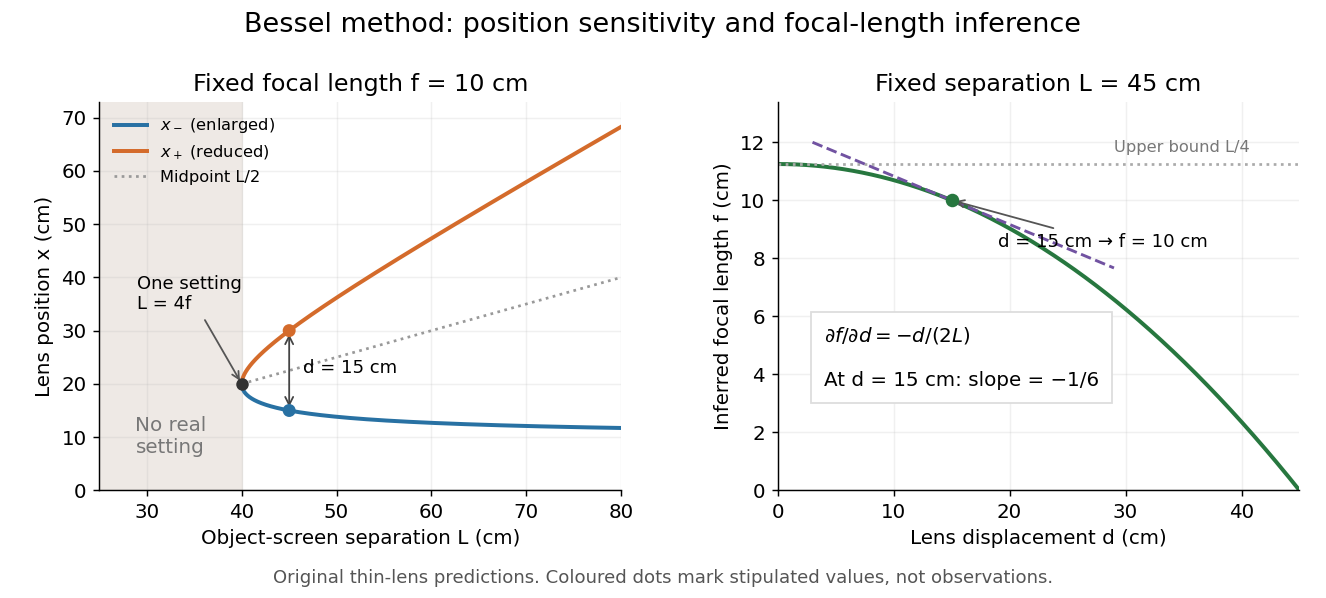
Bessel lens displacement method: merging settings and focal length sensitivity
. Original ideal-model curves. Left: settings versus object-screen separation for fixed ; below there is no real setting on the fixed screen. Right: inferred focal length versus measured displacement at fixed , with its tangent at the stipulated . The curves are predictions, not experimental points. Details.The two kinds of sensitivity must be distinguished. At fixed focal length,These derivatives diverge as approaches from above: a small change in object-screen spacing strongly changes the separation of the two settings. Yet the inferred focal length's displacement sensitivity tends to zero. That does not make coalescing settings easy to measure. For fixed , define the axial mismatch between the predicted real image and the screen as , for . At a focused setting,Near , moving the optical lens changes this mismatch only weakly, making visual discrimination of the two settings difficult. At the example's settings and , so equal carrier motion produces different axial defocus responses. This is an axial mismatch calculation, not a full prediction of perceived image sharpness.
Choose sufficiently above to separate the two accepted focusing ranges, while retaining both real images on the available screen and rail. There is no universal best : focusing uncertainty itself depends on aperture, transverse magnification, optical aberrations and the target. Close to , the nonnegative measured separation and the quadratic term in also make first-order propagation of uncertainty unreliable if its error is comparable to its value. Repeatability, controls and the principal plane correction determine whether the elegant two-distance formula is an adequate measurement model.
The lensmaker's equation connects focal length to the refractive index and shape of a thin lens. For a thin lens in air with surfaces shaped as parts of spheres, refractive index , and incident light travelling to the right,Each signed radius of curvature is positive when its centre of curvature lies to the right of that surface, and negative when it lies to the left. A symmetric biconvex thin lens with , , and therefore has , giving and optical power . This is an ideal shape example consistent with the thin lens diagrams, not a specification of their finite thickness.
In a uniform surrounding medium of refractive index on both sides, replace by . Thus the same shape reverses its focusing sign if its refractive index is lower than its surroundings: for and , the same radii give , or . Positive focal length therefore cannot be inferred from convex shape in every environment. A proof outline applies Snell's law with the small-angle approximation at each surface, adds their direction changes, and neglects the distance between them. [ref].
An optical aberration is a departure from ideal image formation: light rays from one object point may miss their intended common image point, or image positions may depart from the intended mapping. Spherical aberration, coma, and astigmatism describe different ways of spreading a point's light rays; optical distortion can change image shape without spreading each point. In physical optics, these departures can be described by wavefront error relative to a reference wavefront. Diffraction also gives a finite point spread function in a perfect optical instrument, so an extended image alone does not establish an optical aberration.
The five Seidel aberrations of a rotationally symmetric optical system are spherical aberration, coma, astigmatism, field curvature, and optical distortion.
Spherical aberration makes rays at different pupil radii focus at different axial positions. Its primary pupil dependence is quartic; the balanced Zernike spherical mode also contains quadratic and constant terms to remove defocus and piston.
Coma makes an off-axis optical point source appear asymmetric, often with a compact head and a flaring tail like a comet. Different parts of the optical pupil send its light rays to different transverse image positions. A sharp central star image therefore does not guarantee sharp images across an optical telescope's field of view. In an idealized, aligned system with rotational symmetry, coma vanishes on the optical axis; misalignment can introduce coma even at the nominal field centre.[ref]
Coma aberration. Amateur Telescope Optics, §4.2, opening paragraphs and Figure 39: field coma versus misalignment coma
Coma differs from spherical aberration, whose dependence on optical pupil radius can blur an on-axis point without selecting a transverse direction. Astigmatism gives different optical foci in two perpendicular sections of an off-axis bundle; a through-focus sequence can change its elongated image's orientation. Diffraction persists when these optical aberrations vanish. A real asymmetric point spread function may mix several effects, so its appearance alone is not a unique diagnosis of coma.
The classical primary description belongs to the nineteenth-century Seidel aberration classification of five primary monochromatic image errors.[ref]
Seidel aberrations, wavefront aberration function. Amateur Telescope Optics, §3.5.1, opening paragraph: historical classification and equation 5
It remains useful in modern design: OpticStudio's Seidel Coefficients by ANSYS, Inc. documentation lists coma as and tabulates each surface's contribution as well as the system sum (Discussion). Cancellation of contributions can reduce coma without making every surface individually free of it. The same documentation limits this calculation to specified systems with axially symmetric surfaces; higher-order terms and broken rotational symmetry require more general ray tracing.Consider an original, explicitly normalized model of primary coma, rather than a prescription for a particular optical lens. Let be Cartesian coordinates in a circular optical pupil divided by its radius , with . Let be a signed small field angle divided by an arbitrary positive reference angle. With polar coordinates , , prescribe the wavefront errorHere is an arbitrary positive optical path difference scale, not a measured error. The cubic optical pupil dependence and linear field dependence are the classical Seidel form.[ref]
Coma aberration. Amateur Telescope Optics, §4.2, classical coma formula after equation 15 and equation 13: pupil-cubic and field-linear dependence
In the paraxial approximation, light ray direction errors follow the transverse gradient of wavefront error. For a reference sphere a distance from the exit optical pupil in a uniform image medium of refractive index , the corresponding image-error scale is . Choose image-error coordinate signs so the normalized displacement is ; reversing the convention reverses the plotted orientation. Image coordinates below are errors relative to the ideal image of this particular object point, rather than positions of different objects:The partial derivatives explain the asymmetry: opposite optical pupil points and land together, rather than on opposite sides of the ideal image. For , every is nonnegative, while can have either sign. The figures stipulate this single wavefront error, omit other optical aberrations and diffraction, and assign no instrument dimensions.
For a ring of fixed optical pupil radius , the double-angle formulas for trigonometric functions giveThus each ring maps into a circle of radius whose centre is displaced by . Doubling quadruples both sizes; for , the edge ring has centre and radius , while the half-radius ring has centre and radius . Superposing these displaced circles produces the comet-like envelope.
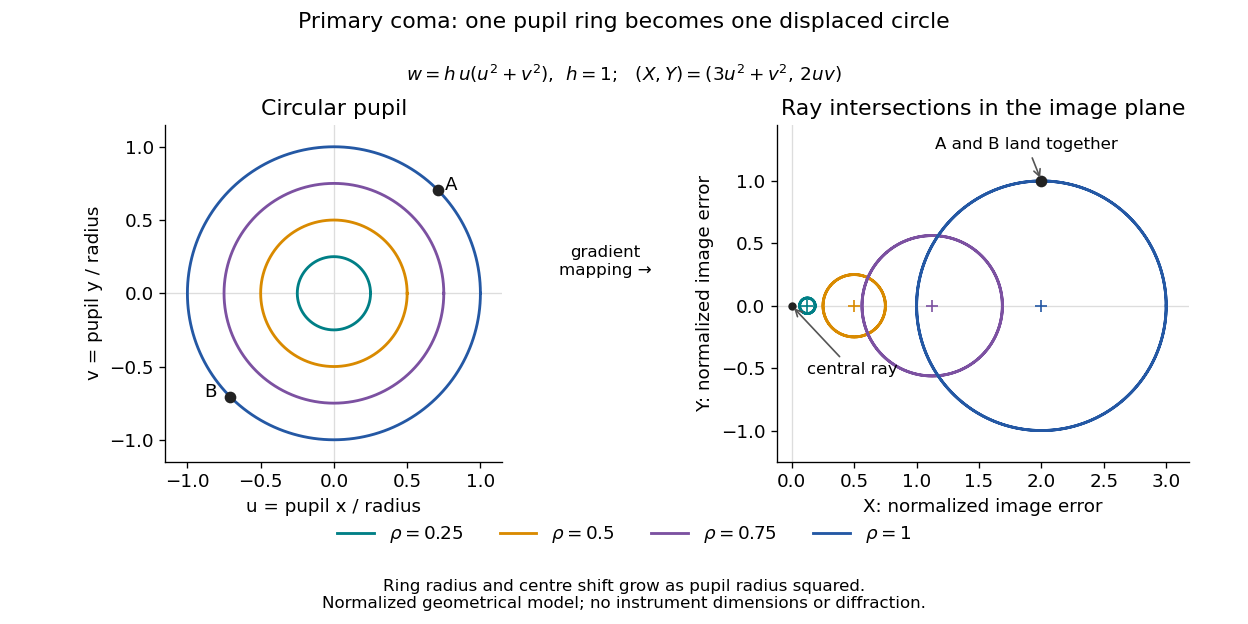
For uniform irradiance over the circular optical pupil, equal area samples give an equal-weight geometrical image. Its centroid is because and . Moving the coordinate origin to that centroid translates the image; it does not remove its asymmetric shape. Adding a linear term to likewise translates all light rays equally. These origin choices must be distinguished from changing the optical aberration itself.
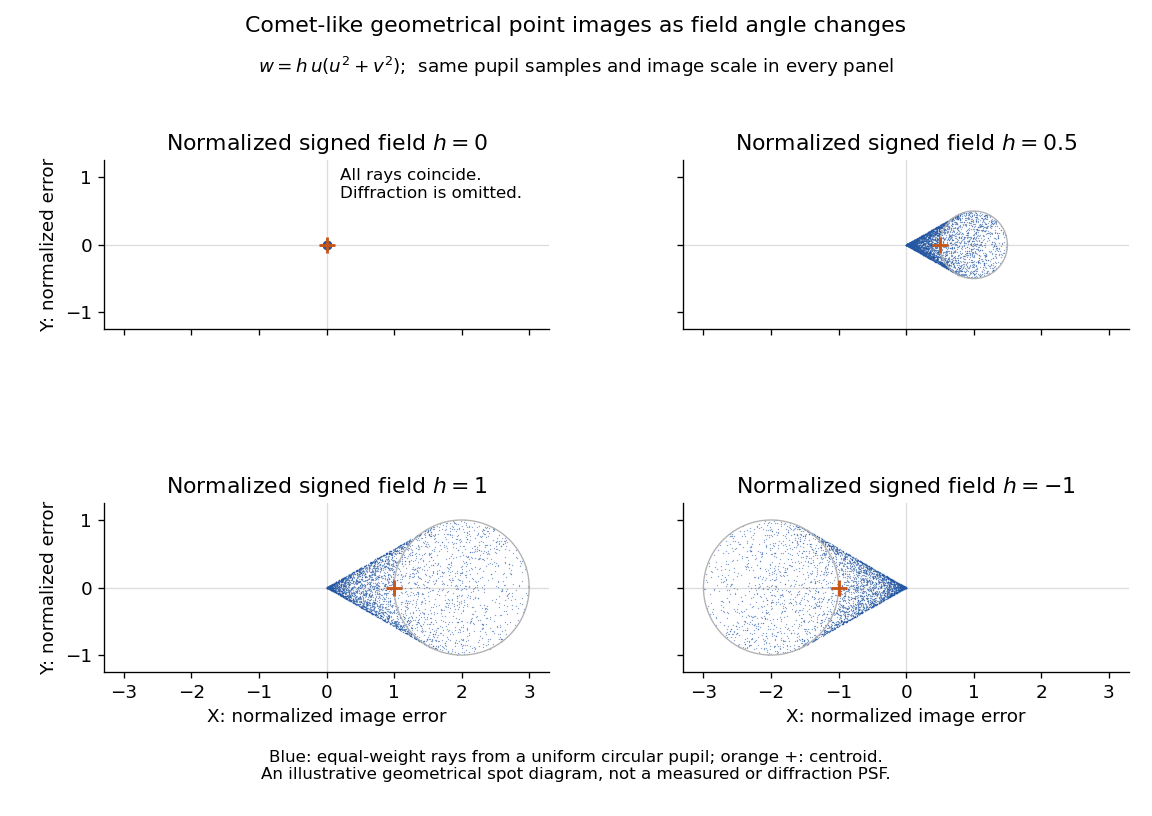
The model's full transverse extent is along and along . Halving the field angle halves the blur, and reversing it reverses the pattern about the ideal image. This isolates why coma matters for an optical camera's usable field of view: collecting more light does not ensure that off-axis points remain compact. Near diffraction-limited resolution, a physical optics calculation of the point spread function is needed instead of interpreting the geometrical tip as an infinitely sharp image.[ref]
Coma aberration. Amateur Telescope Optics, §4.2, Figure 41: geometrical spots versus diffraction images
The institution-issued AY 105 Lab Experiment 3: Optical aberrations by California Institute of Technology (Spring 2011 offering, Part A, pp. 2–3, 7–8) specifies a concrete optical bench: a lamp, opal diffuser and condensing optical lens illuminate a or optical pinhole; a photographic telephoto optical lens acts as a collimator, producing an approximately beam. A test optical lens sits on a rotation stage, followed by an adjustable optical microscope. The procedure establishes the on-axis image, then rotates the test optical lens a few degrees and examines the off-axis image through optical focus. It compares this readout with through-focus ray tracing at the corresponding field angles and offers a Ronchi ruling to calibrate the measuring eyepiece.
Part B (pp. 9–10) substitutes a spherical mirror of radius of curvature, with the optical microscope beside the incoming beam so the image is necessarily off-axis. It calls for measuring the field angle, calibrating the eyepiece and recording the image's length and width at minimum size. These are specified apparatus dimensions and instructions, not supplied measurement results or dimensions of the normalized figures.
A controlled extension would record images at zero and equal positive and negative field angles, repeat zero afterwards, and scan through optical focus at every setting. Keep the illuminated optical pupil and illumination fixed, recenter the optical microscope without clipping the bundle, and use its calibrated scale to separate a mere image displacement from a change in blur shape. The pure Seidel coma pupil mapping predicts reversal and linear growth; a stationary asymmetric central image instead calls for checking alignment. A focus-dependent change between perpendicular elongations suggests an astigmatism contribution. These comparisons test the model rather than assuming every off-axis flare is pure coma.
The optical pinhole has finite angular size, approximately its diameter divided by the collimator's focal length; the collimator and observing optical microscope also contribute their own optical aberrations. A broadband lamp can mix chromatic aberration with the geometric blur, and diffraction limits the smallest visible structure. A narrow spectral band, repeated field settings and a reference image help separate these effects. Consequently a measured length and width are useful checks on off-axis image formation, but they cannot by themselves determine a unique coma coefficient or recover the full point spread function.
An optical camera can focus a white object sharply in one colour while leaving coloured fringes around its edges in another. Chromatic aberration is the dependence of image position or image scale on wavelength, caused by optical dispersion in the optical lens materials. Axial chromatic aberration separates the optical foci along the optical axis; lateral chromatic aberration changes the transverse magnification with wavelength. Moving the receiving plane can favour one colour without bringing all colours into focus. [ref]
https://farside.ph.utexas.edu/teaching/302l/lectures/node142.html. Richard Fitzpatrick, University of Texas at Austin, Chromatic aberration
; [ref]https://imaging.nikon.com/sport-optics/guide/fieldscopes/choosing/choosing_03/. Nikon, Comparison of ED glass and ordinary lens
.For ordinary optical glass in the visible range, the blue refractive index exceeds the red refractive index. For a fixed positive thin lens in air, the lensmaker's equation then givesHere is wavelength, is refractive index, is optical power, is focal length, and are the signed surface radius of curvature values in the lensmaker's equation. The blue light rays therefore bend more strongly and meet sooner. This ordering is a statement about ordinary visible optical dispersion, not a universal rule for every material and every spectral range. [ref]
https://farside.ph.utexas.edu/teaching/302l/lectures/node142.html. Fitzpatrick, Chromatic aberration, colour-dependent focusing
.For a worked example, take a single positive thin lens with reference optical power and Abbe number , hence reference focal length . Its F–C optical power difference is , by the achromatic doublet power balance relation below. This difference alone does not locate the reference optical power within the F–C interval. To draw a transparent example, introduce a synthetic colour coordinate , a dimensionless quantity, with red , reference , and blue , and choose the toy optical dispersion modelThe diagram's red and blue endpoints represent the C and F endpoints of this toy model. Its reference point is placed symmetrically in optical power by construction; is not a measured wavelength scale, and the model is not measured optical glass data. The endpoint focal lengths areThus the axial chromatic aberration in this example separates the endpoint optical foci by about . A single receiving plane cannot coincide with both optical foci.
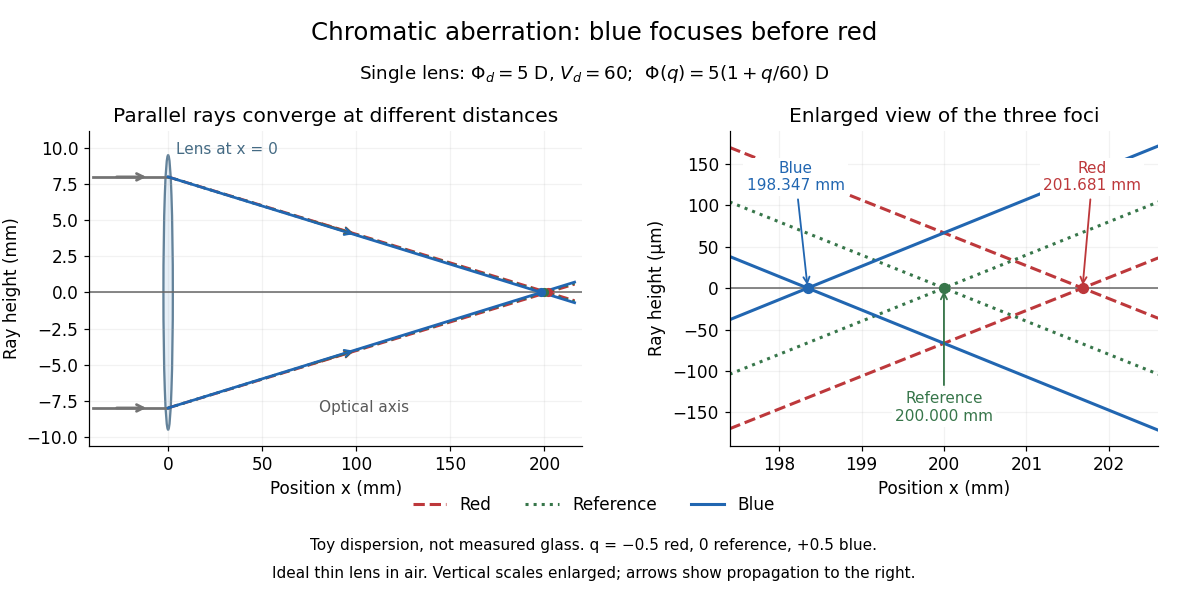
Chromatic aberration: the blue optical focus precedes the red optical focus in a toy single thin lens
. Parallel incoming light rays meet an ideal positive thin lens at . The right panel enlarges the neighbourhood of the three optical foci; the reference focal length is . The synthetic model uses , , and . This is toy optical dispersion, not measured optical glass; the vertical scales are enlarged. Details.The useful design idea is to cancel changes of optical power while retaining a positive total optical power. An achromatic lens does this with materials having different Abbe numbers. It greatly reduces chromatic aberration, but correcting two chosen wavelengths still leaves the possibility of a secondary spectrum.
Axial chromatic aberration, also called longitudinal chromatic aberration, is colour-dependent focus position along the optical axis. For incident light rays parallel to the optical axis, it appears as a changing focal length. The chromatic aberration diagram isolates this effect using an ideal thin lens at each colour.
Lateral chromatic aberration, also called transverse chromatic aberration, is colour-dependent image scale: an object away from the optical axis can have different image heights at different wavelengths. Its changing transverse magnification produces displaced coloured edges. The on-axis parallel bundle in the chromatic aberration diagram illustrates axial chromatic aberration, and does not measure lateral chromatic aberration. [ref]
https://imaging.nikon.com/sport-optics/guide/fieldscopes/choosing/choosing_03/. Nikon, wavelength-dependent focal point and magnification
.An achromatic lens combines optical lens elements with different optical dispersion so that two specified wavelengths have the same focal length in the paraxial approximation. This brings their parallel incoming light rays to a common optical focus, helping an optical camera form a sharper image under mixed-colour illumination. A common implementation is an achromatic doublet: a positive crown glass element paired with a negative flint glass element. [ref]
https://farside.ph.utexas.edu/teaching/302l/lectures/node142.html. Fitzpatrick, Chromatic aberration, compound lenses
.The achromatic doublet does not require either material to have zero optical dispersion. Instead, the positive element gains positive optical power toward blue, while the negative element becomes more negative. Suitable Abbe numbers and signed optical powers let these changes cancel even though their reference optical powers do not cancel. For example, the achromatic doublet power balance calculation below combines with to obtain , or focal length , with zero primary F–C optical power difference. The smaller Abbe number of the negative element makes its weaker reference optical power sufficient to oppose the positive element's colour change.
An achromatic lens is corrected at two chosen wavelengths, not necessarily at every wavelength between them. The remaining focal length variation is the secondary spectrum. Correcting axial chromatic aberration also does not automatically remove lateral chromatic aberration throughout an imaging system, spherical aberration, or diffraction. Actual designs therefore need ray tracing with the intended wavelengths, element thicknesses, separations and apertures. [ref]
https://imaging.nikon.com/sport-optics/guide/fieldscopes/choosing/choosing_03/. Nikon, ED glass and secondary spectrum
; [ref]AY 105 Lab Experiment 3: Optical aberrations by California Institute of Technology. Caltech AY 105, Optical aberrations, 2011, Part A: doublet ray tracing and through-focus comparison
.An achromatic doublet is an achromatic lens with two optical lens elements. In the contact thin lens model, their optical powers add and their primary colour changes cancel according to achromatic doublet power balance. The conventional positive achromatic doublet uses a converging crown glass element and a weaker diverging flint glass element; these names describe a common choice, not a universal ordering of every modern optical glass composition.
Achromatic doublet power balance chooses two signed optical powers to meet two goals: obtain the required focal length and cancel the primary F–C colour difference. Model two thin lens elements in contact in air, using the paraxial approximation. Let label the crown glass and flint glass elements, and let denote each element's optical power at the reference d line. The Abbe number for each material isThe subscripts label standard spectral lines: blue F near , red C near , and reference d near . These are three specified wavelengths, not colour bands. A larger Abbe number means less relative optical dispersion between F and C. [ref].
For a fixed thin lens shape in air, write the lensmaker's equation as , with signed shape factor . Subtracting its C value from its F value gives the primary optical power differenceThe negative element has negative : its blue optical power is more negative, not less negative. The contact rule for optical power therefore givesThis zero is equality of the total F and C optical powers, hence equality of their focal lengths when the total optical power is nonzero. The relation follows directly from the lensmaker's equation and the Abbe number; it is exact within the fixed-shape contact thin lens model. [ref]
https://phys.libretexts.org/Bookshelves/Optics/Geometric_Optics_(Tatum)/02:_Lens_and_Mirror_Calculations/2.10:_Designing_an_Achromatic_Doublet. Jeremy Tatum, University of Victoria, Geometric Optics §2.10, equations 2.10.8–2.10.11, authored text hosted by LibreTexts
. Tatum uses a yellow D-line reference; here the Abbe number convention uses the d line consistently.For a toy design, choose , , and . ThenThe positive element contributes to the F–C difference and the negative element contributes . This retains the same reference focal length as the single , thin lens in chromatic aberration, while cancelling its primary colour split. The values are illustrative design parameters, not a catalogue optical glass pair.
Use the same synthetic colour coordinate and toy optical dispersion as in chromatic aberration. The two element optical powers and their sum becomeAt the red endpoint, the element optical powers are and ; at the blue endpoint, they are and . Both sums are . In this first-order toy model alone, the sum is constant for every and the focal length remains throughout. Real material optical dispersion is not captured by these two straight slopes, so the flat line is not a claim that a real achromatic doublet focuses all colours perfectly.
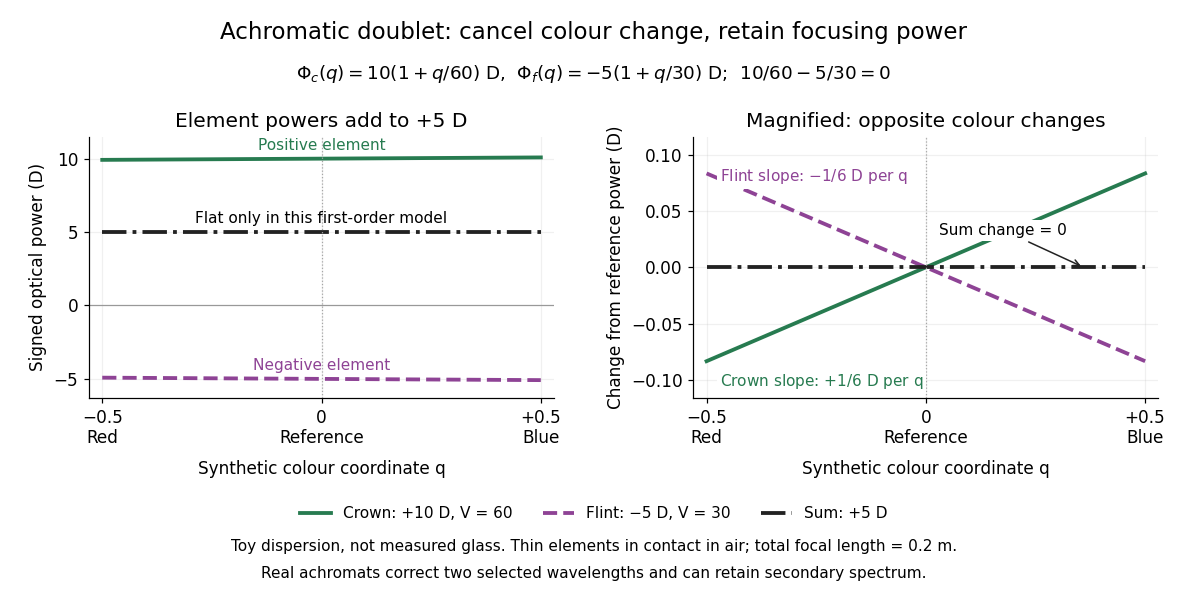
For specified nonzero reference optical power and distinct Abbe numbers, solving the two balance equations givesThus and require positive crown glass optical power and negative flint glass optical power. If the two finite Abbe numbers were equal, cancellation would force zero total optical power. If they are close, the required element optical powers become large compared with the total: cancelling primary colour can demand much stronger individual elements.
The contact assumption matters. For two thin lens elements separated by distance in air, the equivalent optical power is , evaluated at each wavelength; its colour change need not satisfy the contact balance. Finite thickness, departures from the paraxial approximation, and the secondary spectrum also limit the simple prediction.[ref]
Lecture Notes on Geometrical Optics. §J: Composite lenses
The secondary spectrum is residual chromatic aberration after an achromatic lens brings two selected wavelengths to the same optical focus. For example, equal red and blue focal lengths can coexist with a different green focal length. The Abbe number fixes one F–C relative difference, not the complete shape of optical dispersion between or beyond those wavelengths. The perfectly flat sum in the achromatic doublet power balance diagram deliberately omits this residual effect. [ref]
https://imaging.nikon.com/sport-optics/guide/fieldscopes/choosing/choosing_03/. Nikon, ED glass and secondary spectrum
.Optical dispersion is the dependence of refractive index or phase velocity on frequency. It gives an optical prism wavelength-dependent deviation and causes chromatic aberration.
In normal dispersion, the refractive index increases with frequency, , equivalently for vacuum wavelength . Transparent regions away from isolated absorption resonances often have this behaviour. Near a resonance the slope can reverse, producing anomalous dispersion accompanied by absorption.
The Abbe number compares refractive strength with visible optical dispersion. The traditional reference lines are near nm, respectively. A large means weak relative dispersion.
An Abbe diagram plots refractive index against Abbe number to show available optical glass families. Many diagrams put increasing to the left. Ordinary crown glasses have larger than ordinary flint glasses, while modern compositions occupy a broader region.
For the lower-face-first ray path through an equilateral optical prism, take external entry angle , internal refraction angle , base incidence and one total internal reflection at the horizontal base. At the other sloped face the internal incidence equals , so Snell's law gives exit angle again. Its counterclockwise, oriented direction change is the displayed expression with . It is independent of refractive index for this route, but whether the base reflection is total is not. Under normal dispersion, a setting at the green critical threshold sends shorter wavelengths along the total-reflection route while longer wavelengths can leak through the base.
For a homogeneous optical prism in air, with apex angle and refractive index , minimum deviation occurs at the symmetric ray path. Then both internal angles are and both external angles are , so Snell's law givesMeasuring the deviation therefore determines the refractive index at the chosen wavelength.
Schlieren photography makes spatial changes of refractive index visible by converting deflections of light rays into contrast at an optical camera. In a gas, mass density variations can produce these deflections through refraction. A knife edge in the focused beam is a common implementation.
Articles by others on the same topic



Geometrical optics is a branch of optics that describes light propagation in terms of rays. It simplifies the behavior of light by assuming that it travels in straight lines and can be represented as rays. This approach is particularly useful for understanding how light interacts with various optical elements, such as lenses, mirrors, and prisms, where the wavelength of light is much smaller than the dimensions of the optical components.