
Geometrical optics describes propagation by rays and Snell's law, neglecting diffraction on scales much larger than the wavelength.
A light ray is a path in an approximation, not a physical thread of zero width. In a transparent, homogeneous, isotropic medium it is straight and perpendicular to a wavefront; boundaries redirect it by the law of reflection or Snell's law. The approximation is useful when the wavelength is small compared with relevant apertures, surface curvature scales, and distances over which the refractive index changes. For an illustrative wavelength of and a aperture, their ratio is . That small ratio supports ray tracing for image location, but does not eliminate diffraction when calculating the fine structure of a focused spot. At a wave caustic, geometrical optics can fail despite large optical elements. [ref].
The mechanism of refraction is a change in phase velocity. For transparent isotropic media at the chosen frequency, the refractive index iswhere is the vacuum speed of light and the angles are measured from the interface normal vector. At a stationary planar interface the frequency and tangential wavevector match across the boundary. Since the wavenumber is , that matching gives Snell's law. The transmitted wavelength changes while the frequency stays fixed. Here uses phase velocity, which need not equal group velocity. [ref]. [ref].
Choose model air with and model glass with , without claiming these are exact values for every sample or wavelength. At , Snell's law givesThe transmitted light ray bends toward the normal vector; its phase velocity is , and its wavelength is two thirds of the air value. By reversibility of an optical ray, incidence from glass at returns the outgoing air angle .
Incidence from glass at is a different experiment. It would require , so there is no real transmitted angle. The critical angle for total internal reflection isAbove this angle, an ideal lossless glass-air boundary produces total internal reflection. The physical optics description still permits an evanescent wave in the air, although no propagating transmitted light ray crosses the boundary. [ref]
https://openstax.org/books/university-physics-volume-3/pages/1-4-total-internal-reflection. OpenStax: Total internal reflection
. [ref].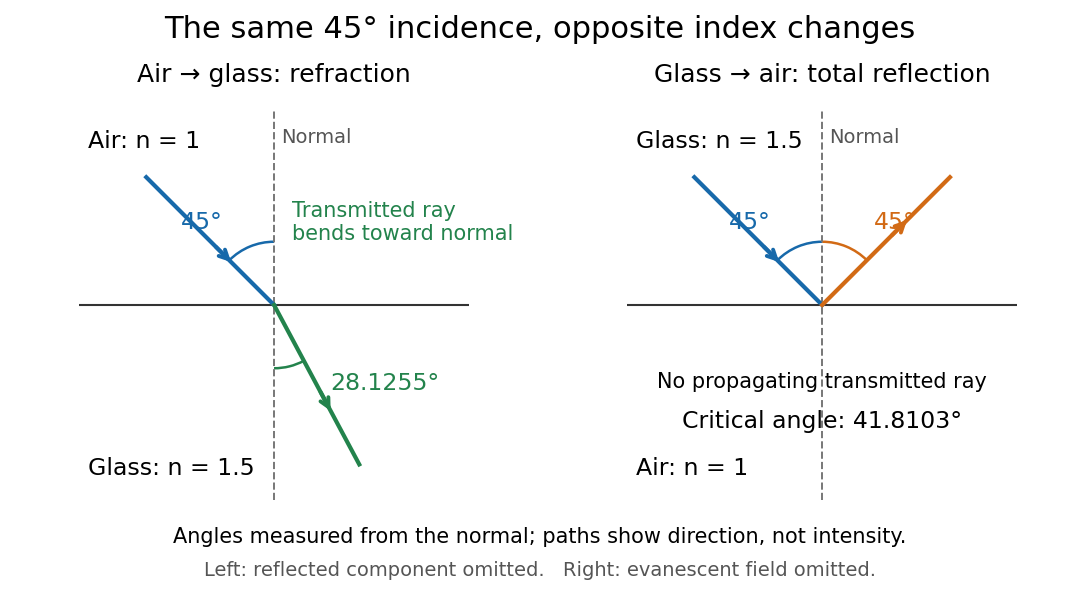
Refraction into glass and total internal reflection on incidence from glass; all angles are measured from the normal
. Details. The usefulness of geometrical optics is that complicated instruments can be assembled from these local rules. Applying Snell's law at successive curved surfaces changes a spreading bundle into a converging one. The Fermat principle unifies the construction through stationary optical path length; stationarity does not require a global minimum. [ref]
https://www.feynmanlectures.caltech.edu/I_26.html. Feynman Lectures: The principle of least time, section 26-5
. Fang's MIT notes explicitly connect this principle to specular reflection, refraction, and thin lens imaging, providing a route from individual paths to complete instruments. [ref].

Geometrical optics is a branch of optics that describes light propagation in terms of rays. It simplifies the behavior of light by assuming that it travels in straight lines and can be represented as rays. This approach is particularly useful for understanding how light interacts with various optical elements, such as lenses, mirrors, and prisms, where the wavelength of light is much smaller than the dimensions of the optical components.
New to topics? Read the docs here!