Probability generating function of an independent sum
ID: probability-generating-function-of-an-independent-sum

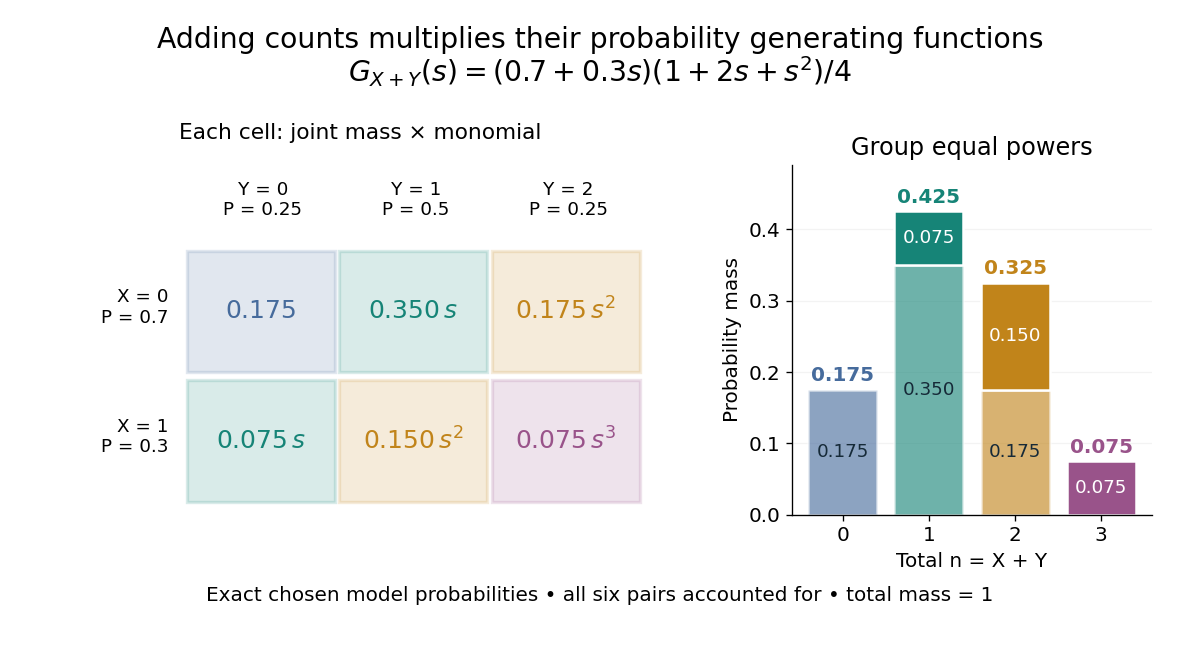
For nonnegative integer-valued independent random variables , factor the expected value of a product:The Cauchy product explains what this means for individual probability masses:Every way of splitting the total contributes once. This is convolution of independent random variables; multiplying probability generating functions performs the bookkeeping automatically.
For an original example, take independent and , using the Bernoulli distribution and binomial distribution. ThensoDirect enumeration of the six pairs gives the same probability masses. For example, total one collects and , with contributions . The coefficients sum to one. The expected value is ; since , the variance is , agreeing with .

Uncorrelated random variables are insufficient for the product identity. For a concrete counterexample, let be uniform on and set , . Then , but , whereas . Zero covariance controls one mixed moment, not the full joint probability mass function.
New to topics? Read the docs here!