
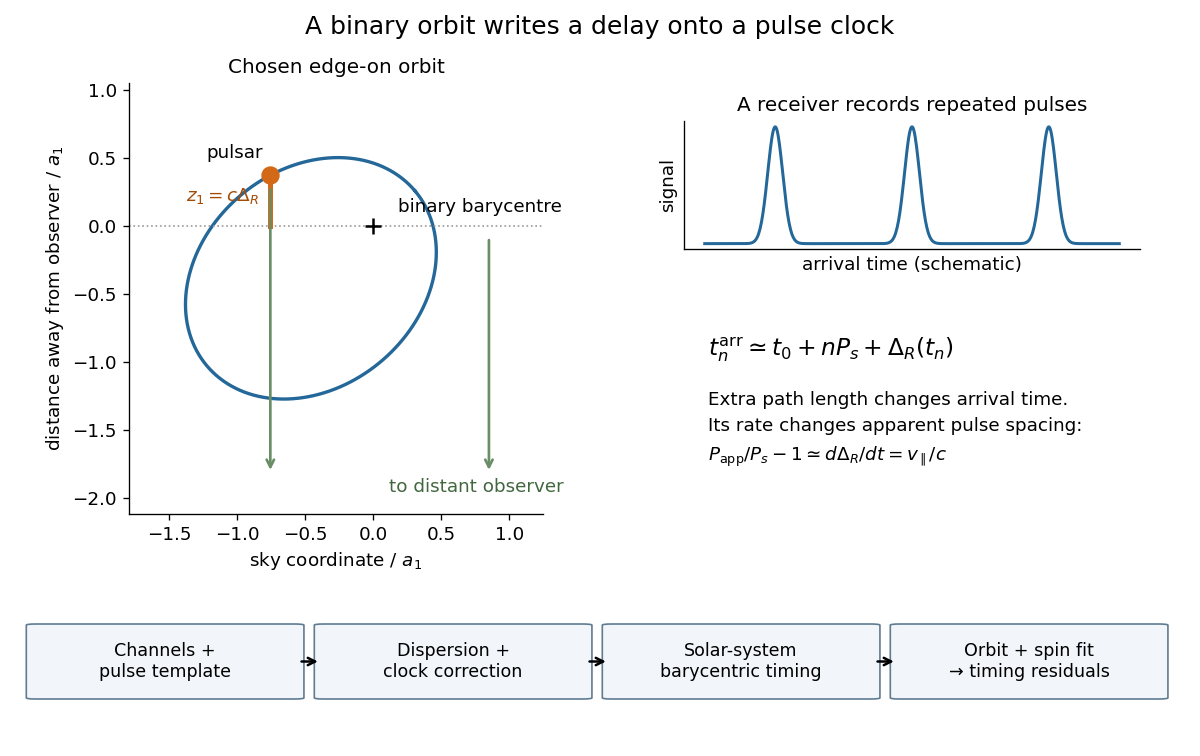
The mature experiment uses channel-template comparison, pulsar dedispersion, GPS clock-offset transfer, Solar system barycenter corrections and connected pulse counts.[ref]
For a geometric illustration, let a perfectly uniform source emit pulse at , with spin period , and let increase away from the observer. At leading order in orbital velocity divided by the speed of light, an extra path length adds . Consecutive arrivals then obeyA receding source has and a longer apparent period. This derivation isolates the geometric Doppler effect; a precision relativistic clock model also needs gravitational redshift and time dilation.

New to topics? Read the docs here!