Quadratic magnetostriction and frequency doubling
ID: quadratic-magnetostriction-and-frequency-doubling

As an original stipulated low-field model, take the axial magnetic field intensity in and prescribeAll strain components are dimensionless, and their trace vanishes. This is an even, quasistatic, unsaturated toy law with a fixed measuring axis. It is distinct from the fixed-magnitude directional model in saturated isotropic magnetostrictive strain. In particular, one must not replace local unit magnetization by normalized net magnetization in a many-domain specimen and assume this law follows.
For , , and , a trigonometric identity givesThe axial strain ranges from zero to , with mean and a component of amplitude . The cosine coefficient is negative with the chosen time origin. For the length ranges from zero to relative to . There is no term in this unbiased model.
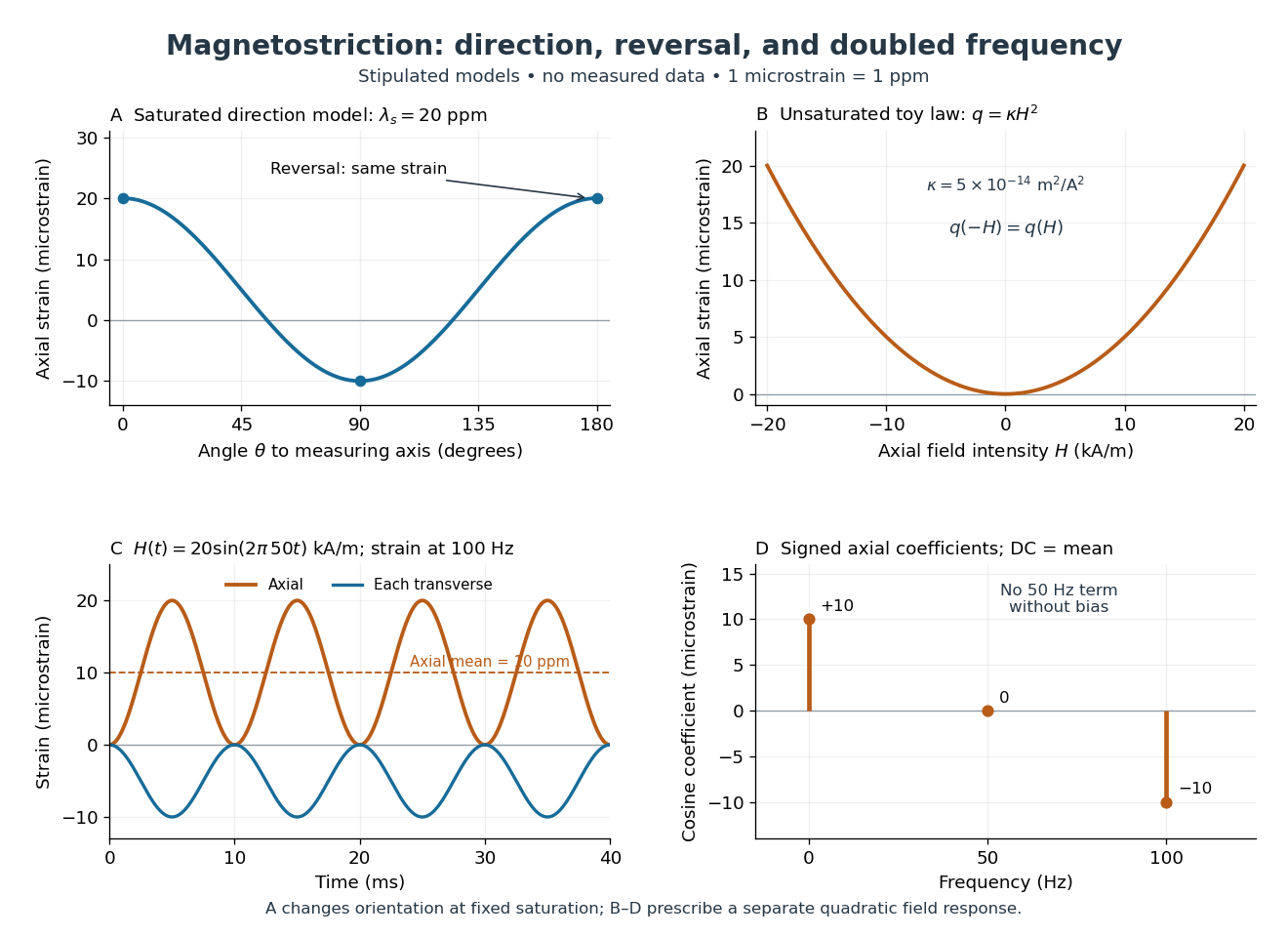
Stipulated angular, reversal, and frequency responses of magnetostrictive strain
. Original calculations, not experimental data: the angular panel uses a saturated isotropic model with positive saturation magnetostriction; the other panels use a separately stipulated quadratic field law. Microstrain denotes a relative length change of one part per million. Details.
A static bias changes the conclusion. Expanding produces a fundamental-frequency term as well as the doubled-frequency term. This is an incremental linear response about a state with a chosen magnetic axis; it does not contradict isotropic linear magnetostriction vanishes at an unbiased isotropic reference. Real hysteresis, thermal expansion from Joule heating, and mechanical resonance can add further components or change their phases. Frequency alone cannot identify the cause of motion: Joule heating also contains an even-in-electric current contribution.
New to topics? Read the docs here!